
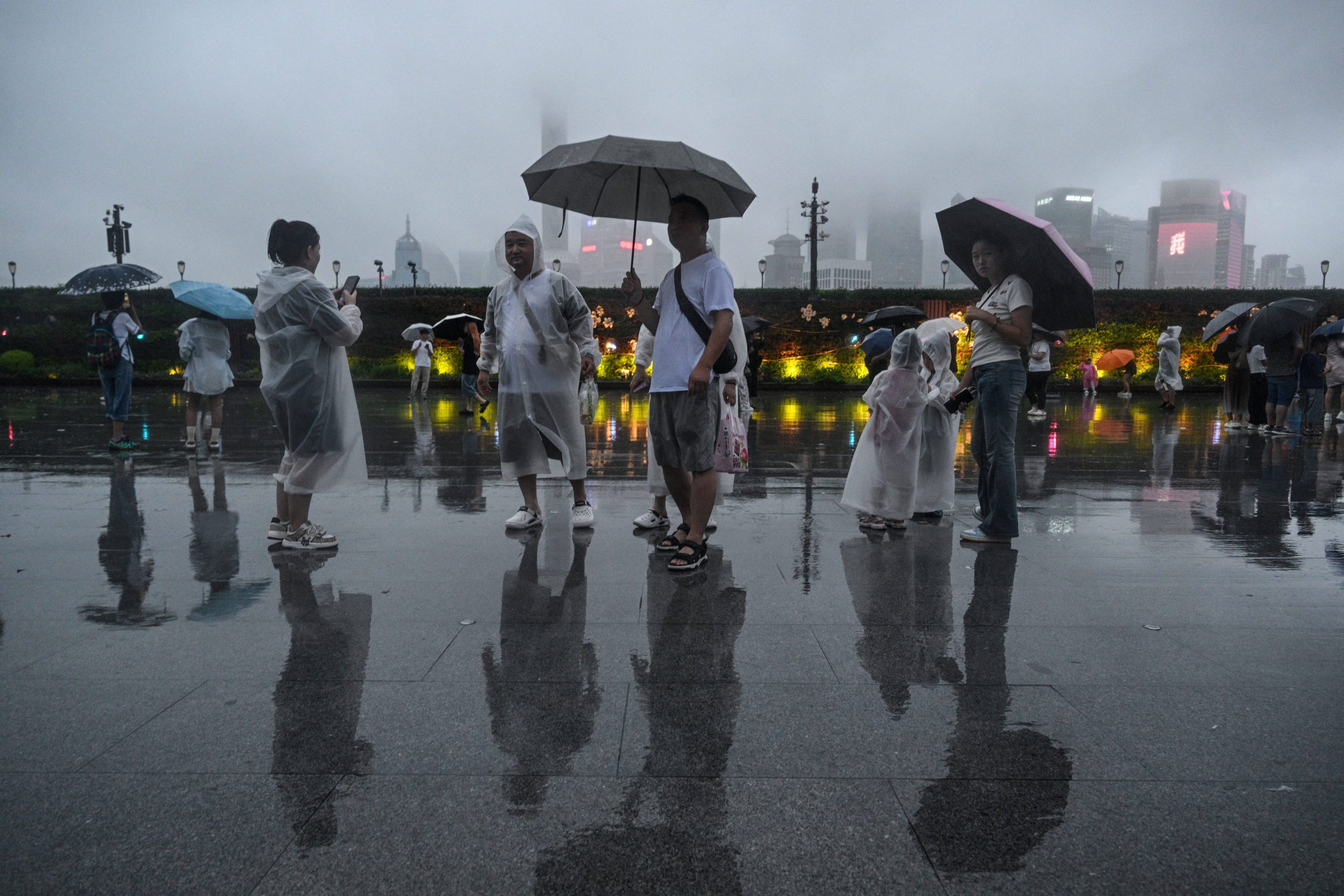
Shanghai evacuated nearly 283,000 residents from coastal and low-lying areas on Wednesday as Typhoon Co-May battered China’s financial hub with heavy rain and powerful winds.
“From last night to 10:00 am today, 282,800 people have been evacuated and relocated, basically achieving the goal of evacuating all those who needed to be evacuated,” state broadcaster CCTV reported.
Authorities said more than 1,900 temporary shelters have been set up across the city.
The Shanghai Central Meteorological Observatory raised its rainstorm alert from yellow to orange, the second-highest warning level.
Nearly one-third of flights—around 640—were cancelled at the city’s two international airports, local media reported.
Typhoon Co-May first made landfall in eastern Zhejiang province at around 4:30 a.m. Wednesday (2030 GMT Tuesday), packing winds of 83 kilometres (52 miles) per hour.
In a village on Shanghai’s outskirts, reporters from Agence France-Presse saw one shelter—a large hall lined with dozens of iron beds—mostly occupied by elderly residents.
About 20 people sat on beds or gathered around tables for dinner, assisted by community staff.
Relentless sheets of rain flooded the streets as pedestrians struggled against strong gusts and delivery drivers maneuvered through deep puddles.
Ferry services were suspended, speed limits imposed on highways, and parts of the metro and rail network were disrupted. Despite the weather, Shanghai’s Legoland and Disneyland remained open on Wednesday morning.
As the storm moved northwest, live footage from China’s eastern coast showed waves crashing over seaside walkways, while broadcasts from Ningbo depicted residents wading through ankle-deep water.
Meanwhile, China briefly issued a tsunami warning for parts of its eastern seaboard after a magnitude-8.8 earthquake struck off Russia’s Kamchatka Peninsula. The warning was later lifted, according to CCTV.
Co-May, which weakened to a tropical storm after crossing the Philippines, regained strength over the South China Sea before striking China.
Chen Tao, chief forecaster at the National Meteorological Center, told state-run China Daily that the storm was indirectly linked to extreme weather in northern China.
“Typhoon activity can influence atmospheric circulation… thereby altering the northward transport of moisture,” Chen said.
Heavy rains in northern China have killed more than 30 people and forced tens of thousands to evacuate, state media reported Tuesday.
China, the world’s largest emitter of greenhouse gases, faces increasingly frequent and intense extreme weather events. The government has pledged to make the country carbon-neutral by 2060.