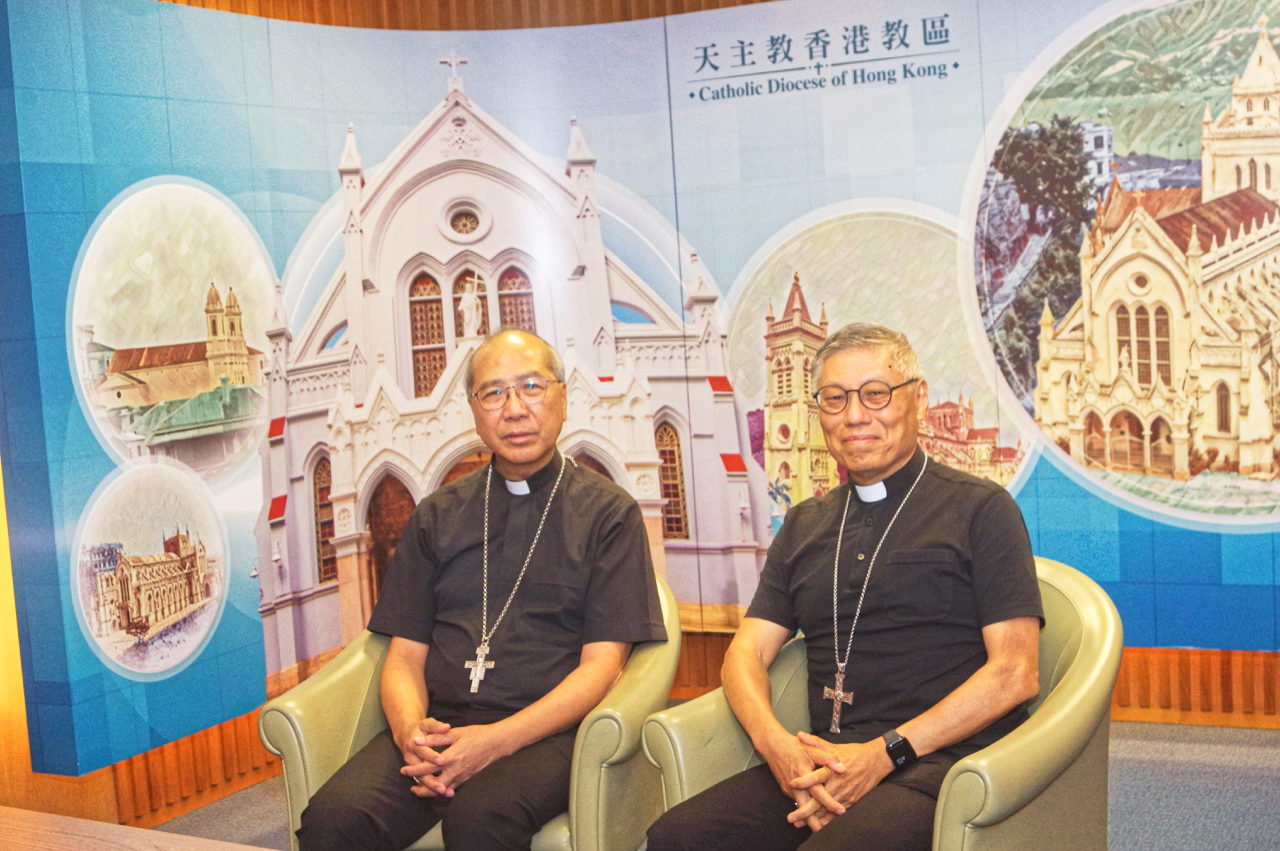
Cardinal Stephen Chow Sau-yan, S.J., and Auxiliary Bishop Joseph Ha Chi-shing said the Diocese of Hong Kong is preparing to take concrete steps on the path of synodality, drawing inspiration from their recent participation in the Federation of Asian Bishops’ Conferences (FABC) Bishops’ Seminar in Thailand.
The five-day gathering, held from September 22 to 26 at the Baan Phu Waan Pastoral Training Centre in Sampran, brought together bishops, clergy, and experts from across Asia to reflect on “conversion of relationships, processes, and bonds.”
On September 29, the two bishops spoke with the Sunday Examiner and Kung Kao Po about lessons from the seminar and how these may shape the diocese’s future, especially as it approaches its 80th anniversary in 2026.
Asian examples and local challenges
Bishop Ha called the encounter “inspiring,” noting how “some Asian Churches have already convened synodal assemblies/synods. These examples can serve as valuable references for us in Hong Kong.”
“I was especially impressed by the progress made in transparency and accountability in some dioceses,” he said.
Cardinal Chow agreed that the meeting was more than an internal Church exercise, adding that “the meeting allowed us to appreciate the importance to deepen relationships with other religious corporates and governments as well. This is very much in line with the Hong Kong Church’s role as a bridge-builder.”
He cautioned, however, that synodality requires a gradual shift. “The Synod’s Final Document is a guiding framework, not a rigid programme. Synodality is not something achieved in one meeting. It is a change of culture, a spirituality. That takes time, patience, and perseverance.”
Towards a diocesan synod
Cardinal Chow revealed that Hong Kong is preparing to hold a diocesan synod or assembly, likely in 2027. He described it as part of a broader effort to strengthen the life of the local Church.
“The ultimate goal is to form a mature laity, well prepared to participate actively in the Church’s life and mission,” he said.
Recent initiatives include the creation of a human resources department and the Goretti Centre, the Diocesan Office for the Safeguarding of Minors and Vulnerable Adults. Still, the cardinal said reforms must be built on spiritual depth.
“We must first ensure that there is a good spiritual and cultural foundation. Otherwise, structural changes risk being superficial. Mentality and maturity must come first,” he added.
Discernment over democracy
Both bishops underscored that synodality does not mean turning the Church into a democratic system.
Cardinal Chow said the decision-making in the Church “is through discernment, not simply consultation. It is not about majority votes or promoting personal agendas.”
The prelate described discernment is about “seeking together the will of the Holy Spirit. It is not democracy, but it is also not top-down authoritarianism. It is communal, Spirit-led discernment.”
Bishop Ha added that “we need formation—both intellectual and experiential—to help people live this spirituality in daily life.”
Participation, inclusion, and pastoral priorities
The bishops pointed to the Conversation in the Spirit as a practical method for dialogue, discernment, and decision-making, even on sensitive issues. Bishop Ha stressed that retreats, more than lectures, can help Catholics “learn to listen with the heart.”
Cardinal Chow highlighted the need for wider participation. “Within the limits of canon law and diocesan possibilities, we must create more spaces for women’s leadership,” he said. He also cited pastoral priorities of inclusion: “The message of Pope Francis is clear. All the baptised must be welcomed. A new way of being Church should touch the wounds of those who suffer.”
Hong Kong’s synodal path
On local progress, Bishop Ha described the diocese’s synodality as “dynamic, not static,” saying, “We have made progress compared with some regions, but there is room to grow.”
Cardinal Chow reaffirmed that synodality “is a deepening of the vision of Vatican II, which describes the Church as the People of God. Decision-making is not democratic, but neither is it arbitrary. It is a communal process of discerning God’s will.”
He distinguished between “decision-making” as a communal process and “decision-taking” as the responsibility of the ordained, who must also safeguard unity and fidelity to Church teaching.
A journey of faith
Hong Kong’s bishops said the city’s interreligious environment provides opportunities to build bridges. Bishop Ha pointed to parish initiatives with Anglican communities and proposed exchanges to deepen mutual respect.
He also underlined that the path ahead must be gradual: “We cannot expect instant results. But we can nurture the seeds of dialogue, listening, and discernment. The 80th anniversary of our diocese is a timely moment to reflect on our past and prepare for the future with renewed faith.”
Cardinal Chow concluded: “It is a spirituality, a way of life. It calls for patience, openness, and trust in God’s timing. If we walk this path together—with humility, with respect, with the Holy Spirit as our guide—then our Church in Hong Kong can grow ever more into the People of God we are called to be.”