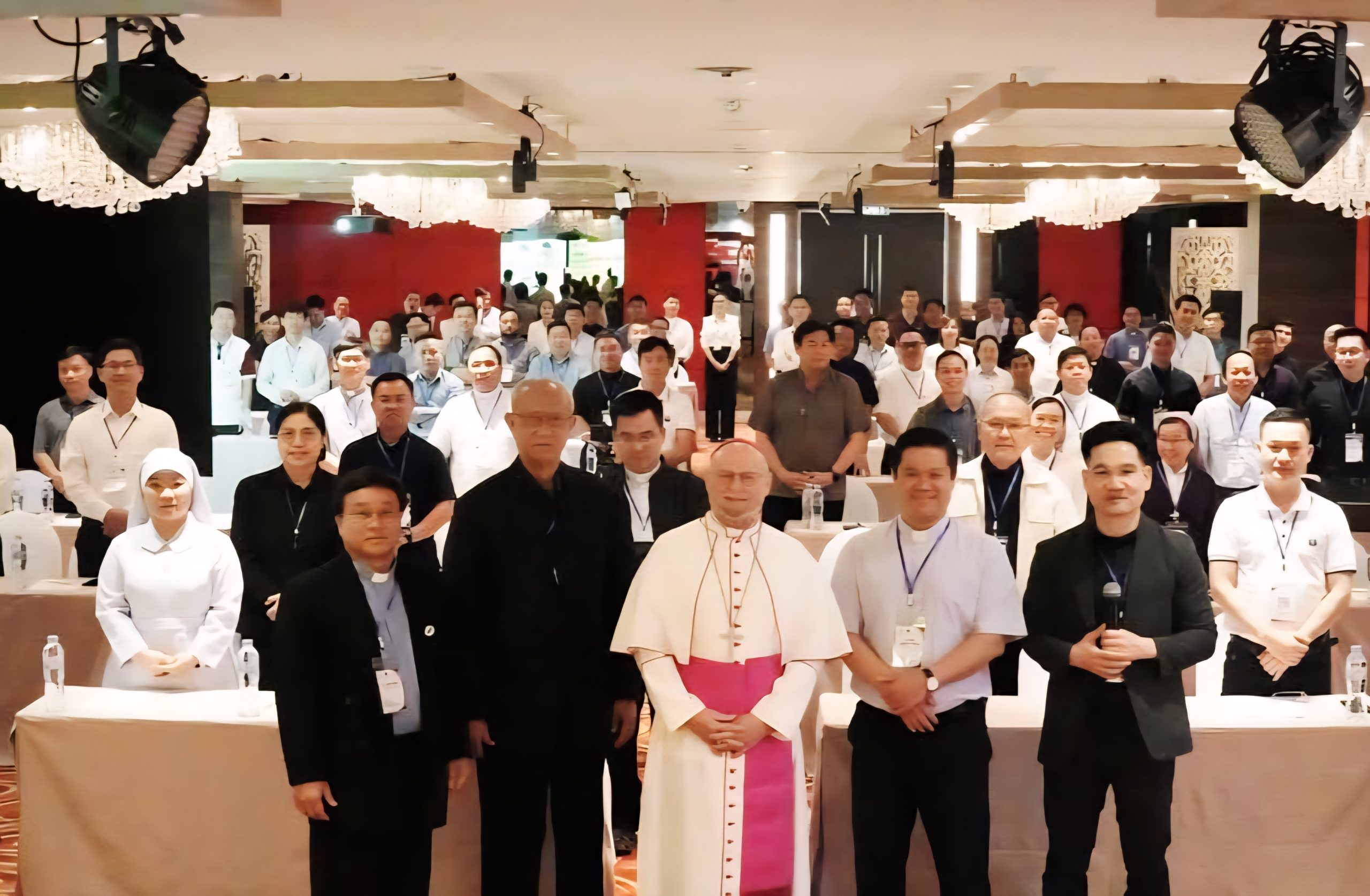
A global gathering of Vietnamese Catholic leaders closed on Dec. 5 with a renewed call to recognize migrant communities as key drivers of the Church’s pastoral renewal.
The three-day gathering, titled “The Journey of Faith and the Mission of the Vietnamese Catholic Migrants in Proclaiming the Good News,” drew participants from Vietnam, the United States, Italy, Germany, Thailand, Taiwan, and Papua New Guinea.
The conference addressed the pastoral opportunities and challenges arising from one of Southeast Asia’s largest internal and external migration movements.
Vietnam is home to an estimated seven million Catholics, more than half of whom now live away from their home parishes. The majority are young workers and students, including missionaries.
Church leaders at the conference noted that this mass migration has created new realities for both sending and receiving communities, requiring expanded pastoral strategies to meet the spiritual, cultural, and social needs of migrants.
Vietnamese leadership in U.S. Church
Speaking on the first day of the conference, Fr. Nguyễn V. Viên, SCJ, provincial superior of the Dehonians in the United States, said Vietnamese priests and religious have become a “vital spiritual and cultural bridge” within the U.S. Catholic Church.
“They enrich parish life, support immigrant communities, and strengthen the Church’s global outlook,” he said, pointing to their growing leadership roles as signs of “deep commitment and the trust placed in them by the wider Church.”
Fr. Viên acknowledged challenges facing Vietnamese missionaries abroad, including language barriers, cultural adaptation, and differing ecclesial expectations that demand resilience, humility, and continuous formation.
Yet he noted that these experiences uniquely prepare them for ministries of compassion, accompaniment, and advocacy among marginalized communities.
Among the more than 100 participants was Fr. Anthony Trần Xuân Sang, SVD, a Vietnamese priest serving in the Philippines, who said the presentation highlighted the strong vocation culture within the Vietnamese diaspora.
“The Vietnamese Catholic community in the U.S. now numbers around 700,000 faithful,” he told LiCAS News, citing figures shared during the conference showing that Vietnamese Americans account for about 4 percent of newly ordained priests and 8 percent of all seminarians nationwide. Approximately 1,000 Vietnamese priests and more than 700 men and women religious are currently ministering across the United States.
Fr. Viên attributed this vocational vitality to family faith formation, parish communities, and youth movements such as the Eucharistic Youth Movement (EYM), combined with a distinctive missionary spirit marked by willingness to serve “wherever the Church needs.”
“The talk was truly impressive,” Fr. Sang said. “It highlighted how Vietnamese migrants, and migrants of many ethnic groups, bring new vitality to both the Church and the societies where they settle.”
Pastoral responses in Europe
From Europe, Fr. Ho Anh Tuan, SVD, chaplain to the Vietnamese migrant community in Germany, described local communities as rich in faith and cultural heritage but facing internal generational divides.
“Strengthening understanding among the first, second, and third generations is crucial for sustaining community life and preparing younger members for leadership,” he said.
Fr. Tuan proposed a “center-oriented pastoral model” that places second-generation Catholics at the heart of ministry while fostering intergenerational dialogue and stronger collaboration with German parishes.
Mission and evangelization in Taiwan
Addressing the situation in East Asia, Fr. Anthony Phạm Trọng Quang, SVD, of Fu Jen Catholic University in Taiwan, reported on the growing presence of Vietnamese missionaries in Taiwan. Their ministries span parish pastoral work, schools, healthcare institutions, migrant outreach programs, and social services.
He said Vietnamese missionaries have adopted patient and relationship-centered approaches to evangelization, particularly among young people and non-Christian students.
“Instead of rapid conversion strategies, their work emphasizes cultural sensitivity, accompaniment, and long-term witness,” he explained, reflecting the realities of mission within predominantly non-Christian societies.
Witness in new mission territories
From Papua New Guinea, Fr. Nguyễn Trung Tây of St. Joseph Seminary emphasized that the hardships confronting migrants, including language barriers, isolation, and economic insecurity, can become powerful sites of Christian witness when supported by the Church.
“Through compassion, service, and steadfast faith, migrant disciples can transform the environments where they settle,” he said.
Meanwhile, Sr. Nguyễn Thị Ngọc Anh, FMA, highlighted the impact of rural Catholic migrants on parish life in Hanoi. She observed that although many migrants relocate for employment or education and often face economic difficulties, they integrate rapidly into urban parish communities.
“Connecting with nearby parishes helps them adapt both spiritually and socially, allowing them to contribute actively to parish ministries,” she said.
Vietnamese migrants as missionary disciples
On the final day, conference organizer Fr. Anthony Lê Đức, SVD, presented a regional analysis of Vietnamese Catholic migrants in Asia, particularly in Japan, Taiwan, South Korea, and Thailand.
He said migrants should be recognized not only as recipients of pastoral care but as active missionary disciples. Tracing the long history of Vietnamese migration, he noted that today’s migrant populations are large, youthful, and rooted in strong Catholic communities.
“At a time when many Asian Churches face aging congregations, declining vocations and growing secularization, Vietnamese migrants carry significant missionary potential,” he said. “They evangelize through everyday witness to Gospel values, care for fellow migrants, participation in parish life, and by bringing vitality to aging churches.”
Earlier, Fr. Lê Đức, who also serves as executive director of the Asian Research Center for Religion and Social Communication, told LiCAS News that the conference came at a critical moment.
“Vietnamese Catholics now form one of the fastest-growing migrant communities globally,” he said. “Their presence is reshaping Church life from Asia to North America and Europe, challenging pastors and communities to reimagine how migration can become a powerful force for evangelization.”