

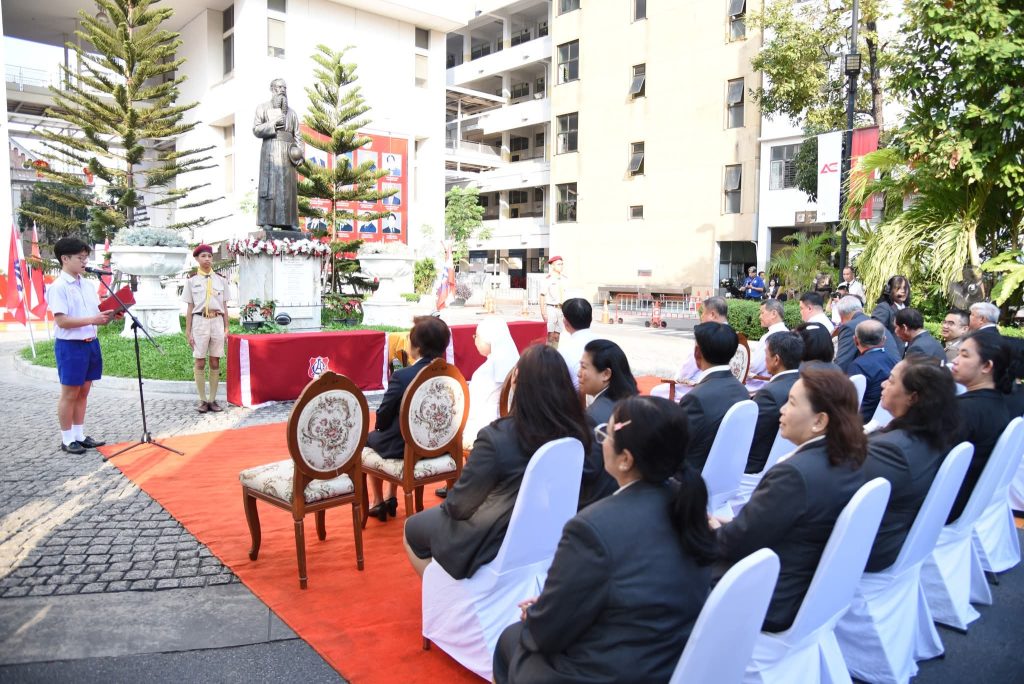
The resonant chords of the school anthem filled the air on Monday, February 16, as Assumption College, the oldest Catholic educational institution in Thailand, celebrated its 141st anniversary.
The milestone was marked by a solemn ceremony honoring its founder, Father Emile August Colombet, whose vision transformed a humble wooden seminary into a cornerstone of Thai academic excellence, and by celebrations recognizing generations of alumni who have helped shape the country’s public and professional life.
February 16 holds special meaning for the school community, known for its red-and-white colors, as it commemorates the establishment of the institution in 1885 — a milestone widely regarded as the beginning of a new chapter in modern education in Thailand.
School director Bro. Dr. Dechachai Sripicharn said the annual celebration offers students and alumni an opportunity to journey back into the school’s history while reaffirming its mission in contemporary society.
“This day reminds us how education has transformed lives for over a century,” he said, describing the school as the “big brother” of the nationwide network of Gabrielite schools.
This year’s celebration drew particular excitement with the homecoming of Prime Minister Anutin Charnvirakul, an alumnus of the school, who returned as guest of honor. He is the fifth Thai prime minister educated at the prestigious institution.
Students lined the campus to welcome him, while the prime minister warmly greeted pupils and teachers, reflecting on how the school shaped his character and leadership.
“As an alumnus of the 98th graduating class, and having returned here many times over the years, I realize even more how fortunate I am to have received my education and formation from this school,” he told administrators, teachers, classmates, and student representatives.
He later met former teachers and joined student activities, including classroom visits, drawing enthusiastic responses from current pupils.

A school born from missionary vision
Assumption College traces its roots to French missionary priest Emile August Colombet, who arrived in Siam in 1872 under the Paris Foreign Missions Society (MEP).
Seeing limited educational opportunities for local youth, Colombet established a small school in 1885 using a former seminary building as classrooms.
The school opened as Le Collège de l’Assomption with only 33 students but welcomed children of all nationalities and religions — an inclusive approach rare for its time.
Colombet, then parish priest, had earlier served as a teacher at a local seminary outside Bangkok, experiences that helped shape his vision for education in Siam.
Administration of the school later passed in 1901 to the Congregation of St. Gabriel, marking the beginning of a long tradition of Gabrielite education in Thailand.
From that foundation grew a nationwide educational network now known as the St. Gabriel’s Foundation of Thailand, which includes institutions such as Montfort College in northern Thailand and Assumption College Sriracha in the east.

Royal support and lasting recognition
The school quickly gained recognition, including royal patronage. In 1887, King Chulalongkorn (Rama V) presided over ceremonies linked to the early development of the school, while Crown Prince Maha Vajirunhis laid the foundation stone for its first permanent building.
Colombet later received high honors, including the Legion of Honour from France and the Order of the White Elephant from King Vajiravudh, acknowledging his contributions to education and society in Thailand.
He passed away in 1933, leaving behind an educational institution that would continue to influence generations of Thai leaders in business, public service, and the professions.
In its earliest years, Assumption College taught Thai and French before adding English, then considered a modern innovation. Over time, the school developed a reputation for discipline, leadership formation, and academic excellence.
More than a century later, its anniversary celebrations continue to blend nostalgia with renewed commitment to forming young people capable of serving society.
For many alumni returning each year, February 16 is not simply a school celebration but a reminder of how education can shape both personal lives and the future of a nation.