In the quiet, hallowed halls of Bush House in London during the 1970s, the air hummed with a polyglot of hope. It was a place where the Thai Service sat as neighbor to the Vietnamese, Burmese, Indonesian, and Chinese sections – a microcosm of a world seeking clarity.
For one young Catholic broadcaster, I was the only one in this section, the mission was clear: to marry the rigorous, unbiased standards of British journalism with a “humanistic lens” that saw beyond mere statistics.
“The programs will neither be very interesting nor very good,” remarked John Reith with typical British understatement when he launched the Empire Service in 1932.
Nearly a century later, his successor, Director General Tim Davie, faces a grimmer reality. With a funding cliff just weeks away, the World Service – now broadcasting in 43 languages to 313 million people in more than 200 countries – is at risk of falling silent.
As the March 2026 funding deadline approaches, the UK government must decide if it will sustain this “greatest gift to the world,” as Kofi Annan once described it.
A Magisterium of Truth in a Desert of Disinformation
In Catholic social teaching, the “right to information” is intrinsically linked to the common good. As Pope Leo XIV addressed journalists who had arrived in Rome to cover his election last year, he called on journalists to give voice to the voiceless. The Church, the pope said, recognizes the courage of those who defend human dignity, justice, and the right to information.
Truthful communication, respect for human dignity, and service to the common good lie at the heart of Catholic social teaching. Reliable journalism can mean the difference between safety and danger, especially where rumors or manipulation fuel conflict.
The World Service has long served as a reliable reference point in a sea of state-sponsored noise.
“Accurate journalism is the strongest weapon in the war of information. The World Service must not be allowed to stumble into decline.” – Tim Davie, BBC Director General
The Echo of History: From London to Bangkok
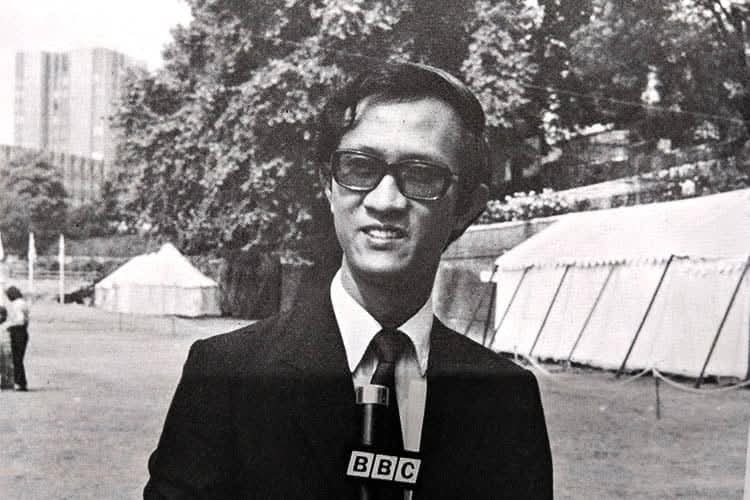
From 1972 to 1977, I served in the Thai Section of the BBC World Service in London. Our small team of seven broadcast daily news and analysis in Thai via shortwave radio to audiences back home.
The BBC Thai Service wasn’t just reporting on the UK; it was a bridge of light.
For me, the only Catholic staffer on the team, the weekly time slot became a space for “pastoral sensitivity,” sharing stories of Christmas, Holy Week, and the hope of Easter Sunday with a predominantly Buddhist audience, fostering a dialogue of mutual respect.
More importantly, the BBC shaped my understanding of journalism’s responsibility: accuracy before speed, impartiality before opinion, and service before self. Reporting was never about fame; it was about trust.
That trust became crucial during one of Thailand’s most dramatic historical moments.
In October 1973, protests erupted after years of military rule. As M24 tanks rolled through the streets of Bangkok and soldiers opened fire on peaceful student protesters at Thammasat University, the local airwaves were often choked by censorship.
Back in London, the Thai Service worked feverishly, translating and broadcasting live reports. By informing the public of where the danger zones were, those broadcasts saved countless lives.
While 77 students tragically fell that day, many survivors still credit that distant voice from London for their safety. It was a moment where professional duty met a higher calling.
The Cost of Silence
Today, the BBC remains the only international news organization broadcasting inside Afghanistan, providing an “educational lifeline” for children barred from schools.
It is the “lifesaving” frequency for Iranians during internet blackouts and a source of solace for those in the war-torn regions of Sudan and Ukraine.
As debates continue in Britain about budgets and priorities, the stakes extend beyond finance. In an age when misinformation spreads faster than truth, institutions committed to factual, balanced reporting remain essential to global peace and understanding.
For Catholic communities committed to truth, dialogue, and solidarity, the survival of trusted global journalism is not merely a political matter. It is a moral one.
If the World Service fades, something more than a broadcaster could be lost, a shared space where facts, not fear, guide decisions, and where people in darkness can still find reliable light.
Chainarong Monthienvichienchai is a founding member of the LiCAS News Board of Governors. His formation in international broadcasting began with the BBC External Services, where he served in the Thai Section of the BBC World Service in London from 1972 to 1977.
He later became world president of UNDA, the International Catholic Association for Radio and Television, from 1987 to 1994. UNDA, founded in 1928, merged with OCIC, the international Catholic organization for cinema and audiovisual media, in 2001 to form SIGNIS, the World Catholic Association for Communication.
For the past two decades, he has served as Vice Chairman of the Association of Catholic Education Council of Thailand.