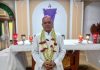

Archbishop Robertus Rubiyatmoko of Semarang has urged Indonesia’s leaders to halt policies that harm the public and listen to the poor and vulnerable as the country prepares to mark the 81st anniversary of its independence.
“We place our hope in leaders and those holding public responsibility to have the courage to stop policies that harm the interests of the nation, the state and society,” Rubiyatmoko said in a pastoral letter dated Aug. 8.
He said public policies should arise from “a willingness to listen to the voices and interests of the people, especially those who are weak” and be carried out honestly and transparently in pursuit of justice, the common good and environmental protection.
The letter is to be delivered during Masses on Aug. 15-16 for the Solemnity of the Assumption of the Blessed Virgin Mary, ahead of Indonesia’s Independence Day on Aug. 17.
Rubiyatmoko acknowledged the country’s progress since independence but said economic inequality remained evident and had become more pronounced in recent years.
Some Indonesians, he said, continued to struggle to secure employment, education, health care and adequate housing.
“Corruption, abuse of power, the weakening of the rule of law, the suppression of civic space and civil society, violence, human trafficking, and various forms of injustice continue to wound our common life,” the archbishop said.
He also warned that divisions over religion, ethnicity and political choices, along with claims of group superiority, false information and hate speech, were straining relations among Indonesians.
Rubiyatmoko raised concern over environmental degradation, citing forest destruction caused by irresponsible logging, rivers polluted by untreated waste, mounting garbage and irresponsible mining driven by economic gain.
“All of these threaten the lives of communities as well as the future of coming generations,” he said.
The archbishop said independence should not be regarded only as an inheritance to be enjoyed but as a responsibility to build a more just and prosperous society.
“Independence means having the courage to build a common life that is more just and prosperous,” he said.
Rubiyatmoko linked that responsibility to the Catholic Church’s role in Indonesia’s religiously and culturally diverse society.
Citing the July 20-26 plenary assembly of the Federation of Asian Bishops’ Conferences in Jakarta, he urged Catholics to embrace its call to become “bridges and bridge-builders.”
“We are not called merely to live side by side. We are called to build encounters with one another; to listen to, understand and work with one another in building a civilization of love,” he said.
“Being a bridge means connecting those who are different and bringing together those who are opposed and in conflict.”
The archbishop called on Catholics to support poor and vulnerable families, strengthen small businesses and cooperatives, create employment opportunities and take practical steps to protect the environment.
He said Catholic families, parishes, schools, hospitals, communities and institutions should adopt clear and measurable actions to reduce plastic use, manage waste, conserve water and plant and care for trees.
“We must pursue economic progress together while preserving nature, not through excessive exploitation that destroys life,” he said.
Rubiyatmoko also warned about the risks posed by technology and artificial intelligence when they undermine human dignity.
He urged Catholics to verify information before sharing it and to avoid creating or spreading false information, defamation, fabricated images and hate speech.
“Technology may help us make decisions, but moral responsibility remains with human beings,” he said.
Rubiyatmoko urged Catholics to mark independence through concrete acts of service, environmental responsibility and a commitment to truth and justice.
“May each of us offer one concrete step: restore a broken relationship, help a family in difficulty, care for the environment, use technology responsibly, and speak the truth and uphold justice for the common good,” he said.