
The Indonesian Caritas Network and its diocesan organizations mobilized an emergency response after a magnitude 7.7 earthquake struck Flores in East Nusa Tenggara on Aug. 15, killing dozens and displacing thousands.
The earthquake, centered about 30 kilometers northeast of Mbay in Nagekeo Regency, caused widespread damage, triggered a tsunami warning, and was followed by hundreds of aftershocks.
Indonesia’s National Disaster Management Agency, or BNPB, reported that as of Aug. 16, 77 people had died, 150 were injured, and more than 5,934 had been displaced.
Sikka Regency recorded 3,356 displaced residents and Manggarai Regency 2,078, with others displaced in Nagekeo, Bima and Selayar.
More than 2,400 houses were damaged, along with dozens of schools, health facilities, government offices and churches.
Caritas activates emergency response
Fr. Fredy Rante Taruk, executive director of Caritas Indonesia, or Yayasan Karina KWI, said the Indonesian Bishops’ Conference fully supports the emergency response.
“This disaster calls us to act out of Christian love and solidarity. Caritas Indonesia has activated Impact Scale Level III (Orange) and is ensuring that humanitarian posts and essential assistance can quickly reach survivors,” said Fr. Fredy.
Caritas Indonesia activated humanitarian service posts in the Archdiocese of Ende and the dioceses of Maumere, Ruteng and Labuan Bajo, while trained Caritas Response Team volunteers were being deployed.
Under the principle of “One Church, One Response,” dioceses, parishes, religious communities, volunteers and other Church institutions are working together to assist affected communities regardless of religious background.
Logistics transit posts are also being established in Surabaya and Kupang to support aid distribution.
Response across four dioceses
In the Archdiocese of Ende, Caritas is assessing damage and assisting displaced residents, particularly in Nagekeo, Ngada and Ende.
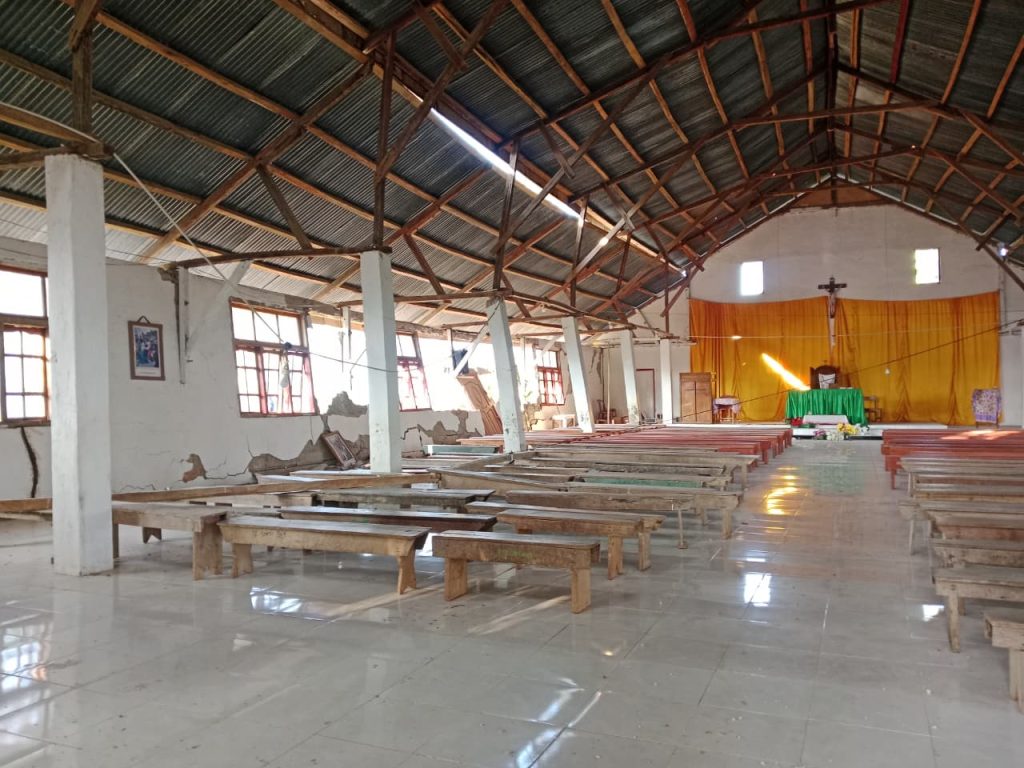
At least 20 church buildings have reportedly been damaged. A service post and temporary shelter for elderly residents have been established at Aeramo Parish.
In the Diocese of Maumere, Caritas is coordinating with local disaster authorities and the Indonesian Red Cross. Food, clean water, bedding, hygiene kits, and other basic necessities remain priorities as continuing aftershocks force many residents to remain in open areas.
In the Diocese of Ruteng, emergency tents have been erected at a regional hospital to protect patients amid continuing aftershocks. Parish networks are supporting evacuations and damage assessments.
More than 50 church buildings, including Ruteng Cathedral, have reportedly been damaged.
The Diocese of Labuan Bajo is focusing on emergency shelter and psychosocial support. Around 150 houses have reportedly been affected, although assessments are continuing amid communication disruptions.
Church facilities opened to residents
The bishops of the four affected dioceses have called on parishes, priests, religious communities and volunteers to support relief efforts. Church compounds and diocesan facilities are being opened as safe spaces for displaced residents.
Caritas Indonesia has also activated an emergency communication network and deployed personnel to strengthen rapid assessment, data management and aid distribution.
The Indonesian Caritas Network said it will continue accompanying affected communities through the emergency and recovery phases while urging residents to remain alert to aftershocks and follow instructions from disaster management authorities.