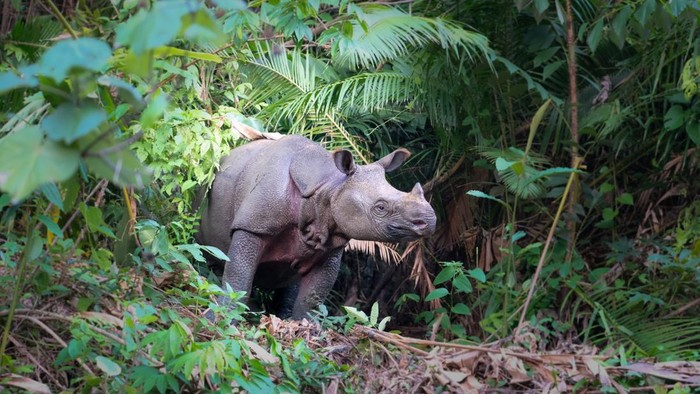
The Indonesian government is considering relocating some of the world’s remaining Javan rhinoceroses to another national park to protect the critically endangered species from natural disasters that could threaten its survival.
The proposal involves transferring some of the animals from Ujung Kulon National Park in Banten Province, their last remaining wild habitat, to Alas Purwo National Park in East Java.
Hashim Djojohadikusumo, Indonesia’s special presidential envoy for climate and energy and the younger brother of President Prabowo Subianto, discussed the plan during the United Nations Climate Change Conference (COP31) in Antalya, Türkiye, on Nov. 12.
Hashim said the relocation was being considered as a precaution against natural disasters, particularly a possible tsunami triggered by volcanic activity at Mount Anak Krakatau in the Sunda Strait.
“If a tsunami occurs, our Javan rhinos could become extinct. That is why there is a proposal to move some of them to Alas Purwo,” said Hashim.
The proposal remains under consideration, with the government emphasizing the need for scientific assessments before any relocation takes place.
Protecting a critically endangered species
The Javan rhinoceros (Rhinoceros sondaicus) is among the world’s rarest mammals, with its only surviving wild population confined to Ujung Kulon National Park on the western tip of Java.
The International Union for Conservation of Nature (IUCN) classifies the species as critically endangered. It is also listed under Appendix I of the Convention on International Trade in Endangered Species (CITES), which prohibits international commercial trade in the animals.
Its population is estimated at approximately 74 individuals, making each surviving animal important to the species’ future.
Javan rhinos feed primarily on leaves, shoots and other forest vegetation. They depend on tropical forest habitats that provide sufficient food, water and access to natural mineral sources.
The species faces several threats, including limited habitat, genetic deterioration associated with inbreeding and the possibility of catastrophic natural disasters.
With the entire surviving wild population concentrated in a single national park, a major volcanic eruption or tsunami could have devastating consequences.
Establishing a second population outside Ujung Kulon is considered one possible strategy to reduce the risk of extinction.
The idea is not new. Conservation experts and Indonesian government authorities have discussed establishing another Javan rhino population since around 1989-1990.
However, relocating the animals would require careful scientific assessment to determine whether the proposed destination could support their long-term survival.
Previous relocation highlights conservation challenges
The proposed transfer has also brought attention to the death of Musofa, a Javan rhinoceros that died in November 2025, two days after being moved to the Javan Rhino Study and Conservation Area within Ujung Kulon National Park.
The incident raised questions about the challenges involved in capturing and transporting a species with an extremely small surviving population.
The Ministry of Forestry maintained at the time that Musofa’s death was not caused by the relocation.
Satyawan Pudyatmoko, director general of natural resources and ecosystem conservation, said the rhino, estimated to be more than 45 years old, was believed to have suffered from chronic physical weakness before its capture and transfer.
Veterinary examinations found no evidence of injuries caused by sedation or organ damage resulting from acute stress.
The incident underscores the importance of assessing the health and physical condition of individual animals before undertaking any relocation.
A transfer from Ujung Kulon to Alas Purwo would involve a much longer journey than moving an animal within the same national park.
Scientific assessments required before relocation
The Indonesian government has emphasized that no final decision has been made on the proposed relocation.
Hashim said comprehensive assessments would be needed to examine habitat suitability, animal health, the readiness of the proposed destination and the financial resources required.
The government is also exploring international funding opportunities to support the development of an alternative habitat, including forest conservation financing mechanisms.
The proposed relocation is intended to address the vulnerability of a species whose entire remaining wild population is concentrated in one geographical area.
Apart from natural disasters, the small and isolated population faces genetic risks associated with inbreeding, which could threaten its long-term survival.
Establishing another population could reduce the possibility that a single catastrophic event would wipe out the species.
However, the survival of relocated animals would depend on the suitability of their new habitat and the measures taken to protect their health during the transfer.
The proposal also raises questions about how conservation authorities can balance the need to establish another population with continued protection of the species’ existing habitat in Ujung Kulon.
For now, the government’s plan remains at the proposal stage, with scientific assessments expected to guide any decision on whether the Javan rhinos can be safely relocated to Alas Purwo.