A senior Vatican official has urged faith communities to become “bridge builders and peacemakers” by fostering dialogue and friendship, particularly in multicultural and conflict-affected societies.
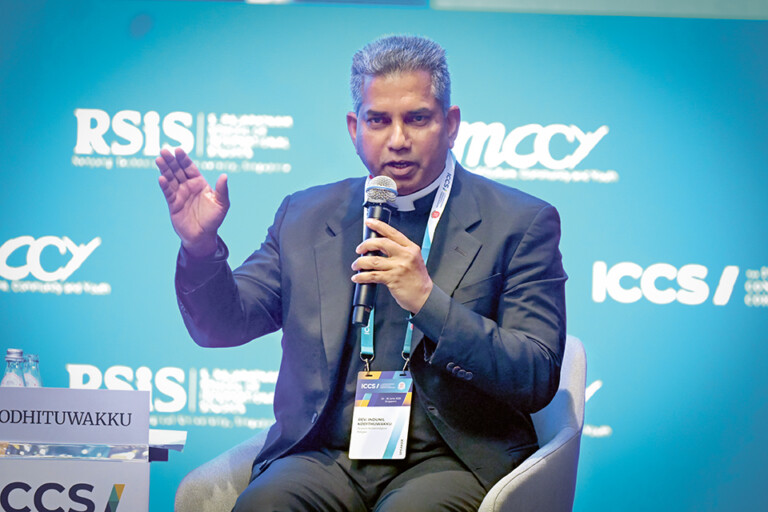
“We need to be at the forefront as bridge builders and peacemakers,” said Monsignor Indunil Kodithuwakku, secretary of the Vatican’s Dicastery for Interreligious Dialogue.
According to a report by Catholic News SG, the official news site of the Church in Singapore, Kodithuwakku said simple acts of kindness—such as exchanging food during religious celebrations—can foster goodwill among neighbors of different faiths.
Recalling his own experience in Sri Lanka, he shared how his Catholic family and their Muslim neighbors would regularly exchange meals during Ramadan and Christmas.
Over time, this led to a deeper understanding of each other’s cultures, beliefs, and values, and helped build mutual trust and respect.
The Vatican official was speaking at the International Conference on Cohesive Societies held last month at the Raffles City Convention Centre in Singapore.
The three-day gathering, organized by the S. Rajaratnam School of International Studies and supported by the Ministry of Culture, Community and Youth, drew more than 1,000 participants from over 50 countries.
Kodithuwakku cited Sri Lanka’s post-war reconciliation efforts as an example of how interreligious dialogue can heal divisions.
In the aftermath of the civil war, people from the war-affected north were brought together with communities in the south.
Although they spoke different languages—Sinhalese and Tamil—religious leaders, including Buddhist monks, lived together in villages to better understand one another.
When the time came to part ways, many wept, having realized that their long-held prejudices were unfounded.
While religion is often blamed for many of the world’s conflicts, he said the underlying causes are usually socio-economic inequalities, political polarization, and environmental degradation. “We need to address the root causes of most problems,” he said.
He emphasized the need to promote a “culture of encounter,” one grounded in mutual listening and respect.
This, he said, means engaging with those who think differently or hold other beliefs, not with the intent to debate but to understand.
“In a dialogue, one person listens to the other’s faith experiences without trying to prove them wrong, with an open heart,” he said. “Once the speaker is done, the other shares their faith experiences, and the first listens without aiming to debate.”