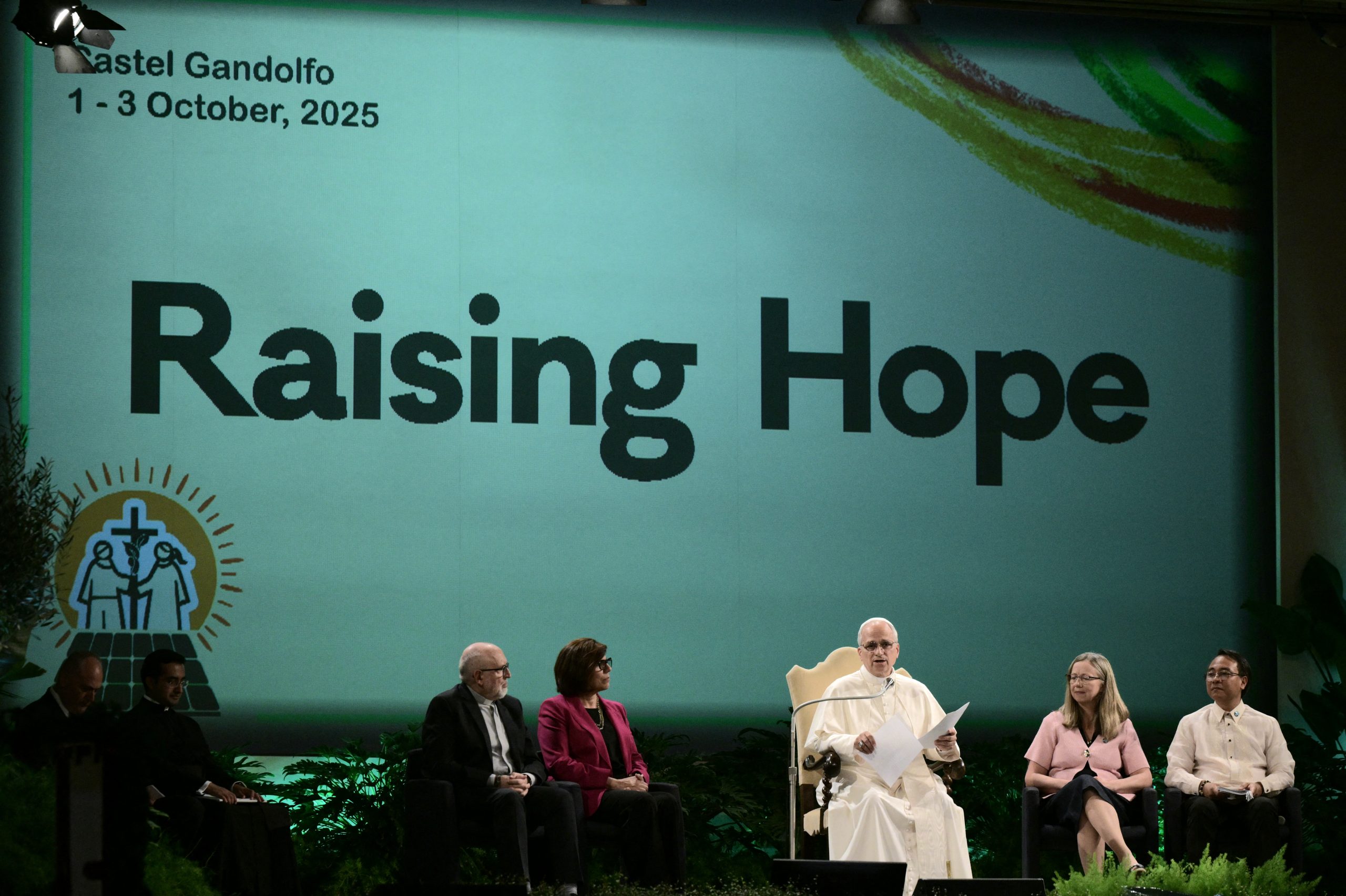
Pope Leo XIV has renewed a strong appeal for unity and collective responsibility in caring for the planet, warning that the ecological crisis cannot be solved by individual efforts alone but requires a global response rooted in both faith and political will.
“We are one family, with one Father, who makes the sun to rise and sends rain on everyone,” the pope told participants of the “Raising Hope” Conference organized by the Laudato Si Movement on October 1.
“We inhabit the same planet, and we must care for it together. I therefore renew my strong appeal for unity around integral ecology and for peace!” he added.
The pontiff stressed that “the most effective solutions will not come from individual efforts alone, but above all from major political decisions on the national and international levels.”
He called on advocacy groups and citizens to “put pressure on governments to develop and implement more rigorous regulations, procedures and controls,” insisting that active participation in political decision-making is essential to mitigate environmental damage.
Conversion of the heart
Pope Leo underlined that authentic ecological renewal must be rooted not in data alone but in the heart. He urged everyone to “shift from collecting data to caring; and from environmental discourse to an ecological conversion that transforms both personal and communal lifestyles.”
He emphasized that authentic discipleship demands reverence for creation, saying that love for God is inseparable from respect for His creatures and from sharing Christ’s concern for all that is fragile and wounded.
He described the heart as “the place where external reality has the greatest impact, where the deepest searching takes place, where the most authentic desires are discovered, where one’s ultimate identity is found, and where decisions are formed.”
Legacy of Laudato Si’
Reflecting on the ten years since Pope Francis’ encyclical was published, he called Laudato Si’ “a gift we have inherited from Pope Francis,” noting that its influence has extended to “international summits, ecumenical and interreligious dialogue, economic and business circles, as well as theological and bioethical studies.”
The encyclical’s paradigm of integral ecology and its appeal to “bring the whole human family together to seek a sustainable and integral development” remain even more urgent today, he said, adding that the challenges identified are “first and foremost of a spiritual nature: they call for conversion.”
Call to young people and societies
The pope urged young people, parents, and leaders in local and national institutions to embrace what Laudato Si’ described as “cultural, spiritual and educational challenges.” He insisted that “there is no room for indifference or resignation.”
Looking ahead, he expressed hope that the upcoming COP30 climate summit, the 53rd Plenary Session of the Committee on World Food Security, and the 2026 Water Conference will “listen to the cry of the Earth and the cry of the poor, families, indigenous peoples, involuntary migrants, and believers throughout the world.”
Concluding his address, Pope Leo posed a question to the faithful and to all humanity: “God will ask us if we have cultivated and cared for the world that he created, for the benefit of all and for future generations, and if we have taken care of our brothers and sisters. What will be our answer?”