Beijing’s religious authorities and state-recognized Catholic leaders reaffirmed a stronger political line for the development of Catholic theology in the capital.
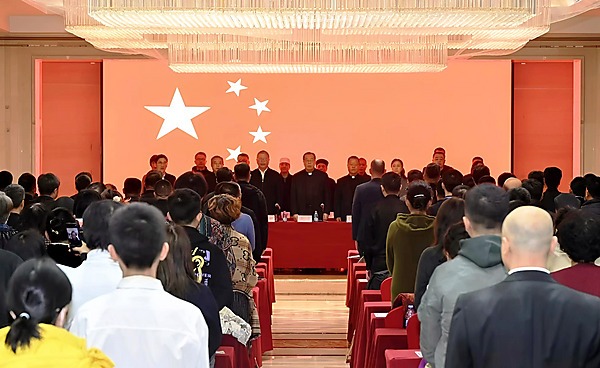
The leaders gathered during the 10th Beijing Catholic Symposium on the Sinicization of Theological Thought held on Nov. 29.
The event, part of the Tiandao Forum, convened senior officials from the United Front Work Department, the Beijing Ethnic and Religious Affairs Commission, and the city’s major religious associations.
The symposium aimed to advance the state-driven agenda to systematically promote the deepening and solid implementation of the Sinicization of Catholicism in Beijing.
Bishop Li Shan of Beijing, who also chairs the Chinese Catholic Patriotic Association, opened the forum by thanking national and municipal religious authorities for their “care and guidance,” and scholars for their support.
He outlined three expectations for the next phase of theological development: to “continuously strengthen political guidance,” “accelerate the cultivation of dual-competency talents,” and “continue promoting the transformation of theological research into practical application.”
Beijing United Front official Li Xin delivered one of the clearest political directives of the gathering, saying the capital’s Catholic community had achieved “positive results” in advancing the Sinicization process but must meet four key requirements.
These are to “strengthen political guidance and always maintain the correct political direction,” “deepen cultural infusion and strengthen the Sinicized interpretation of doctrine and canon law,” “uphold strict governance of the Church and improve levels,” and “leverage the role of the forum and strive to promote.”
Representatives of the Buddhist, Taoist, Islamic, and Protestant communities also attended, underscoring the cross-religious visibility of the Sinicization program.
This year’s symposium focused on “the Sinicization of Catholic liturgy and sacred music.”
Presenters examined the historical integration of Catholic liturgical music with traditional Chinese musical culture and outlined new pathways for expanding this process.
Organizers described the outcomes as “systematic, in-depth, and achieving significant,” saying the forum “promoted further harmonious coexistence between Catholicism and Chinese culture.”
In his closing remarks, Auxiliary Bishop Zhen Xuebin of Beijing, who also chairs the city’s Catholic “Two Associations,” said the symposium was “high in academic rigor, strong in contemporary relevance, and rich in historical depth.”
He said it “systematically reviewed and presented the historical evolution and innovative practices of the Sinicization of sacred music,” which holds “extremely important significance” for the future of theological development in the capital.
The sessions were moderated by clergy from the Beijing Diocese’s Theological Research Office and Marriage Office.
Fr. Zhu Jie, vice chair and secretary general of the Beijing Catholic Church Affairs Committee, presided over the closing ceremony.