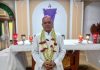

St. Peter’s Church in Mae Sot, Thailand, bid farewell to a Myanmar priest who spent a decade serving refugees and migrants along Thailand’s western border during a simple but moving Eucharistic celebration.
The farewell took place on Sunday, Dec. 14, near Thailand’s western border with Myanmar. Clergy and faithful gathered to honor Father Joachim of the Diocese of Hpa-An in Myanmar’s Kayin State as he returned home after ten years of pastoral service in Thailand.
The Eucharistic celebration was simple in form yet deeply moving in spirit, marking a significant moment for Catholic communities along the Thai-Myanmar border.
For four decades, the Diocese of Nakhon Sawan has supported ethnic refugees and migrant communities from Myanmar, particularly in the Mae Sot area of Tak Province.
Throughout the Mass, the atmosphere reflected unity and affection as the community offered thanksgiving to God for the gift of Father Joachim’s witness of faith, humility, and tireless service.
For many, the celebration was not only a farewell, but an expression of shared memories shaped by hardship, perseverance, and compassionate presence among people living on the margins.
At the conclusion of the Mass, representatives of the diocese and clergy, led by Father Phongsak Sangiamkaew, pastor of St. Peter’s Church, offered words of farewell, praising Father Joachim’s faithfulness, patience, and sacrifice over the past decade.
They affirmed the enduring friendship and cooperation between the dioceses of Nakhon Sawan and Hpa-An, rooted in a shared commitment to pastoral care for displaced and vulnerable communities.
Representatives of the parish faithful followed, speaking with heartfelt emotion. They described themselves as sheep lovingly cared for by a devoted shepherd, particularly in a difficult and fragile borderland marked by displacement, uncertainty, and cultural complexity.
Father Joachim began his ministry in the Diocese of Nakhon Sawan in response to urgent pastoral need.
Concerned for Christian communities living along the border, many of them Burmese and Karen Catholics residing in refugee camps such as Mae La, Umphiem, and Nu Po, as well as among migrant workers, the diocese sought assistance from Myanmar’s Diocese of Hpa-An. Father Joachim accepted the call with courage and generosity.
Serving in a vast and demanding pastoral territory approximately 500 kilometers northwest of Bangkok, he worked closely with local clergy, often under challenging conditions.
Fluent in the language and deeply familiar with the culture of the refugees and migrants, he became a vital bridge between communities. Living simply among villagers, he ministered to thousands of displaced people, celebrating the sacraments and offering accompaniment to those navigating life “at the crossroads.”
During the farewell, Father Joachim responded with humility, thanking the clergy and faithful for their welcome and affection. He emphasized that whatever good had been accomplished was the work of God’s grace rather than his own effort.
Following the formal program, parishioners came forward one by one to present small souvenirs and offer personal words of thanks. The gestures reflected the deep and enduring affection between the priest and the community he served.
“Although it seemed like a small event, it was immense in the warmth and love shared,” one parishioner remarked, a sentiment that captured the spirit of the day. The farewell testified that faith and love are not measured by grandeur, but by sincerity and mutual devotion.
Father Joachim now returns to St. Francis Xavier Cathedral in Hpa-An, approximately 150 kilometers from Mae Sot, where he is expected to resume pastoral duties amid the ongoing conflict and its humanitarian consequences in Myanmar.
In Kayin State and other conflict-affected regions, Catholic clergy and religious, alongside groups such as the Jesuits, continue to accompany local communities with prudence and courage.
Church leaders note that the presence of priests often determines whether villagers remain or flee, as abandoned villages are vulnerable to occupation and destruction. By staying with the people, clergy play a quiet but crucial role in sustaining hope, preserving community life, and preparing for future rehabilitation.
In some areas, such as Nan Hlaing village, priests have even joined villagers in farming despite risks from unexploded ordnance, affirming life and encouraging families to remain connected to their land. Church workers say such acts help keep alive the hope of return and renewal once peace is restored.
As Father Joachim crosses the border once again to serve his war-affected homeland, the Church on both sides of the frontier entrusts him to God’s care, grateful for a decade of faithful service that strengthened bonds of faith, solidarity, and hope between Thailand and Myanmar.