
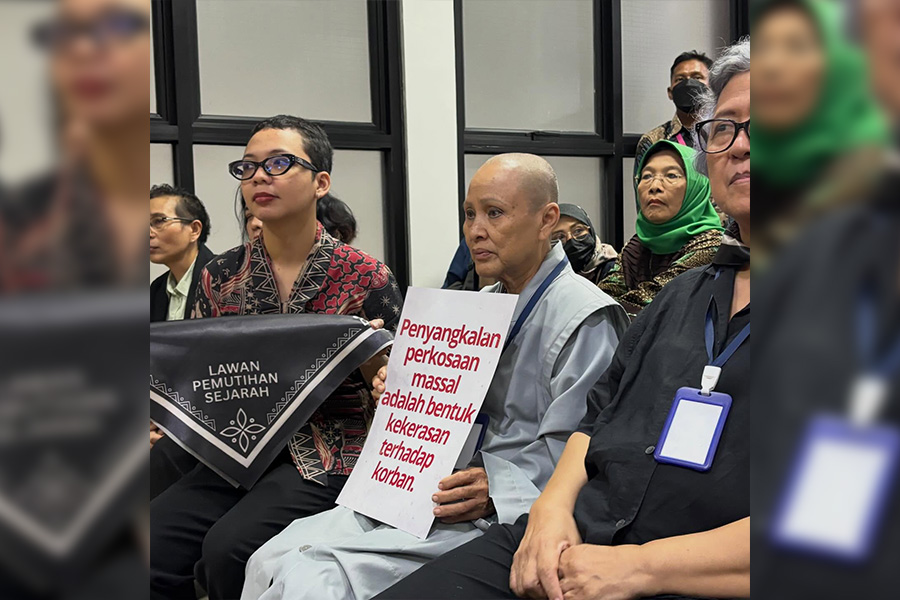
The mother of a victim of the May 1998 mass rapes testified in a Jakarta court, directly challenging Minister of Culture Fadli Zon’s rejection of documented sexual violence against ethnic Chinese women during the riots that shook the Indonesian capital.
The hearing at the Jakarta State Administrative Court is part of a lawsuit filed by the Civil Society Coalition Against Impunity against what it calls a state-backed effort to deny the mass rapes that occurred during the May 14–15, 1998 unrest. The case revisits one of the most painful chapters in Indonesia’s modern history, when widespread violence preceded President Suharto’s resignation and ended the New Order regime.
A court hearing was held in Jakarta on Thursday, Feb. 7. The mother of a victim of mass rape attended the hearing as a witness and key figure opposing the historical narrative recently released by Minister of Culture Fadli Zon, which rejects the fact that acts of rape against ethnic Chinese women occurred during the social unrest that struck Jakarta on May 14–15, 1998.
The riots themselves ended with a crucial episode in modern Indonesian political history, when President Suharto decided to step down from power, marking the end of the New Order regime (1967–1998).
This was an era characterized by anti-Chinese policies, the pursuit and punishment without due process of members of the Indonesian Communist Party (PKI) and sympathizers of leftist political groups, who were sent to detention camps on Buru Island, Central Maluku, or, at worst, executed and buried in unmarked graves.
Protests outside the courthouse included the display of hashtags reading:
∙ “The body is an archive that the state has no right to deny.”
∙ #LongLiveTheVictims
∙ #DoNotBeSilent
∙ #Resist
Inside the Jakarta courtroom, the group opposing the Ministry of Culture’s version of history initiated by Fadli Zon is called the Civil Society Coalition Against Impunity.
A number of pro-humanitarian activists attended the hearing of the lawsuit challenging the denial of the mass rapes of May 1998 at the Jakarta State Administrative Court (PTUN Jakarta).
The hearing examined witnesses and experts in Case No. 335/G/TF/2025/PTUN.JKT—an effort to resist the practice of denial by public officials that erases the suffering of victims and distorts history.
“The denial of the real events of the May 1998 mass rapes against ethnic Chinese women is not merely an opinion; it constitutes a continuation of violence and a whitewashing of state crimes,” human rights group Kontras writes.
The facts of violence against Indonesian women of ethnic Chinese descent have been documented by several humanitarian organizations, both official state bodies and others, including:
∙ The National Commission on Human Rights (Komnas HAM).
∙ The National Commission on Violence Against Women (Komnas Perempuan).
∙ The Joint Fact-Finding Team (TGPF).
∙ Numerous testimonies from victims and their families, in which the victims’ “silence” amid stigma, threats, and the absence of state protection has never meant consent or acknowledgment that these crimes against human rights did not occur.
“Historical truth does not arise from office or position, but from the memory, bodies, and lived experiences of victims. The state has an obligation to acknowledge, take responsibility for, and resolve the gross human rights violations of May 1998—not to erase them for the sake of political convenience,” Kontras writes.
Testimony of the victim’s biological mother
Feb. 5 became a historic moment when Mrs. Wiwin Suryadinata, also known as Buddhist Master “Suhu” Shien—the biological mother of the late Ms. Ita Martadinata—appeared publicly for the first time. She courageously gave testimony before the Indonesian public in a court of law. She spoke about the mass rapes of May 1998 and the murder of her daughter.
“I am one of the eyewitnesses to the rape and brutal murder of Ita Martadinata. From the very beginning, I have tried to reveal and testify everywhere for many years—from 1998 until this year, 2026—but de facto I have been denied by many people. Not only by state officials, but also by some individuals or groups whom I once felt close to. Even one or two people from among the victims’ families themselves—so much so that not a few people thought I was insane and hallucinating,” wrote a Facebook account quoting Mrs. Wiwin Haryono as saying.
“But finally, now, Mrs. Wiwin, who previously with her family tried to flee and seek asylum in Singapore but failed after several years—I also tried to help but failed—they returned to their homeland. She seemed to have lived in Bali for a while, then disappeared to an unknown place. I lost contact, but now she has reappeared and turns out to have become a Buddhist nun, and has given such open testimony,” the Facebook post continued.
Mrs. Wiwin Haryono stated that the incident that befell her daughter Ita in May 1998—being raped and murdered—has gone without trial to this day. Wiwin refuses to remain silent; she testified and demands an end to the denial of the history of the May 1998 rapes.
The mother of Wawan, a student shot dead
Also present in the courtroom was Mrs. Sumarsih, whose son, a university student named Wawan, was killed by live gunfire in November 1998.
After Mrs. Wiwin delivered her testimony, Mrs. Sumarsih immediately approached and embraced her. Wiwin broke down in tears in Sumarsih’s arms—two mothers whose children were both killed by the state.
Volunteer Team for Humanity
The late Ita Martadinata and the late Wawan were both members of the Volunteer Team for Humanity.
Ms. Ita Martadinata was a female activist and a 12th-grade high school student who became one of the victims of rape in May 1998. After the incident, Ita continued to accompany and provide counseling to other women victims of rape.
Ita was preparing to travel to New York to testify at a United Nations hearing on the May 1998 events. However, one week before her departure to the United States, and three months before her high school graduation, Ita was found dead in her bedroom.
To this day, the case of her rape and murder—like the case of the mass rapes of May 1998—has not received justice.
Indonesian Human Rights for Women (Komnas Perempuan) chief Mrs. Maria Ulfah Anshor also testified as an expert witness in the lawsuit filed by the Civil Society Coalition Against Impunity at the Jakarta State Administrative Court.
“The perpetrators of past crimes (human rights violations) are still roaming free, without appropriate punishment. Are they truly that immune to the law in Indonesia?”
In addition to Wiwin as a witness and Mrs. Maria U. Anshor as an expert, another expert witness was also present: historian Andi Achdian.