I will admit something. When the word “synodality” first started appearing in every Catholic document and diocesan newsletter, my instinct was mild irritation. Not because the idea is wrong, it is not, but because of the way institutions reach for new vocabulary when old commitments have quietly stalled. Synodality can mean genuine renewal. It can also mean a very long meeting after which nothing much changes and everyone goes home feeling vaguely consulted.
That suspicion has not entirely left me. But something keeps pulling me back to a question I did not expect: what if the resources for making synodality real were already there, largely ignored, sitting in a tradition most people in those meetings have mentally filed under “devotional” and moved past?
I mean the Sacred Heart. Bear with me.
What the Image Actually Says
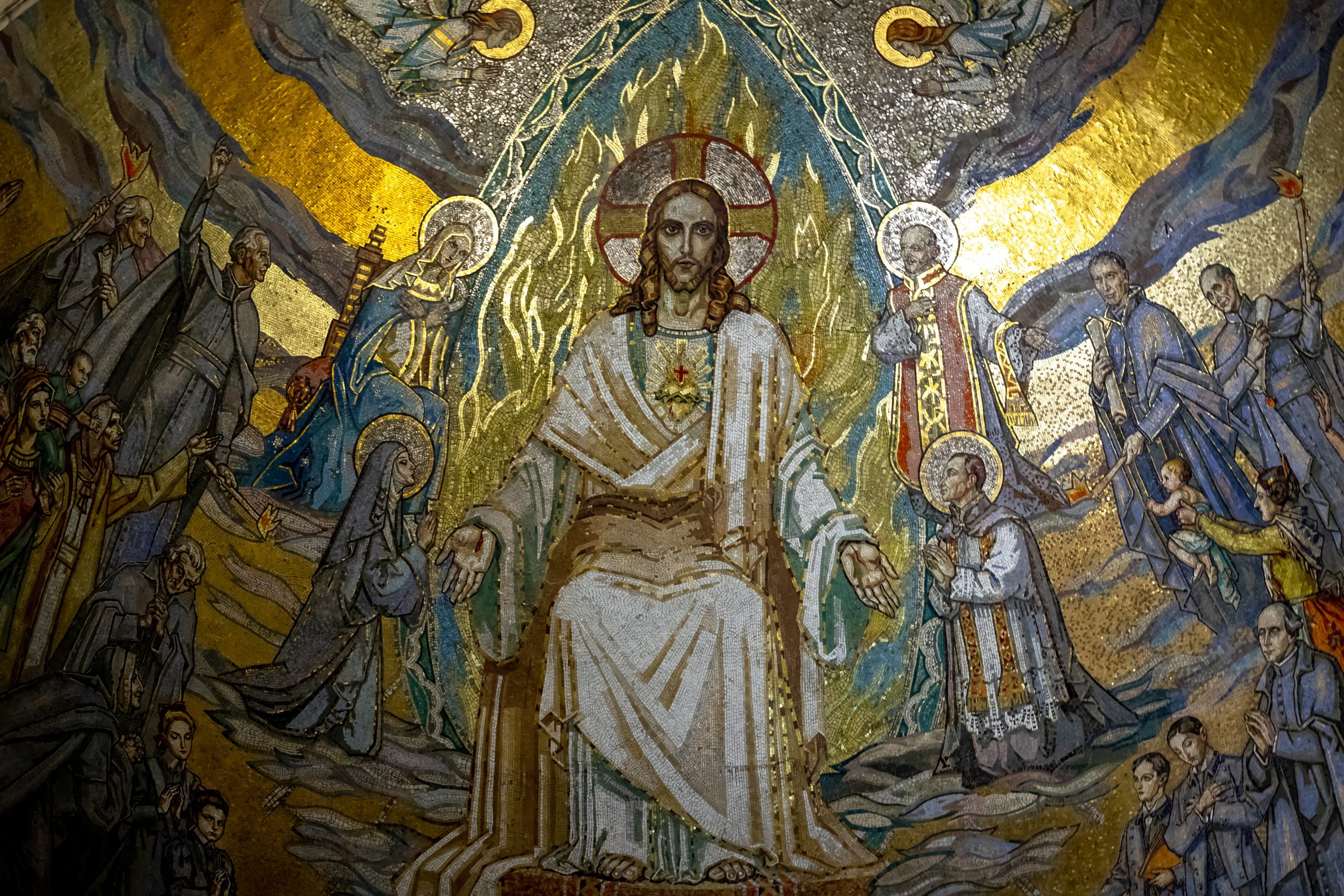
The Sacred Heart of Jesus is one of the most theologically serious images in Catholic tradition and one of the most aesthetically unfortunate. The thorns, the flames, the exposed organ. In its worst artistic expressions, it has the emotional register of a Victorian greeting card. That is the tradition’s problem to own, and it has done real damage. Generations encountered the image before the theology and came away thinking it meant “feel warmly about Jesus.”
It means something far stranger and more demanding than that.
The heart pierced on the cross, from which blood and water flow, is the Church being born. Those are the sacraments. That is the whole mystery of a God who chose vulnerability over invulnerability, presence over distance, and wounding over safety. The Church’s own liturgical tradition says it plainly: the Sacred Heart names the entire mystery of Christ, the Incarnate Word, as infinite charity. Not a feeling. A person. Not a mood. A mission.
That distinction matters enormously right now because a certain version of synodality has the emotional register of the bad Sacred Heart art: warm, well-intentioned, and somewhat vague. Lots of listening. There is less clarity about what is actually being listened for or what would count as a genuine response.
The Man Who Didn’t Theorise
Arnold Janssen was not, by most accounts, a naturally charismatic figure. He was persistent, principled, occasionally difficult, and absolutely convinced that the love of God was not a private possession. Working through the Kulturkampf, that grinding political war against Catholic institutional life in Germany, he had every structural reason to contract, to protect what existed, and to wait for better conditions.
He opened a missionary house in Steyl instead, with almost no money and an idea most of his contemporaries considered poorly timed. What grew from that, congregations, publications, missionaries sent to places European Catholicism had barely imagined, and women given genuine roles before anyone considered it obvious, emerged from a spirituality that never treated the Sacred Heart as decoration. It was the theological ground of everything: love that moves outward because that is simply what love does.
What stops me every time I think about Janssen is not the scale of what he built. It is the timing. He did not wait for the Church to be in better shape. He did not wait for consensus, or permission, or a more favourable political climate. He read the love of God as an imperative rather than a comfort, and he acted on it in conditions that would have justified paralysis.
The synodal Church is not short of people who can articulate what needs to change. It is sometimes short of people willing to move before the conditions are ideal.
What Still Needs Saying
There is a critique that needs making, and it is uncomfortable precisely because it comes from within the renewal tradition rather than against it.
Some of what travels under the name of synodality has mistaken gentleness for depth. Inclusion is real and necessary. The Church has excluded and silenced and caused serious harm, and the reckoning with that is not finished. But a community that welcomes every voice into the room without ever asking what those voices are being welcomed toward is not a synodal Church. It is a very large and theologically anxious support group.
The Sacred Heart does not support that reading. The heart, pierced and poured out, is not a symbol of unconditional validation. It is a symbol of love that costs something, that calls people somewhere, that has content and direction and makes demands. Mercy, in this tradition, is not the suspension of truth. It is truth’s most searching form.
Janssen understood this. His communities were not held together by warmth alone. They were held together by formation, common rule, shared mission, and a willingness to be sent into discomfort. The listening served the sending. Always.
Where This Leaves Us
I do not think the Sacred Heart solves synodality’s tensions. I do not think Arnold Janssen maps cleanly onto contemporary ecclesial debates. History is not a template.
But I keep coming back to the direction both of them point: outward, toward the world, toward the stranger, toward whatever is farthest from the Church’s current comfort. Not because the Church has nothing to offer, but because a love that stays inside eventually begins to feed on itself.
The heart that was wounded on a Friday and open again by Sunday was not, after that, a cautious heart. It still bore the marks. It still showed them, apparently, to anyone who needed to see. But it moved. It went somewhere.
That is still the point.
John Singarayar, a member of the Society of the Divine Word, India–Mumbai Province, holds a doctorate in anthropology. He is the author of several books and a regular contributor to academic conferences and publications. His work focuses on sociology, anthropology, theology, philosophy, ecology, artificial intelligence, leadership, management, tribal studies, spirituality, and mission.