
The Archdiocese of Bangkok recently launched Thailand’s first Basic Bibliodrama Workshop at Baan Phu Waan to promote an experiential approach to Scripture.
Located just west of Bangkok, the gathering marked a significant milestone for religious education in the region, introducing an experiential method of Scripture study that invites participants to engage biblical texts through improvisation, reflection, and self-discovery.
The landmark event was facilitated by Ms. Prapha Weerasilp and Ms. Tasanee Mathurotsuwan, together with a dedicated team from the Bible Department of the Archdiocese of Bangkok.
The Word Made Flesh: A Pastoral Vision
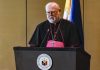
Championing the initiative is the Archbishop of Bangkok, Most Rev. Francis Xavier Vira Arpondratana. For a prelate whose decades-long commitment to catechesis and religious education is widely recognized, the introduction of Bibliodrama represents a natural development in contemporary faith formation.
“Bibliodrama is an immersive approach to Scripture that helps us better understand the cultural world of the Bible,” Archbishop Vira explained. “Through creative self-discovery and social reflection, participants bridge the Bible text with contemporary society.”
The archbishop, who specialized in youth pastoral ministry and catechesis at the Pontifical Salesian University in Rome and serves as chair of the National Catechetical Commission, emphasized that this method moves far beyond traditional classroom learning.
Rather than simply studying Scripture, participants engage in an intensive encounter with the text, allowing their own life stories to intersect with the biblical narrative.
The Four Dimensions of the Human Person
Rooted in a methodology pioneered by Fr. Rudy Phohl, SVD, in Manila, Bibliodrama uses group dynamics, guided conversations, improvisation, interviews, and physical movement to help participants internalize biblical narratives.
Under the guidance of trained facilitators, participants do not merely read a story. They step into it, embodying biblical characters and exploring their motivations within their own contemporary cultural contexts.
According to Archbishop Vira, the method intentionally engages four distinct dimensions of the human person:
- The Cognitive Level: Deepening structural and historical understanding of the biblical text.
- The Emotional Level: Awakening empathy and personal insight through the embodiment of biblical characters.
- The Spiritual Level: Drawing participants toward deeper prayer, contemplation, and communion with God.
- The Social Level: Transforming personal insights into concrete action within the community.
By encouraging spontaneity and creativity, the workshop invites participants to experience their faith intellectually, emotionally, physically, and spiritually, fostering a more personal encounter with God’s Word.
A Happening, Not a Show
The organizers are quick to emphasize that, despite its theatrical elements, Bibliodrama is not a performance intended for an audience. Quoting the foundational vision of Fr. Phohl, the Archdiocese explained that Bibliodrama is fundamentally an interior journey.
“Bibliodrama is not a show for an audience,” Fr. Phohl once observed. “It is a happening in which the participants themselves experience the Word physically, emotionally, spiritually, and socially.”
Rather than following a single fixed script, Bibliodrama employs a wide variety of short exercises, improvised scenes, and locally adapted methods designed to meet the particular needs of each group.
The facilitator’s role is equally important. Facilitators present the biblical text, help participants select and inhabit their biblical characters, and guide them through the essential reflection that follows, enabling them to connect their experience with everyday life.
As more believers seek meaningful and authentic ways to engage their faith, this participatory approach to Scripture continues to gain popularity in pastoral and educational settings around the world.
With its successful debut at Baan Phu Waan, the Archdiocese of Bangkok has opened a new avenue for pastoral formation, inviting the faithful not only to study the Word of God but also to experience and live it more deeply.