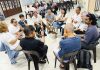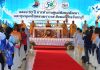

The Catholic Church in Thailand joined faith communities worldwide on July 12 to observe Sea Sunday, a day dedicated to recognizing the vital contributions and profound challenges faced by the world’s maritime workers.
The local celebration, held at Our Lady of Lourdes Church in the coastal Diocese of Chanthaburi, echoed a universal call to look past the mechanics of global trade and acknowledge the human dignity of those who toil upon the waves.
Father Sudjen Fonreung, parish priest and director of Stella Maris for the Diocese of Chanthaburi, presided over the Eucharistic liturgy.
He welcomed Thailand’s participation in the global observance under this year’s theme: “Beyond Cargo and Commerce: The Human Face of the Sea.”
The observance brought to light the stark realities of an industry that handles more than 80% of global trade but often leaves its workforce invisible.
Speaking to LiCAS News, Apinya Tajitt, deputy director of the Seafarers Department for Stella Maris Chanthaburi, emphasized the urgent need for pastoral vigilance.
“We joined the Church worldwide in special prayers for seafarers, fishers, and their families. Many are separated from their loved ones for their livelihoods, facing acute danger, injustice, and exploitation,” Tajitt said.
Tajitt appealed for prayers for seafarers’ protection and human dignity, “so they do not lose hope,” adding, “Behind every piece of cargo that travels across the sea are lives, families, and human stories.”
During his homily, Father Sudjen drew a vivid parallel between the day’s Gospel — the parable of the sower — and the perilous lives of maritime workers.
He noted that the “rocky and thorny ground” described by Christ manifests clearly in the modern seafaring experience.
“When we see a massive cargo ship, we often see only containers, logistics, and economic figures,” Father Fonreung reflected. “But God’s Word invites us to look deeper.
“On every vessel, there is a father thinking of his children, a husband longing for his wife, or a youth far from home. The thorny ground they navigate includes deep isolation, unpaid wages, abandonment in foreign ports, and the terrifying volatility of storms, accidents, and geopolitical conflicts,” he said.
The priest reminded the congregation that the Church is called to be the “good soil” and active sowers of hope.
Simple acts of accompaniment — a welfare visit to a docked ship, listening to a distressed crew member, or advocating against labor exploitation — serve as seeds of love that can transform a cold, indifferent industry.
Referring to the first reading from the prophet Isaiah, he assured the faithful that no act of goodness is wasted in the eyes of God, even if the fruits are not immediately visible.
The local pastoral concern closely mirrored a sweeping global appeal issued from the Vatican by Cardinal Michael Czerny, S.J., prefect of the Dicastery for Promoting Integral Human Development.
In his official 2026 Sea Sunday message, Cardinal Czerny highlighted how modern geopolitical crises, such as recent tensions in the Strait of Hormuz, reveal humanity’s profound dependence on maritime labor.
“Much of what societies rely upon each day arrives quietly through the perseverance, sacrifice, skill, and endurance of the people of the sea,” Cardinal Czerny said.
He warned that despite advancements in digital communication, mariners are experiencing deeper isolation because of reduced crew sizes, shorter shore leave, and grueling operational schedules.
Furthermore, recent armed conflicts have left many crews facing virtual confinement aboard their vessels, coupled with severe food shortages and persistent fear for their lives.
To address these systemic vulnerabilities, the cardinal pointed to Pope Leo XIV’s landmark encyclical, Magnifica Humanitas.
The papal document explicitly states that technological and economic systems must never reduce the human person to “data, a cog in a machine, or a commodity.” Instead, the maritime industry must safeguard the inviolable dignity and freedom of every individual.
Cardinal Czerny further expanded on the concept of integral ecology, linking the health of the oceans directly to human welfare.
“When the oceans suffer from pollution and irresponsible exploitation, humanity suffers with them — especially fishers and coastal communities. He emphasized that protecting marine environments and defending the safety of maritime workers are interconnected moral commitments to the common good,” the prelate said.
Rooted in the Gospel image of Christ calming the storm, the global Stella Maris ministry — historically known as the Apostleship of the Sea — continues to provide crucial port chaplaincy services worldwide.
These ministries offer material aid, labor advocacy, and the sacraments to crews of all nationalities and creeds, ensuring that the sea does not become a place where the human voice is forgotten.