Cardinal Ignatius Suharyo of Jakarta called on Asia’s bishops to produce a practical roadmap for dialogue and human dignity, saying the Church must confront poverty, exclusion, and religious division while becoming more deeply rooted in Asian societies.
Speaking during the plenary assembly of the Federation of Asian Bishops’ Conferences in Jakarta, Suharyo said dialogue must extend beyond relations among religions to include local cultures, social inequality, access to education and health care, solidarity with marginalized communities, and care for the environment.
“I hope this assembly will produce a roadmap for peaceful dialogue with all elements of society and for strengthening human dignity,” Suharyo told Indonesian journalists after a press conference Monday, July 20.
He said such commitments could help ensure that the Catholic Church is “no longer perceived as a foreign institution, but rather as an integral part of society.”
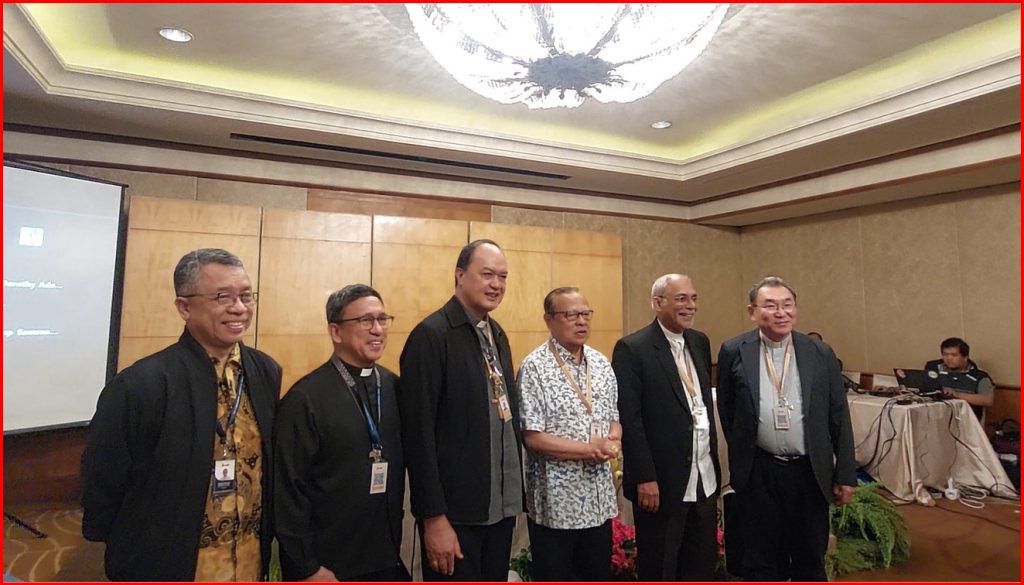
The 12th FABC Plenary Assembly is being held at Hotel Mulia Senayan in Jakarta.
Suharyo said Indonesia has a special historical connection with the federation because it hosted an FABC plenary assembly in Bandung, West Java, in 1990.
He recalled that the gathering generated reflections and initiatives that encouraged Asian Churches to contribute more actively to society.
“The 1990 FABC Assembly was a very significant moment for the Church in Asia,” he said.
At the time, Suharyo taught sacred Scripture at the Faculty of Theology of Sanata Dharma University in Yogyakarta and served as a formator at St. Paul’s Major Seminary in Kentungan.
Reflecting on that experience, he agreed with remarks made earlier by Cardinal Pablo Virgilio David that building pathways of dialogue and peace and promoting human dignity must remain central priorities for the Church in Asia.
A Church open to dialogue
“The central idea is both attractive and realistic for Asia,” Suharyo said.
He said the Church must promote dialogue and seek new ways to make its presence beneficial to society.
“We are not speaking about a closed Church, but about a Church that continually opens itself to dialogue,” he added.
The prelate said the question of whom the Church should engage is particularly important in Asia.
He said dialogue is especially important in Asia, the birthplace of major religions and civilizations whose cultural traditions continue to shape the world.
Inculturation in Indonesia
Suharyo said dialogue must also take root in local cultures, pointing to the Indonesian Church’s use of local languages and traditions in its pastoral and liturgical life.
“For decades, the Church in Indonesia has continued to integrate local cultural values into its pastoral and liturgical life.”
He cited the celebration of the Eucharist, noting that prayers and hymns are offered in local languages. In Central Java, liturgical music is sung in Javanese and accompanied by traditional gamelan, while similar cultural adaptations are used elsewhere in Indonesia.
Dialogue through human dignity
Suharyo said dialogue cannot be limited to religion and culture but must include concrete efforts to uphold the dignity of people living in poverty.
“We must honestly acknowledge that many people across Asia still live in absolute poverty. Such conditions are incompatible with genuine human dignity,” he said.
He said feudal social structures remain influential in parts of Asia, including Indonesia, where people are often valued “not because of who they are, but because of what they own and what they can afford.”
Suharyo said the Church must respond by becoming “a force that helps bring about the Kingdom of God” and by making Catholic social teaching “increasingly relevant to the real needs of society.”
The common good
Promoting human dignity, Suharyo said, requires access to education, health care, and the basic necessities of life. He said the Church’s mission remains unfinished as long as people are poor, unable to attend school, or denied essential services.
“Respecting human dignity means working together for the common good,” he said.
Suharyo said this requires solidarity with people who lack food, health care, and a decent standard of living. The Church, he added, should participate actively in efforts to strengthen social solidarity and give particular attention to marginalized communities, a responsibility also mandated by Indonesia’s Constitution.
Caring for our common home
Suharyo said the defense of human dignity is also connected to the responsibility to care for the earth as humanity’s common home.
“Today, our planet cannot truly be called our common home if only a small number of people control its resources while many others remain excluded,” he said.
A symbol of religious harmony
Suharyo pointed to Jakarta’s Istiqlal Mosque and the nearby Jakarta Cathedral as symbols of Indonesia’s commitment to interreligious harmony.
He said Indonesia’s first president, Sukarno, deliberately chose to build the national mosque opposite the cathedral so the two houses of worship would stand “side by side—not facing each other in conflict,” but as symbols of the country’s aspiration for harmony.
That vision was later reinforced by the construction of the Tunnel of Friendship, or Terowongan Silaturahmi, connecting the mosque and the cathedral.
Suharyo described the tunnel as more than a passageway, calling it “an educational space” that reminds Indonesians of the nation’s founding vision of religious harmony and peaceful coexistence.
He said he hoped the site would continue to promote civic education and inspire future generations to uphold unity, mutual respect, and interreligious dialogue.