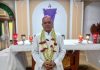
Cardinal Isao Kikuchi of Tokyo warned against sacrificing human lives in the name of peace as Japan marked the 81st anniversary of the end of World War II.
Kikuchi delivered the message Aug. 15 during Mass for the Feast of the Assumption of the Blessed Virgin Mary at Tokyo Cathedral of St. Mary. The day also marked the final day of the Catholic Church’s Peace Week in Japan.
“Peace cannot be found in the exclusion of weak or different beings,” Kikuchi said, adding that “true peace cannot exist in the judgment that it is acceptable to sacrifice others for one’s own benefit.”
The prelate said peace cannot be achieved by accepting the suffering or death of others as necessary for one’s own security.
“God’s peace cannot be found in the belief that it is unavoidable for someone to be sacrificed in order to protect one’s own existence,” he said.
Kikuchi described Mary as the “Queen of Peace,” saying she dedicated her life to fulfilling God’s will and showed the Church how peace is rooted in respect for life and human dignity.
“We humans, finding every possible excuse, violently attack life, a gift from God, and disregard its dignity,” he said.
The cardinal said life “must be protected without exception from its beginning to its end” and that human dignity must likewise be respected without exception because it is a gift from God.
Kikuchi pointed to ongoing conflicts as examples of humanity continuing to justify violence.
“Even now, humanity continues to find various reasons to justify its actions, violently attacking many lives in Gaza, the war in Ukraine shows no end in sight,” he said.
He also referred to the conflict involving Iran, Israel and the United States and questioned public reactions that appear to celebrate aggressive rhetoric and military action.
“On the contrary, there are even voices of applause that seem to praise the belligerent statements and actions of some leaders,” Kikuchi said.
He urged people to consider the families behind the casualties of war. “Behind that applause, how many people are grieving as their children, parents, and loved ones have been violently taken from them?” he said.
Kikuchi said images of grieving families in war zones should not be treated as distant tragedies.
“We sometimes see images on the news of people grieving over the loss of loved ones in war zones. I want us to engrave that sorrow in our own hearts, rather than leaving it as someone else’s tragedy,” he said.
Reflecting on Mary’s Magnificat, Kikuchi said God’s concern is directed toward people who are “abandoned, forgotten, excluded as unwanted, and driven out of the center of society and relegated to the periphery.”
He said the Gospel overturns conventional measures of power and human worth. “All life is inherently precious because He created it in His own image,” Kikuchi said.
“Where we humans consider something to have no value, God finds value in what He cherishes,” the prelate added.
The cardinal also cited Pope Leo XIV’s remarks during a Rosary for Peace gathering in the Vatican Gardens on May 30.
“Peace springs forth from justice and love, just as harmony unites people, families, communities, and nations,” the pope said, according to Kikuchi.
Leo said peace remains possible amid conflict if people listen to “the cries of those who have been deprived of peace—the cries of innocent children, suffering mothers and fathers, abused prisoners, refugees, and suffering people of all ages.”
“The only word they all speak is peace,” the pope said.
Kikuchi warned against “a social climate that condones such violence and seeks to increase the weapons that are its source.”
He called on Catholics to follow Mary’s example and work so that “God’s word may be fulfilled, His order may be established, and God’s peace may be realized.”