
Thailand’s education minister said Catholic schools remain a crucial force in the country’s education system as schools confront artificial intelligence, inequality and rapid social change.
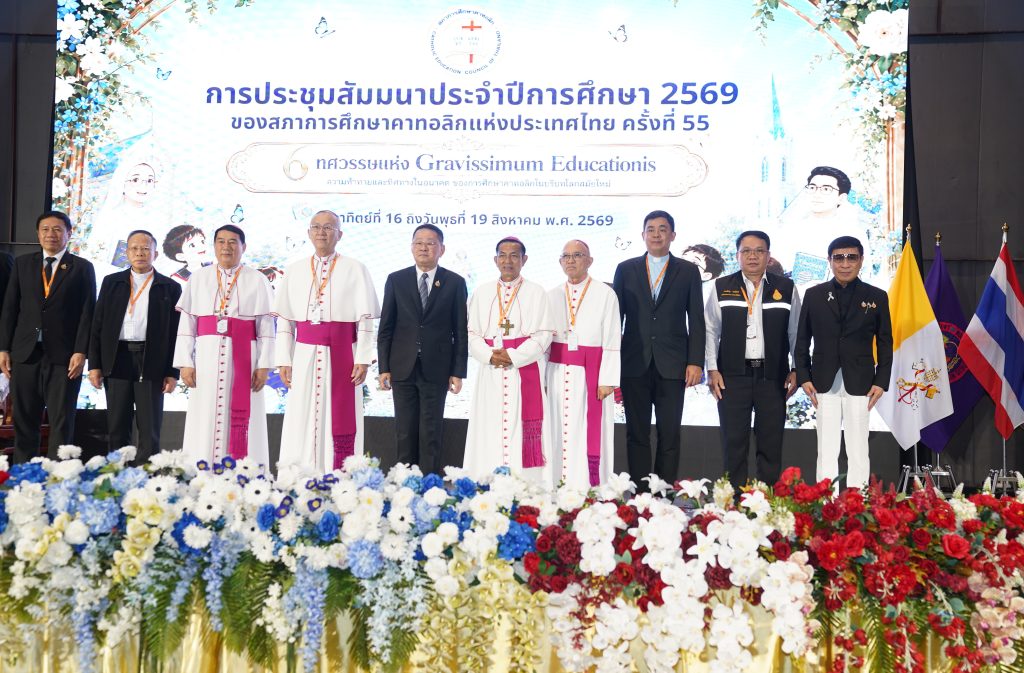
Education Minister Prasert Chandraruangthong made the remarks in a keynote address to more than 550 bishops, priests, religious leaders and lay educators gathered at Khao Yai Resort for the 55th Annual Seminar of the Catholic Education Council of Thailand (CECT) on Aug. 17.
Prasert said the Church’s educational mission closely aligned with national education policies and praised Pope Leo XIV’s Apostolic Letter, Drawing New Maps of Hope. He said he had carefully studied the papal document and highlighted its relevance to the direction of education in Thailand.
“On the 60th anniversary of Gravissimum Educationis, this convention holds exceptional meaning as it re-evaluates the foundational pillars of Catholic education—a direction that harmonizes perfectly with the core principles of the Ministry of Education,” Prasert said.
Technology as a Tool, Not a Master
Addressing artificial intelligence, digital transformation, climate disruption and societal inequality, Prasert said education in the 21st century could not focus solely on academic output.
“In a world where artificial intelligence is advancing rapidly, we face a fundamental choice: whether we use technology to elevate humanity or allow technology to define human value. AI helps us learn faster, but it can never replace love, compassion, morality, or self-sacrifice. Education must cultivate both the brain and the heart, ensuring technology remains a tool for human flourishing,” Prasert said.
He said hundreds of Catholic schools across Thailand have long served the country by forming skilled young people with a commitment to public service.
Shifting from Rote to Reason
Prasert also stressed the need for active learning rather than traditional rote memorization as schools adapt to new technologies.
“Allowing children to utilize AI must be built upon their own established thinking processes first—not simply allowing students to use AI as an effortless answer generator,” he said. “Children need to shift from reading to memorize to reading to understand.”
Fr. Paul Eakarat Homprathum, secretary-general of the Catholic Education Council of Thailand, said CECT’s strategic framework incorporates active learning methods.
“Active learning transforms classrooms into vibrant, engaging environments where knowledge is not merely stored temporarily for examinations, but deeply understood and concretely applied to real life,” Eakarat said.
Leaving No One Behind: Green Education and Shared Goals
Prasert also highlighted the Ministry of Education’s policy of “Leaving No One Behind,” which seeks to ensure equitable access to quality learning and portable skill sets across transitions.
He praised Pope Francis’ Global Compact on Education and the encyclical Laudato Si’, saying the government’s “Green Education” policy reflected the Catholic commitment to ecological stewardship.
“Caring for our common home and caring for humanity are one and the same mission,” Prasert said. “Because our ultimate goals are identical—to develop individuals who are physically, mentally, and spiritually whole—the Ministry of Education regards Catholic schools as a crucial network within our national private school system.”
Prasert urged Catholic school leaders to maintain safety standards for students and faculty while strengthening academic quality.
He also invited CECT leaders to submit the seminar’s proposals and conclusions directly to the Ministry of Education for possible cooperation and policy implementation.