From a small hill tribe community nestled in misty mountains, the bishop calls Catholics to become a living Church for the poor and suffering.
“The construction of the building may be complete, but the building of the Christian community has only just begun.”
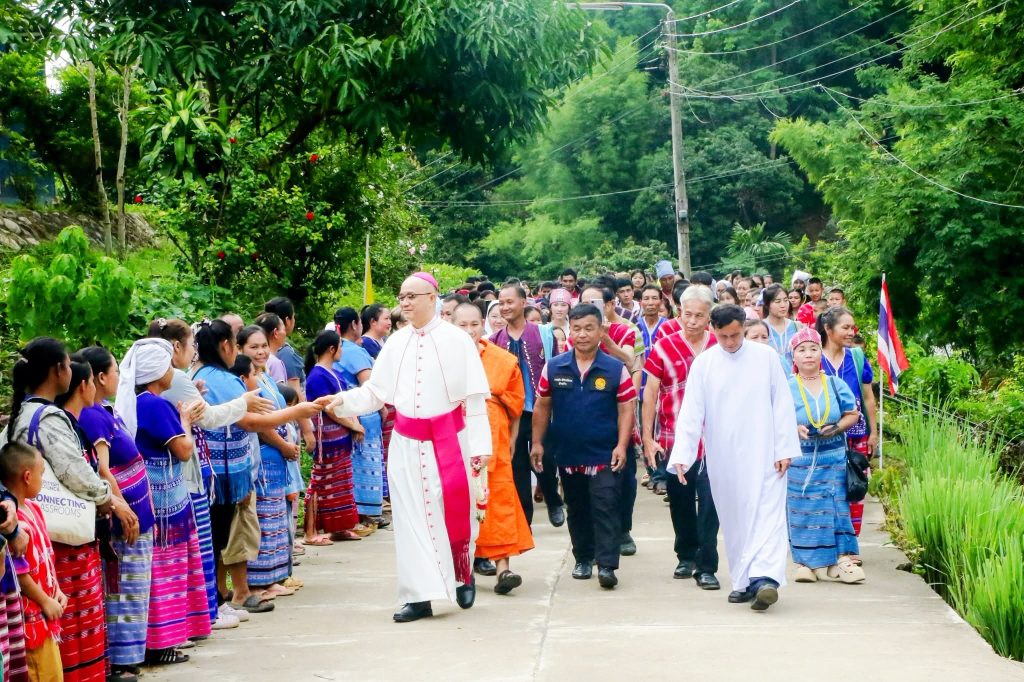
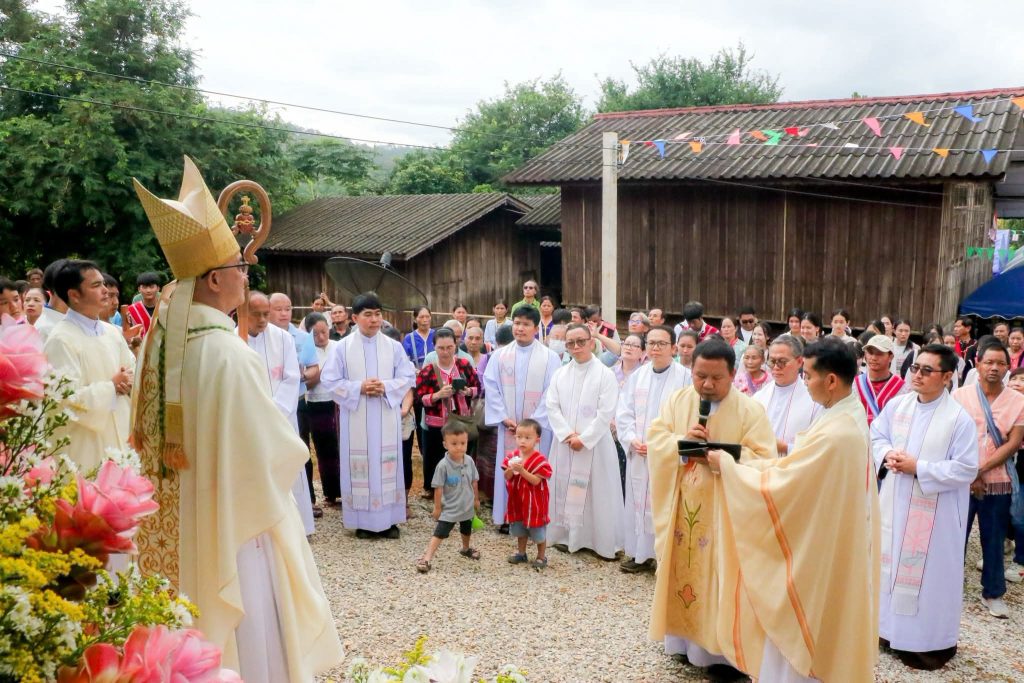
With these words, Bishop Peter Suphot Roeksujarit of Chiang Mai challenged a small Indigenous Catholic community to look beyond bricks and mortar as he blessed and opened the new St. John the Apostle Village Chapel at Ban Santonpao on Aug. 29.
The chapel, a sub-parish of St. Michael Garicoits Parish in Chiang Dao District, is nestled in nature amid a thriving watershed forest and mountain views, with a viewpoint overlooking a sea of morning mist clinging to the mountainsides and the majestic Doi Luang Chiang Dao peak as a backdrop.
It serves the Catholic faithful of Ban Santonpao, most of whom belong to the Lahu (Muser) ethnic group, who together built “The House of God” to serve as their spiritual center.
A Small Chapel in a Vast Mission
The blessing may seem modest, but it reveals the reality of the Church in northern Thailand. The Diocese of Chiang Mai serves approximately 60,000 Catholics and nearly 4,000 catechumens across the north.
It comprises about 50 parishes, but its heart lies in more than 700 Catholic villages and roughly 500 village chapels spread across mountainous terrain.
Pastoral ministry is supported by around 100 priests, 180 religious men and women, and hundreds of lay catechists who walk for hours to reach some remote communities.
Chiang Dao District itself is home to a mosaic of highland ethnic groups — Karen, Hmong, Lahu, Lisu and Kachin — many of whom migrated to escape unrest along the Myanmar border during the 1950s-1960s.
The Lahu: A People of Faith and Tradition
The Catholics of Ban Santonpao are part of that story. Originating in the high Tibetan Plateau, the Lahu migrated through Yunnan, China, and Myanmar over generations, eventually settling across the mountainous landscapes of Chiang Mai, Chiang Rai, and Mae Hong Son to escape regional conflict during the mid-20th century.
While traditional Lahu culture remains deeply rooted in animism, Western missionaries introduced Christianity to their lands over a century ago.
Early evangelists found a bridge between traditional beliefs and the Gospel: the Lahu already held an ancestral devotion to G’u-sha, a supreme Creator. This cultural resonance allowed Christian faith to flourish naturally alongside Indigenous traditions, fostering a distinct identity that harmonizes ancestral customs with Catholic worship.
The new chapel at Ban Santonpao stands as a fruit of that long journey of inculturation and faith.
A Call to Become a ‘Living Church’
During the solemn dedication, Bishop Suphot urged the congregation to look beyond the physical beauty of their new sanctuary, framing the chapel not as a final destination but as the engine of a transformed community.
Reflecting on the Gospel where the beloved disciple entered the empty tomb, “he saw and believed,” the bishop said those three words encapsulate the meaning of the new church: Come – See – and Believe.
“People who come here may initially see the building, the cross, the altar, the image of Christ, and people gathered in prayer. But we hope they won’t stop at what they see. They will gradually look deeper and discover, ‘God is here.’ We didn’t build this church to create another Christian building in Chiang Dao, but what will happen inside this house and in the hearts of those who enter it, a place where people can find God.”
“If the altar is beautiful but no one attends Mass, the church is incomplete. If there are bells but no prayers from the family, the church is incomplete. If there is a cross but we don’t know how to forgive each other, the church is incomplete,” he said. “Because a true church must build people, not just a building.”
The bishop’s most powerful call came at the end of his homily, turning the dedication of a building into a mission for every family.
“The construction of the building may be complete, but the building of the Christian community has only just begun. From today, I want to see this church as a place where children grow up to know God, a place where youth feel that the Church is their home, a place where families pray together, a place where those who are suffering can come in and receive encouragement, a place where the poor, the lonely, the neglected feel, ‘There is a place for me here,’” he said.
“Most importantly, when we attend Mass, we must leave this church and become a ‘living church’ in the midst of our village and community, because Jesus is not confined within the church walls. He awaits us in the sick, in the elderly, in children, in the poor, in families in trouble, and in neighbors who need our help.”