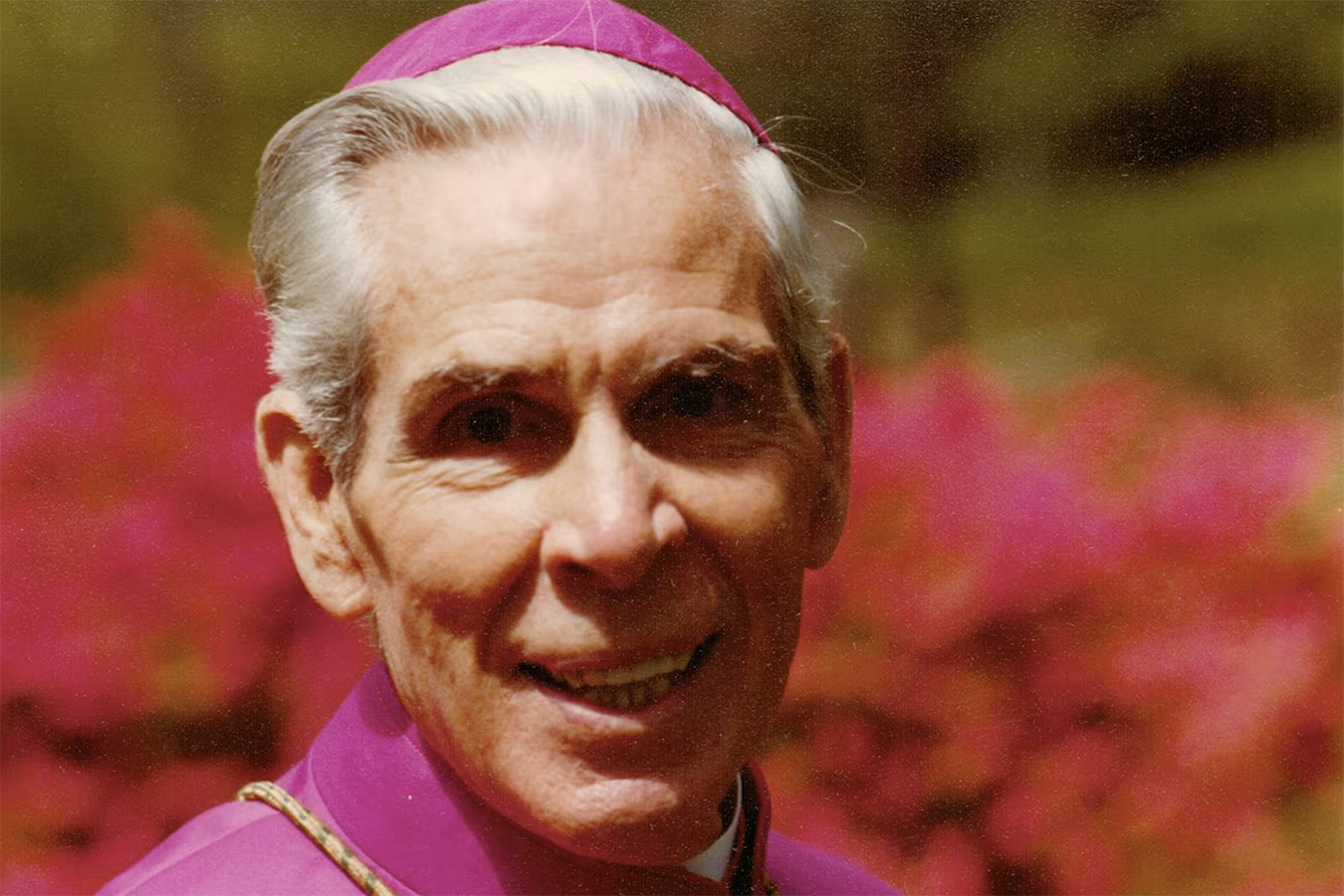
On September 24, in St. Louis, a man who once shared a network time slot with Milton Berle will be declared a saint. Fulton Sheen—priest, professor, and midcentury America’s most-watched religious broadcaster—reaches a milestone delayed since 2019, when his beatification was paused weeks before the ceremony. The timing fits. We are living through the most chaotic religious media landscape since Sheen first stepped in front of a camera, and the Church is about to honour the man who saw it coming.
A Voice Before Its Time
Sheen didn’t stumble into broadcasting. He chose it, deliberately, when many churchmen still treated radio and television as vulgar distractions. His show Life Is Worth Living drew as many as thirty million viewers a week in the 1950s, a number modern preachers can only dream about. He wore the cape, used the chalkboard, and delivered theology with the timing of a stand-up comedian. Critics inside the Church worried he was cheapening the sacred by putting it on the same screen as sitcoms and variety hours. Sheen’s answer was simple: souls don’t care what channel they are on.
That instinct—treating the medium as neutral territory to be claimed rather than avoided—is exactly what makes him useful to us now. Every generation of Christians faces the same argument about whatever new technology has just arrived. Sheen already had it out, decades ago, and he came down clearly on the side of showing up.
The Medium Was Never the Message
Here is where a lot of retellings of Sheen’s story go soft. It is tempting to reduce his genius to “he was good on TV,” as though charisma alone explains thirty million viewers. It doesn’t. Sheen spent twenty-five years teaching philosophy before he ever touched a microphone. What audiences responded to wasn’t slickness; it was substance delivered without condescension. He assumed his audience could handle real ideas—natural law, the problem of evil, the meaning of suffering—if you respected them enough to explain things clearly.
That distinction matters enormously for anyone trying to do ministry online today. There is a real temptation in digital religious content to chase engagement the way engagement is chased everywhere else: outrage, spectacle, the fifteen-second hook that says nothing but moves fast. Sheen’s model was almost the opposite. He trusted depth to hold attention. It is a harder path and a slower one, but it is the one that actually built something lasting.
What Today’s Creators Could Learn
Walk through religious content online now and you will find two failure modes in abundance. One is retreat—the assumption that faithful content has to be dull, defensive, or apologetic about existing at all. The other is capitulation—content so eager to be relatable that it dissolves into lifestyle branding with a cross in the corner. Sheen avoided both. He was unmistakably confident in what he believed and unmistakably generous toward the audience he was speaking to, including the many non-Catholics who tuned in.
He also understood something that gets lost in a metrics-obsessed culture: reach isn’t the same as formation. Sheen wanted converts and he wanted catechized Catholics, not just viewers. He measured success in changed lives, which is a far slower and less flattering scoreboard than follower counts. Any Catholic influencer, podcaster, or parish social media manager working today is, whether they know it or not, operating in territory Sheen mapped first.
Where the Model Gets Complicated
None of this should turn into hagiography of the medium itself, though, and this is worth sitting with honestly. Sheen’s success also previewed a risk the Church is still wrestling with: the personality-driven ministry, where the messenger becomes inseparable from the message. Parasocial attachment to a compelling religious figure can nourish faith, but it can also substitute for it. People can end up devoted to a voice, a face, an algorithm-friendly personality, without ever building the harder, slower relationships—with a parish, a confessor, a community—that actually sustain a spiritual life over decades.
Sheen himself seemed aware of the danger, at least eventually. He wrote candidly about wrestling with vanity and ambition, the occupational hazards of being a famous churchman. That self-awareness is part of what makes him a believable saint rather than a marketing case study. The lesson isn’t “be a celebrity for Christ.” It is closer to using whatever platform you are given; watch your own soul carefully while you do it, and never let the format outrank the content.
A Saint for the Scroll
There is something quietly encouraging about the Church beatifying a broadcaster in 2026, of all years, when so much energy is spent debating whether social media is compatible with serious faith at all. Sheen’s answer, delivered from decades in the past, is neither naive optimism nor reflexive suspicion. It is a third way: go where people already are, take their intelligence seriously, and let the medium serve something bigger than itself. That is a harder assignment than either extreme, and maybe that is exactly why it worked.
John Singarayar, a member of the Society of the Divine Word, India–Mumbai Province, holds a doctorate in anthropology. He is the author of several books and a regular contributor to academic conferences and publications. His work focuses on sociology, anthropology, theology, philosophy, ecology, artificial intelligence, leadership, management, tribal studies, spirituality, and mission.