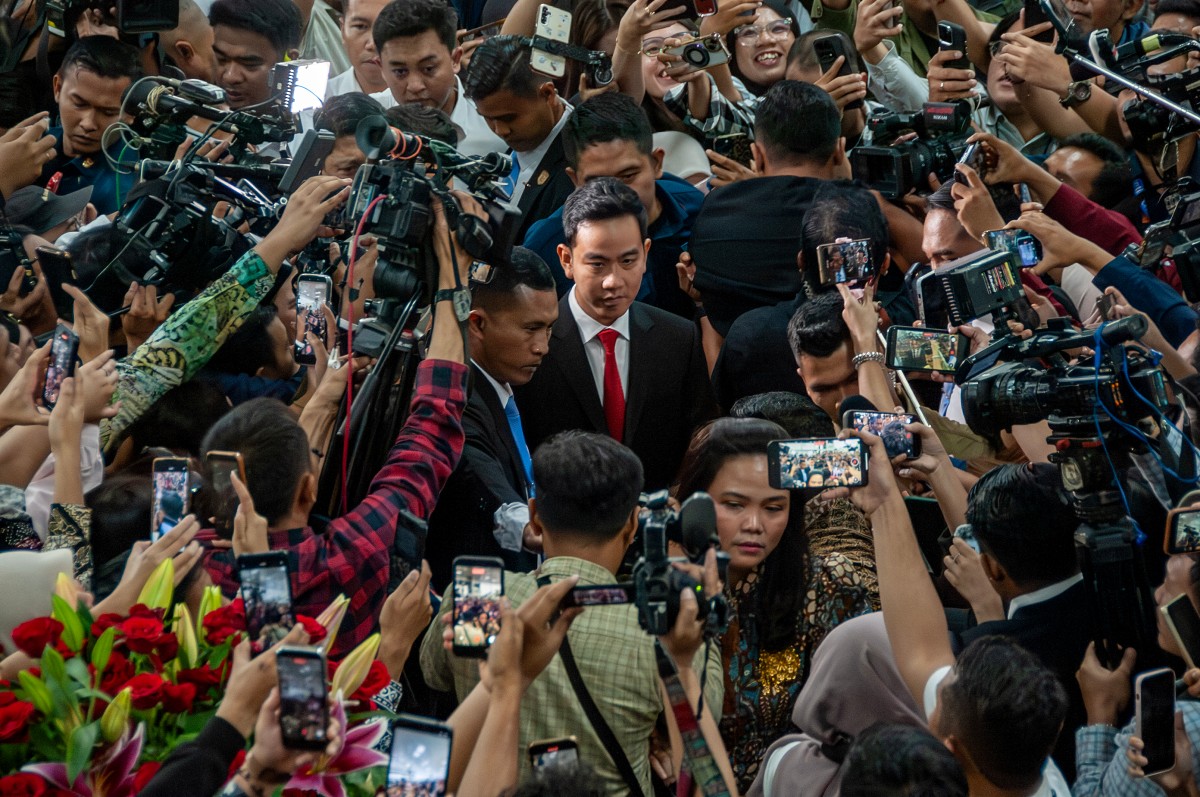
Indonesian Vice President Gibran Rakabuming Raka resigned Thursday, Nov. 12, amid controversy over his educational credentials, creating new uncertainty within President Prabowo Subianto’s governing coalition.
The 39-year-old vice president submitted his resignation to Prabowo and parliament following an October Supreme Court ruling invalidating a certificate recognizing his overseas secondary education as equivalent to an Indonesian high school qualification.
Prabowo confirmed that he had accepted Gibran’s resignation and praised him for placing the country’s interests above his political position.
Gibran maintained that his decision was unrelated to the controversy surrounding his educational credentials. In a video statement Thursday evening, he defended the validity of his academic documents and said he had submitted them to the court.
The resignation followed repeated calls for Gibran to step down after the Supreme Court ruling prompted efforts in parliament to remove him from office.
Gibran completed his schooling in Singapore before pursuing a marketing degree there. When he registered as a vice presidential candidate in 2024, he submitted a certificate recognizing his overseas education as equivalent to a vocational high school qualification in Indonesia.
His educational credentials subsequently became the subject of legal challenges.
Before submitting his resignation, Gibran reportedly met with Prabowo at the Presidential Palace in Jakarta.
House of Representatives Deputy Speaker Sufmi Dasco Ahmad had confirmed that the president and vice president were scheduled to meet before Gibran proceeded to the People’s Consultative Assembly (MPR) complex in Senayan, Central Jakarta.
Former President Joko Widodo, widely known as Jokowi, addressed the resignation during a meeting with journalists at his residence in Solo, Central Java, on Nov. 12.
Jokowi, Gibran’s father, described political changes as a normal part of public life and said he had reminded his son that holding political office is temporary.
The former president also reaffirmed his support for Prabowo’s administration, particularly government programs aimed at improving public welfare.
Gibran’s departure could reshape the political alliance that helped Prabowo win the 2024 presidential election.
Prabowo’s victory was widely credited in part to support from Jokowi, who served as Indonesia’s president from 2014 to 2024.
Gibran’s selection as Prabowo’s running mate strengthened ties between Prabowo’s Gerindra party and political figures aligned with Jokowi, who had defeated Prabowo in two previous presidential elections.
The alliance brought Gibran and other Jokowi allies into influential positions in Prabowo’s administration.
Khairul Fahmi, executive director of the Institute for Security and Strategic Studies, told Agence France-Presse (AFP) that the resignation represented a significant political realignment but did not necessarily threaten government stability.
He assessed that Jokowi would retain political influence, although Gibran’s departure could weaken his political network’s direct access to power.
For Prabowo, the resignation could provide greater room to consolidate his leadership and pursue his own political priorities, according to Khairul.
The resignation comes as Prabowo faces growing public dissatisfaction two years into his presidency.
Thousands of Indonesians have joined demonstrations in recent weeks over economic hardship, corruption, perceived authoritarianism and the government’s handling of devastating wildfires that have produced toxic haze.
Prabowo’s popularity has fallen to record lows, according to AFP.
Gibran became Indonesia’s youngest vice president when he assumed office in 2024. His departure now requires the government to begin the constitutional process of selecting a successor.
Under Article 8, paragraph 2, of Indonesia’s 1945 Constitution, the People’s Consultative Assembly must elect a replacement within 60 days of the vice presidency becoming vacant.
The president nominates two candidates, from whom the assembly selects the new vice president.
Researcher Arya Fernandes of Indonesia’s Centre for Strategic and International Studies told AFP that Prabowo would likely seek a candidate acceptable to all members of his governing coalition to avoid further political divisions.
Fernandes said the president would also need to weigh the longer-term political implications of his choice, including whether the next vice president could become his running mate or a political competitor in the 2029 presidential election.
The selection of Gibran’s successor will determine how the governing coalition adjusts to his departure and whether Prabowo can preserve the political alliance that helped bring him to power.