A pilgrimage to Marian shrines in western Bali became an unexpected journey into memory for Putut Indarto, who found himself reunited with the family of a former seminary classmate more than four decades after they first met.
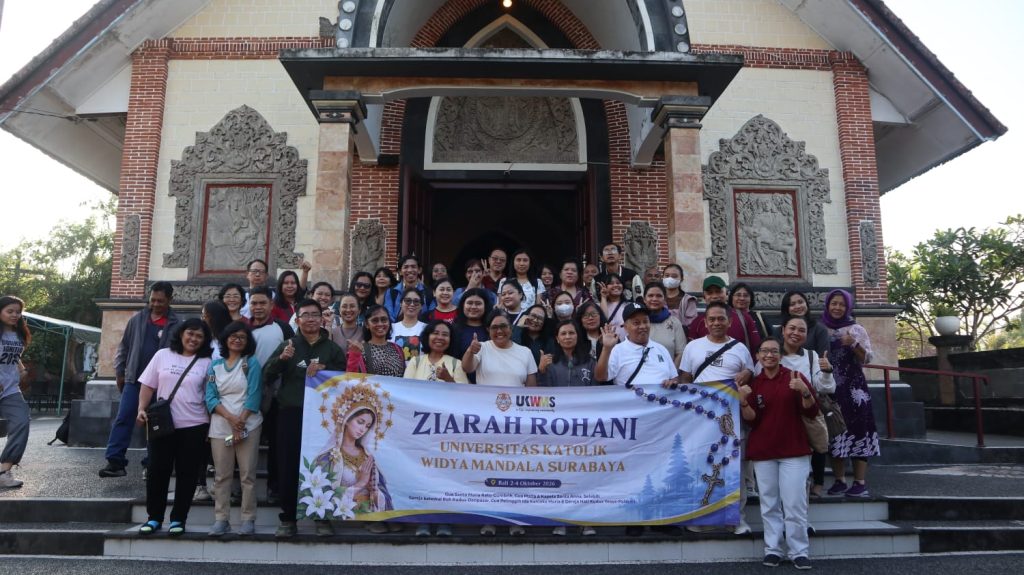
The pilgrimage, organized by a group from Widya Mandala Catholic University Surabaya (UKWMS) in East Java, took place Oct. 2–5 and included visits to the Marian Cave at Gumbrih, St. Anne’s Chapel in Selabih and the Marian Cave at Palasari in West Bali.
Putut had not joined a university pilgrimage for about eight years. For the former seminarian and lecturer at Widya Mandala Catholic University, the journey became an opportunity to rediscover pilgrimage as an experience of faith, memory, gratitude and prayer.
The group left Surabaya on Oct. 2 and traveled toward western Bali. Their first major stop was Gumbrih Parish Church, a small church about 150 meters from the Gilimanuk-Denpasar highway.
The church, which seats around 250 people, caught Putut’s attention because of its distinctive Balinese architecture.
Coming from Wedi Parish’s Gondangwinangun Station in Klaten Regency, Central Java, where the chapel already had a capacity of around 700 people when he left for Surabaya in 1988, Putut initially found the small parish church surprising.
But the simple building offered him a different lesson: a church is not defined primarily by the size of its building, but by the community that gathers there to pray, celebrate the Eucharist and live out its faith.
At the Marian Cave in Gumbrih, the pilgrims prayed the Rosary. One participant reminded the group that it was the First Saturday, traditionally observed as a special day of prayer for priests.
The pilgrims prayed for priests to remain faithful and steadfast in their vocation.
An unexpected encounter in Selabih
The group later traveled to St. Anne’s Chapel in Selabih, about six kilometers east of Gumbrih and several kilometers inland from the main Gilimanuk-Denpasar road.
After praying the Rosary, the pilgrims celebrated Mass presided over by Fr. Gunawan, the chaplain priest serving the university ministry.
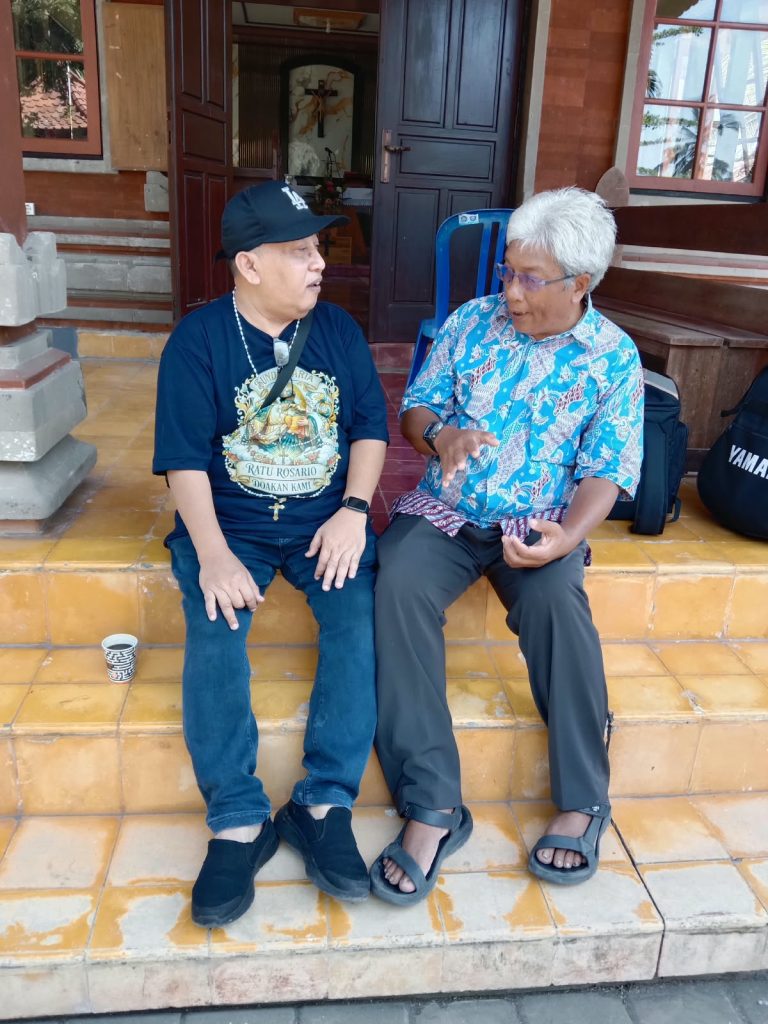
Before Mass, an elderly man with completely white hair gave an introduction about the chapel and its history.
As Putut listened, the man’s voice seemed strangely familiar. He could not explain why, and the feeling remained even after Mass.
While other pilgrims went to the Marian Cave, Putut sat at a resting shelter in front of the chapel and ordered a cup of hot coffee.
He then asked a woman serving the pilgrims whether the area had produced any priests.
“Yes, there are several,” she replied, adding that a priest from the area had died about 10 months earlier.
Putut asked for the priest’s name.
“The late Fr. Thomas I Ketut Suwitra OCSO,” she answered.
Putut was stunned. Fr. Suwitra was his former classmate at Mertoyudan Minor Seminary in Central Java from the KPP 1978 batch.
The woman then pointed toward the white-haired man who had spoken before Mass.
“He is Fr. Suwitra’s younger brother.”
The familiar voice suddenly made sense. The elderly man was the younger brother of someone with whom Putut had shared the daily life of seminary formation from 1978 to 1982.
What began as a visit to a Marian shrine had become an unexpected reunion with the memory of a friend from his youth.
Remembering a quiet Trappist priest
Fr. Thomas I Ketut Suwitra OCSO graduated from Mertoyudan Minor Seminary in 1982 before entering the Trappist community, officially known as the Order of Cistercians of the Strict Observance, at St. Mary’s Trappist Convent in Rawaseneng, Temanggung District, Central Java.
He was ordained a priest on Oct. 4, 2001.
He later served at a Trappist monastery in the Netherlands for more than three decades and was involved in efforts to establish new communities in Lamanabi, Flores Island in East Nusa Tenggara Province, and the Diocese of Ketapang in West Kalimantan Province.
Putut remembered him as quiet but highly intelligent, with a remarkable ability to learn languages. He spoke Balinese, Javanese and Indonesian, as well as Latin, English, Dutch and French, and possibly German.
For Putut, however, Fr. Suwitra’s most important identity was not that of a multilingual monk who had served in different parts of the world.
He was a friend and companion from the formative years of their youth.
Fr. Suwitra died while on leave in his hometown of Selabih. His body was laid to rest temporarily at St. Anne’s Chapel while his community waited for the arrival of his superior from the Netherlands.
The chapel stands on land connected to Fr. Suwitra’s extended family. Before it was built, Masses and Catholic gatherings in the area were held at his grandfather’s house nearby.
A long journey toward priesthood
The encounter also prompted Putut to reflect on the length and complexity of priestly formation.
Fr. Suwitra spent 19 years between graduating from Mertoyudan Minor Seminary and his ordination in 2001. His story reminded Putut that every vocation follows a different timetable.
He also recalled another seminary classmate who retired from a private-sector career after turning 60. Having previously completed a pastoral orientation period, the man returned to the Major Seminary and was eventually ordained a priest for the Diocese of Padang at the age of 63.
The man was Father Benny Margono, a former Jesuit and Trappist novice who later decided to become a diocesan priest of the Diocese of Padang.
Such stories, Putut said, show why Catholics should accompany priests and seminarians through prayer and friendship.
“Every person has their own time. Every vocation has its own path,” he said.
From religious tourism to a journey of faith
For Putut, the unexpected encounter gave the pilgrimage a deeper meaning.
Pilgrimage, he reflected, is not simply about traveling to a holy site, praying the Rosary, attending Mass and taking photographs. It is also an opportunity to stop amid the busyness of everyday life, remember God’s presence and recognize the people who have shaped one’s journey of faith.
Pilgrims often arrive with personal intentions, praying for health, family, work, healing or other needs. But pilgrimage can also become an occasion for gratitude — for life, family, friends, priests and religious who have accompanied communities through important moments.
In Selabih, Putut received an unexpected connection with his past.
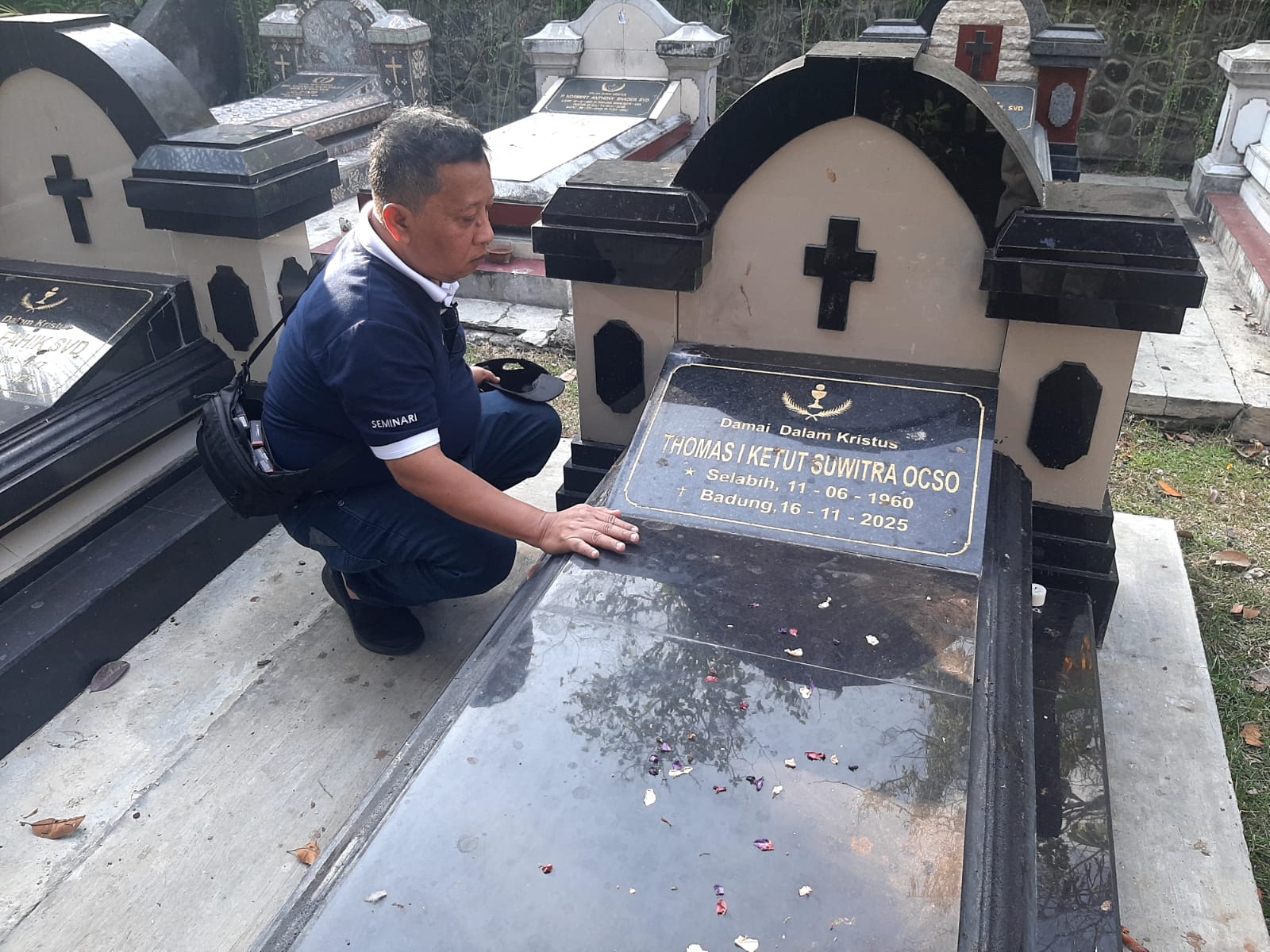
Before leaving the area, Fr. Suwitra’s younger brother, known as Mr. Tengah, asked Putut to visit and pray for the priest at the cemetery for priests of the Diocese of Denpasar beneath the Palasari Marian Cave.
Putut fulfilled the request.
Standing at the grave of his old seminary friend, he found himself confronted with another dimension of pilgrimage. The conversations, laughter and shared experiences of their seminary years were gone. What remained was prayer.
The pilgrimage had begun with a journey to Marian shrines. It ended with a prayer for a friend who had completed his earthly journey.
For Putut, the encounter was also a reminder to pray for priests throughout their lives of service and vocation.
“Let us continue to pray for and support the vocations of our priests. They, too, are pilgrims. We are all pilgrims,” he said.