
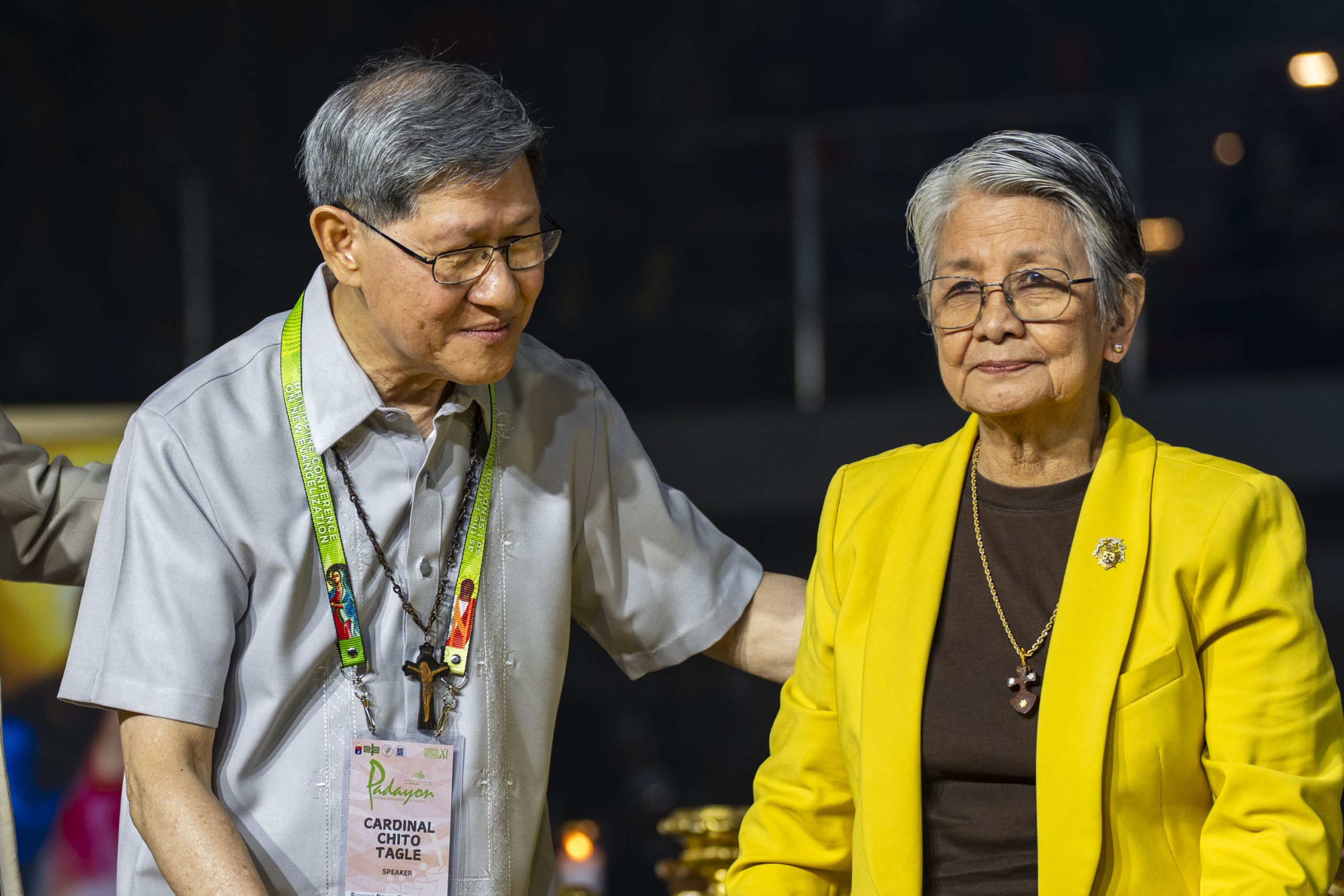
She is a mother shaped by silence, grief, and prayer—one who has spent eighteen years searching not only for her missing son, but for the meaning of justice itself.
“Before, when I said I sought justice, what I had in mind was revenge. The one who took my son should pay and be imprisoned. Before. But now, it’s a different perspective,” said Edith Burgos, mother of desaparecido Jonas Burgos.
What began as a cry for punishment has slowly transformed into a quiet but radical conviction that justice, at its core, must be an act of love.
“Justice is not about revenge. It’s about making sure that nobody else suffers. The suffering you go through—it’s so hard. And if that’s what you’re thinking about justice—to ensure that nobody else suffers—then you’re motivated by love while seeking justice,” she said.

Burgos, a member of the Secular Order of Discalced Carmelites, spoke those words at the 11th Philippine Conference on the New Evangelization (PCNE) held at the University of Santo Tomas in Manila, seated across Cardinal Luis Antonio Tagle.
Her voice was steady, her posture calm. Yet beneath the composure was a world of ache that had, over nearly two decades, turned pain into purpose.
Life in ‘suspended anticipation’
Her son, Jonas, was abducted on a Saturday in April 2007. That morning, he had told his mother he was stepping out to meet someone and would return for dinner—his favorite: fried lechon. Before leaving, he kissed her on the forehead, as he always did. It was the last time she saw him.
“It is not easy to be the mother of a disappeared person,” she told the audience.
Since then, Edith has lived in what she describes as “a state of suspended anticipation”—an anxious waiting that stretches endlessly forward.
Every tip about an unidentified body would send her and her son racing to remote morgues or crime scenes. Yet even when the corpse lying before them wasn’t Jonas, she could find no relief. Each mutilated body was still a child lost—still a mother’s grief.
“When you see the body, you cannot even rejoice that it isn’t your child. Why? Because the body is concrete proof of the cruelty of other human beings,” she said.
There were bodies with fingernails torn out, teeth smashed, eyes forced open in death. For Edith, these were not just victims—they were brutal reminders of what humanity is capable of.
To make peace with this cruelty, she wrestled not only with grief but also with her own beliefs. She found herself asking whether she could ever truly pray for the perpetrators—not just for Jonas and the other disappeared, but for those who had taken them.
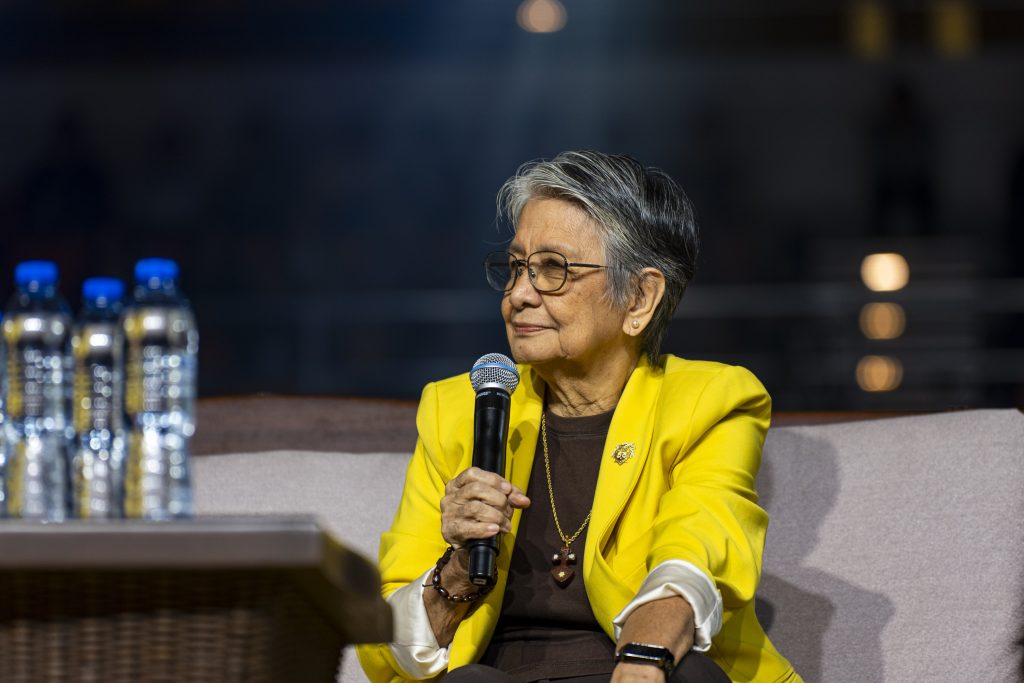
The inner conflict, she admitted, was immense. “Perhaps the most difficult act of all: ‘Will you pray not only for the disappeared but also for the perpetrators?’ That’s the conflict. It’s so hard.”
Even now, when she sees someone in uniform, fear takes over. For Edith and families like hers, those who should protect have become figures of threat. The institutions meant to uphold justice have, in her experience, perpetuated silence and impunity.
One such moment came when the Supreme Court ruled that Jonas had indeed been abducted, and issued an order to the Philippine Army to release him.
The ruling marked a rare judicial acknowledgment of state responsibility. But the military did not comply. No one was held accountable. The law, Edith said, is powerless when institutions refuse to act.
Jonas: Life rooted in compassion
Understanding Jonas means understanding the roots of Edith’s transformation.
As a young boy, Jonas already had a heart attuned to suffering. He would often give away his meals to neighbors who couldn’t afford food, and he’d offer his father’s shoes to vendors with worn-out slippers. When scolded, he would simply remind her that they were taught to give to those who lacked.
“Jonas would say to his Father, ‘Didn’t Mommy say, if someone is lacking, give more?’ That was how he grew up,” said Edith.
Later, he pursued agriculture, believing it was the best way to serve the country’s most marginalized sector—farmers.
He worked closely with rural communities, teaching them organic methods of cultivation and sustainable farming practices. Yet in a society where service to the poor is often met with suspicion, Jonas was labeled an insurgent.
To some military officers, his mother claims, his background as the son of a prominent press freedom advocate and his decision to live simply among farmers made him suspect.
That branding, his mother believes, led to his abduction.

Transformation through suffering
Before Jonas was taken, Edith lived a quiet life. A teacher by profession and a member of the Secular Order of Discalced Carmelites, she valued contemplation and simplicity. But after his disappearance, she was thrust into a world of investigations, protests, courtrooms, and international forums.
In 2025, she was elected president of the International Coalition Against Enforced Disappearances, representing over 40 organizations across continents. It was a role she never sought, but one she accepted as part of her mission.
“I never imagined this would happen in my life,” she said. “I was a simple public school teacher… I’m shy. I didn’t think something like this would happen.”
That mission also meant holding the hands of other mothers. She recalled being beside the grieving mothers of Sherlyn Cadapan and Karen Empeño—university students who were abducted and tortured.
When they finally learned the details of what their daughters had suffered, Edith was asked to be present—not to speak, but simply to hold their hands.
She also recounted meeting a man who survived 18 months of captivity in a military officer’s property, beaten daily with barbed wire and caged like an animal.
Despite testifying in court, he lost his case. She was there when the verdict was read and embraced him when he collapsed in anguish.
For Edith, these encounters are not coincidental. “We are sent to these circumstances because there is something good we can do,” she said.
Faith that stands its ground
Her journey has been accompanied by threats. She currently faces a perjury case, filed in retaliation for her petition to protect human rights defenders in the Visayas and Mindanao. Still, she continues.
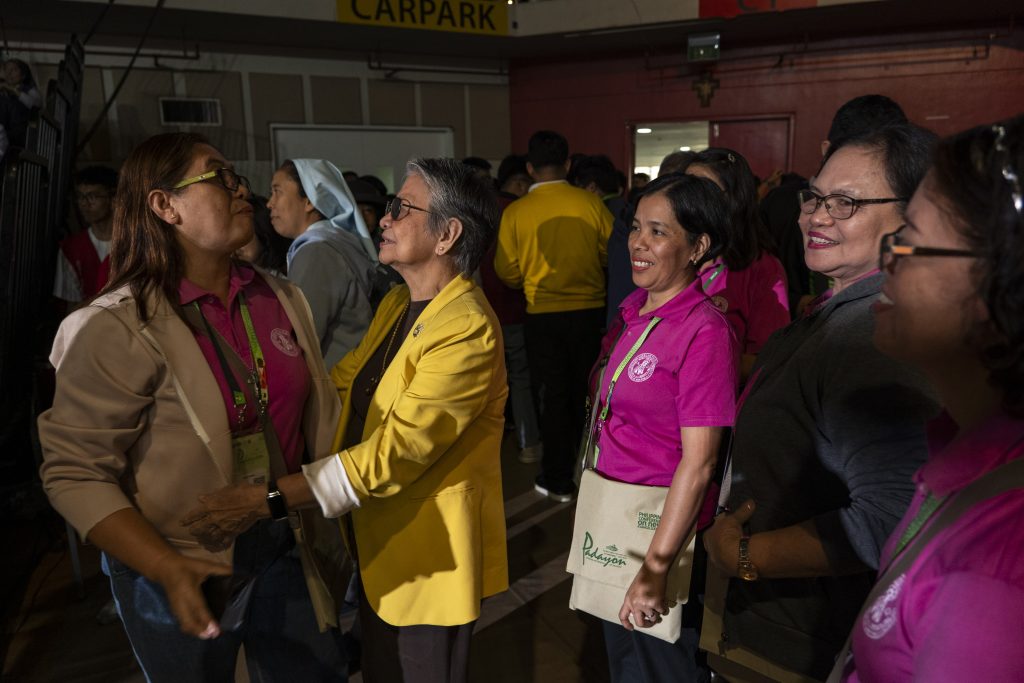
Lawyers have stepped forward to defend her. Religious sisters accompany her to court and on the streets. In them, she sees the presence of God.
Through it all, she remains rooted in contemplative faith, drawing wisdom from Henri Nouwen, her favorite spiritual writer. “The will of God,” she said, quoting Nouwen, “can be seen in the people He puts across your path and in the circumstances of your life.”
She no longer believes that justice is about retribution. She still raises her fist, and does so with resolve—but it is no longer just in protest.
“Yes, I still raise my fist. I am very good at that. But for me, it’s a way of convincing myself that I am doing the right thing,” she said.
That clenched fist now carries the memory of Jonas—and the conviction that love, not vengeance, must guide her steps.

Witness to hope
Reflecting on her story during the session, Cardinal Tagle, Pro-Prefect for the Section for First Evangelization and New Particular Churches of the Vatican’s Dicastery for Evangelization, noted that Edith’s long journey revealed something deeper than resilience.
It revealed love.
“Justice and love meet,” he said. “Justice and mercy meet.”
It is this integration that has come to define Edith’s life: a pursuit of justice that neither excuses wrongdoing nor replicates its cruelty.
“Love keeps her going,” Tagle continued. “And love keeps her gentle and beautiful.”
Edith agreed. She is a mother of a desaparecido, but she is also a mother who continues to love—ferociously, tenderly, and without ceasing.
Her grief has not subsided. Her questions remain unanswered. But in her voice, her hands, and her still-clenched fist, she carries a memory that demands to be honored—not through revenge, but through hope, mercy, justice, and truth.