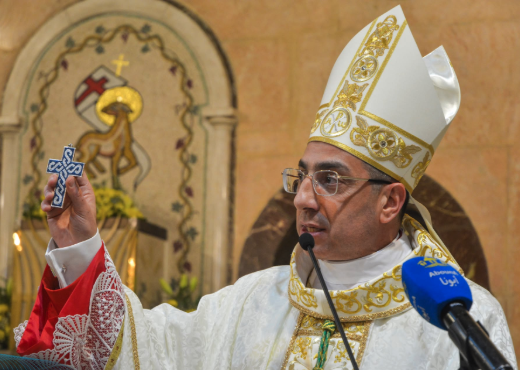
The two-state solution remains the “only solution, if there is a desire to live in peace and justice” in the Holy Land, according to Auxiliary Bishop Iyad Twal of the Patriarchal Diocese of Jerusalem of the Latins for Jordan.
In an interview with the Vatican’s Fides News Agency, Bishop Twal reiterated that the two-state proposal, “as indicated in the 1970s with UN resolutions,” is the only viable framework for peace.
“The alternative would be to build a state like in South Africa, that is, apartheid. But the land is very small. Either we live together, or there is no real solution,” he said.
The bishop expressed concern over the recent Israeli attacks against Qatar, where Hamas leaders had gathered for talks on a ceasefire and hostage release.
Twal described the incident in Doha as “bad news. Wars in the history of humanity are a tremendous evil, and we don’t learn. Every day we try to find hope, but unfortunately, events contradict us.”
He stressed that what might appear to be sabotage in the search for “a solution to the conflict” is also “a violation of international law. The entire world must understand that there is no justice for all in the Middle East and that we cannot continue living like this.”
Citing the words of Cardinal Pierbattista Pizzaballa, Latin Patriarch of Jerusalem, Twal said the devil and evil, “will certainly not win in the end.”
“We believe in justice and in God’s love for all of us. This gives us hope every day, despite the harsh reality we live in. We continue to pray and trust in the possibility of living together,” he added.
Twal acknowledged the difficulty of being in Rome while his people faced crisis at home. He said the experience was eased by the solidarity of fellow bishops, whose prayers and support reminded him of the Church’s universal character and family-like closeness.
Addressing the situation of Christians in Jordan, the bishop said they live “with profound pain. Our young people ask us: Where is God? It is an existential question that is also a temptation, but at the same time it is an opportunity to come closer to peace.”
He explained that Christians in the region “are called to live peace personally, to be witnesses of it in society. In Jordan, thank God, the Catholic Church is committed to this not only internally, but also with our Muslim brothers and sisters living in the country.”
The bishop described Jordan as “an oasis of peace, where we live in dialogue with everyone: from the king to the least of us, everyone tries to help. We have supported our Christian brothers and sisters in Gaza, the West Bank, and Palestine. The more we are disappointed by armed conflicts, the more we are committed to helping those who suffer.”
Reflecting on the religious and political dimensions of the conflict, Twal warned against using faith as a weapon.
“Religion in the Middle East can be an element of peace, but also of war. Here, religions are part of the problem and the solution. The challenge begins with the concept of the State: we have not yet managed to separate State and religion as in Europe,” he said.
Twal warned that as long as religious differences are framed in exclusive and absolutist terms, they will fuel fanaticism rather than peace.
He stressed that faith should inspire justice and respect for human dignity, not serve as justification for violence.
He cautioned that persisting in cycles of war and aggression would only ensure that hatred is handed down from one generation to the next, like a poisoned inheritance.