Cardinal Jean-Claude Hollerich, S.J., relator general of the Synod of Bishops, told Hong Kong Catholics that the essence of synodality lies not in organizational structures but in the Church’s mission to proclaim the Gospel.
“The whole synodality, the whole communion is for mission. It is in order to proclaim the Gospel. And this proclamation of the Gospel is the essence of the Church,” he said during his September 9 to 11 visit.
The Archbishop of Luxembourg, who served as a missionary in Japan for nearly 20 years, came at the invitation of Cardinal Stephen Chow, S.J., according to Sunday Examiner.
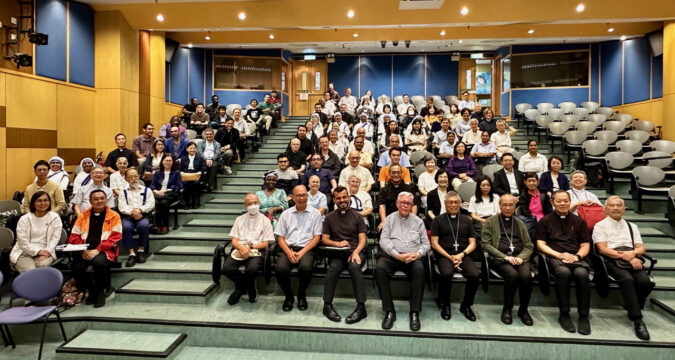
His three-day stay included two public talks at the Catholic Diocese Centre auditorium, organized by the Diocesan Ad Hoc Committee for Synodal Development under the theme “What Do We Mean by Synodality.”
Cardinal Chow opened the first session by expressing his joy in hosting the Jesuit cardinal, saying he would bring “valuable insights and practical experiences on how synodality is shaping the Church today.”
In his talk, Cardinal Hollerich described synodality as a spiritual and experiential journey rooted in listening — to both the people of God and the Holy Spirit.
He explained that it marks a move away from a “top-down” style of leadership toward a participatory model in which every baptized Catholic has a role in discernment.
He recalled Pope Francis’s close involvement in the recent Synod, noting that every decision was presented to him for review.
The pope, he said, trusted the Spirit’s guidance, often reminding participants that “the Spirit first creates a big mess” before leading to “a new harmony,” a process the cardinal compared to Pentecost.
Inclusive tent
Cardinal Hollerich admitted that the synodal journey has shown how some groups, particularly women, often feel excluded from Church discussions. “The tent has to be made large, so that all the people enter it,” he said.
Explaining the synodal process, which begins at the parish level and culminates in Rome, he stressed that its method of “conversation in the Spirit” does not aim at compromise through debate but at reaching “a new, inspired consensus” through prayerful listening.
Strict rules limited participants to one intervention each, a system that initially caused frustration but later ensured balance. The final documents, he added, were approved paragraph by paragraph with a two-thirds majority.
“Every Christian has gifts and charisms from the Holy Spirit for the building up of the Church, and these should be recognised and used,” he said, underscoring that synodality must always serve mission.
Local reactions and practical examples
Drawing from Luxembourg, the cardinal pointed to lay-led funeral services, multicultural pastoral councils, and parish finance committees as examples of how mission can be strengthened when responsibilities are shared.
Some priests, he admitted, struggle to hand over tasks, but the result is a stronger and more mission-oriented Church.
Dominican Father Fernando Muñoz Martin said the reflection was timely, noting that while prayers for synodality are offered at Mass, many Catholics still lack clarity on its meaning.
Father Aloysius Mak of St. Francis of Assisi parish added that the process is not about confusing clerical and lay roles but about discerning God’s will under the Spirit’s guidance.
Auxiliary Bishop Joseph Ha Chi-shing led the closing prayer of thanksgiving, asking for God’s blessing on the local and universal Church as it continues on the synodal path.
Engaging youth and facing challenges
Cardinal Hollerich said young people must be given greater space in the Church’s mission. “Young people are the ones who can proclaim the Gospel in their world. We have to be there for real people,” he said.
On technology, he cautioned against over-reliance, remarking: “I do not worry so much about the surplus of artificial intelligence. I worry about the lack of natural intelligence.”
He also pointed to Pope Francis’s efforts to ensure women feel fully part of Church life, while maintaining doctrinal boundaries on priesthood and showing openness to discussion on the diaconate.
Boldness and love
The Luxembourg cardinal encouraged Catholics to take risks and trust the Spirit. “You have to see, share, try. Sometimes you may fail, but time will prove what is truly from the Holy Spirit. We have to begin the dynamic—and love must always remain at the centre.”