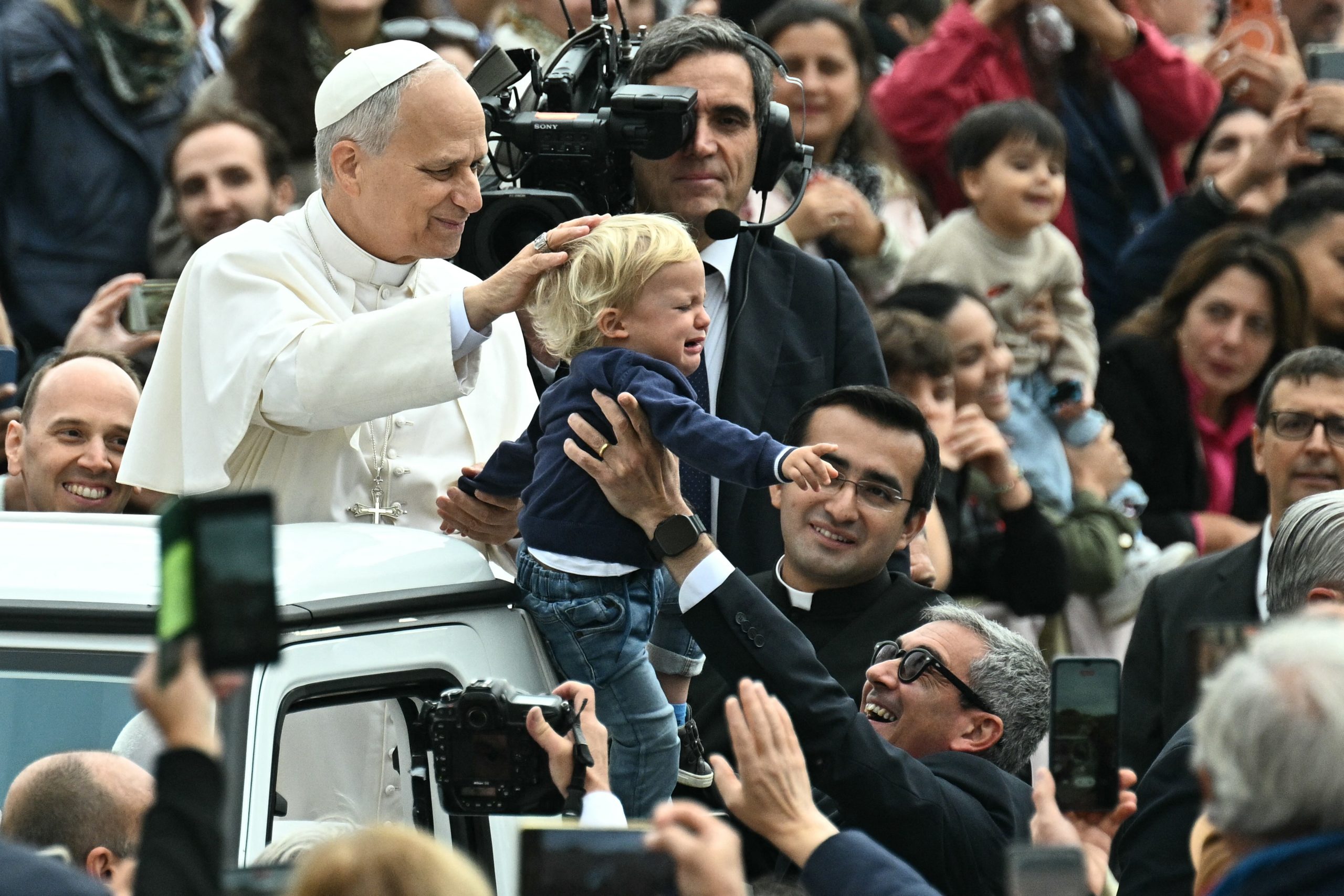
Pope Leo XIV said the “malaises of our time” include a pervasive sadness that robs life of meaning, urging the faithful to rediscover joy in the light of Christ’s Resurrection.
“Sadness accompanies the days of many people,” the pope said during his weekly general audience in St. Peter’s Square on Wednesday.
“It is a feeling of precariousness, at times profound desperation, which invades one’s inner space and seems to prevail over any impetus to joy,” the pontiff added.
He warned that such sadness “robs life of meaning and vigor, turning it into a directionless and meaningless journey.”
The pope’s reflection formed part of his catechesis for the Jubilee 2025 on “Jesus Christ our Hope,” under the theme “The Resurrection of Christ, the Response to Human Sadness.”
Journey through despair
Pope Leo turned to the Gospel story of the disciples on the road to Emmaus as a “paradigm of human sadness.”
He described the two disciples as “disappointed and discouraged,” leaving Jerusalem with “the hopes they held in Jesus, who has been crucified and entombed.”
“Their hope is dashed; desolation has taken hold of their hearts. Everything has imploded in a very short space of time, between Friday and Saturday, in a dramatic sequence of events,” he said.
The pope noted the paradox of their journey—walking away from Jerusalem on the very day of the Resurrection. “It seems that all is lost,” he said. “They must return to their former lives, keeping a low profile and hoping not to be recognized.”
At a certain point, he continued, “a traveller joins the two disciples… It is the risen Jesus, but they do not recognize him. Sadness clouds their gaze, erasing the promise that the Master had made several times: that he would be killed and that on the third day he would rise again.”
Quoting the Gospel of Luke, he said: “The text says that the two ‘stood still, looking sad’ (Lk 24:17). The Greek adjective used describes an all-encompassing sadness: the paralysis of the soul is apparent on their faces.”
Hope rekindled by the Risen Christ
Pope Leo said that Jesus’ presence on the road “allows them to unburden their disappointment.” Through Scripture, “he shows that Christ had to suffer, die, and rise again.”
“The warmth of hope is rekindled in the hearts of the two disciples,” he added. When Jesus “takes the bread, breaks it and offers it,” the disciples finally recognize him—but he disappears from their sight. “The gesture of the breaking of the bread reopens the eyes of the heart, illuminating once again the vision clouded by despair,” the pope said.
He described how “joy is rekindled, energy flows back into their weary limbs, and gratitude returns to their memory.” The disciples then hurry back to Jerusalem to proclaim: “The Lord has risen indeed.”
“In this adverb, indeed, the certain outcome of our history as human beings is fulfilled,” the pope said. “Jesus did not rise in words, but in deeds, with his body bearing the marks of his passion, a perennial seal of his love for us.”
From darkness to the Light of Resurrection
Pope Leo called on Christians to see the Resurrection as a transformative reality that changes one’s perspective on the world.
“It is the Risen One who radically changes our perspective, instilling the hope that fills the void of sadness,” he said. “On the paths of the heart, the Risen One walks with us and for us.”
“To recognize the Resurrection means to change one’s outlook on the world: to return to the light to recognize the Truth that has saved us, and that saves us,” the pope said.
He closed his catechesis with a call to vigilance and faith: “Sisters and brothers, let us remain watchful every day in the wonder of the Pasch of the risen Jesus. He alone makes the impossible possible!”