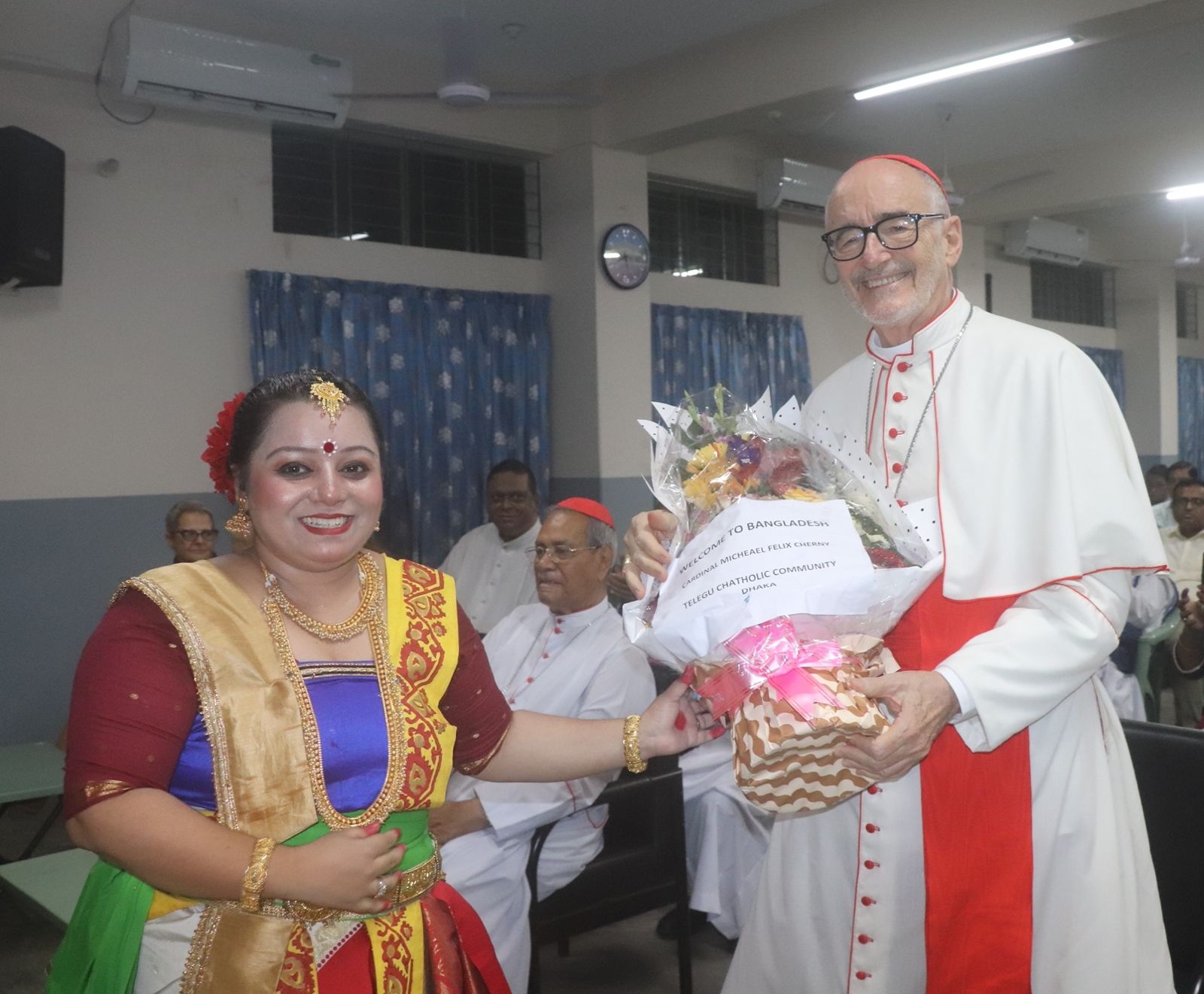
Cardinal Michael Czerny, prefect of the Dicastery for Promoting Integral Human Development, visited hundreds of displaced Christians in Modonpur, near Dhaka, urging them to keep faith and hope alive amid hardship.
On November 2, the Canadian-born Jesuit joined about 600 Christian internally displaced persons (IDPs) at the Peter Bhaban Credit Union Center in Narayanganj, where he prayed, listened to testimonies, and shared a simple meal.
The gathering, according to a report by Asianews, marked by hymns and stories of resilience, became a moment of spiritual encouragement for communities long struggling with insecurity and poverty.
“The pope’s representative came to us: he is a great source of inspiration,” said Ripon Halder, a 37-year-old factory worker and lay leader.
“He demonstrated that we can turn to God even in times of difficulty. Our lives as migrants are difficult. Sometimes we eat in the morning, but go to bed hungry at night,” he said. “However, it is possible to pray together, share the little we have, and educate our children.”
Cardinal Czerny arrived in Bangladesh on November 1 for a five-day pastoral visit—his first to the country, one of the most affected by migration and climate displacement.
He was welcomed with flowers at the residence of Archbishop Bejoy Nicephorus D’Cruze of Dhaka, who described his visit as “a blessing for the Catholic community of Bangladesh.”
“I believe he will encourage us to work more actively for inclusive human development,” Archbishop D’Cruze said.
Speaking to AsiaNews during the reception, Cardinal Czerny said, “I am very happy to be here in Bangladesh. This is a pastoral visit to meet the Church, its leaders, and above all the people it serves: migrants, street children, and those in need of God’s mercy and consolation.”
He added that his mission is guided by the theme of hope, in line with the Church’s Jubilee Year. “We are all pilgrims of hope,” he said. “I have come to see how the Church in Bangladesh is walking toward greater hope, and how the global Church can support this journey.”
In his homily during Mass, the prelate drew parallels between the experience of migrants and the Israelites’ journey through the desert.
“God, through his Spirit, guides and watches over every step of our journey, especially the most uncertain or difficult,” he said.
He reflected on what he called “three movements of the Holy Spirit”: “Our reaching out to others to bring salvation; God who bends down to fill us with love; and divine companionship on life’s journeys, silently and effectively guided by Him.”
For many families in Modonpur, those words resonated deeply. Father Ajit Victor Costa, who has accompanied displaced Christian families since 2017, said many migrants live with constant uncertainty.
“Those who leave their families behind live in anxiety and uncertainty. Those who bring their families with them often face discrimination in rented housing,” he said. “Wives and children, especially girls, suffer abuse at home, on the streets, and at school. Children’s education is also a major challenge.”
Cardinal Czerny’s itinerary includes meetings with the Rohingya refugee community in Cox’s Bazar, as well as encounters with street children, Indigenous peoples, and Church leaders.
He is expected to meet members of the Catholic Bishops’ Conference of Bangladesh (CBCB) and its Justice and Peace Commission, along with interfaith leaders.
Born in Czechoslovakia in 1946 and raised in Canada, Cardinal Czerny was created cardinal by Pope Francis in 2019. As prefect of the Vatican dicastery, he oversees global efforts on migration, climate change, poverty, and humanitarian crises.
His pastoral visit highlights the Church’s commitment to climate justice, ethical leadership, and social solidarity—issues that intersect with the struggles of millions in Bangladesh.
For Ripon Halder, the encounter brought renewed strength. “He taught us not to embrace drug addiction, not to use plastic, and to give our children a good education. His words were full of wisdom and love.”
As the cardinal continues his visit, his message echoes through Bangladesh’s migrant communities: hope and faith can endure, even in the face of displacement.