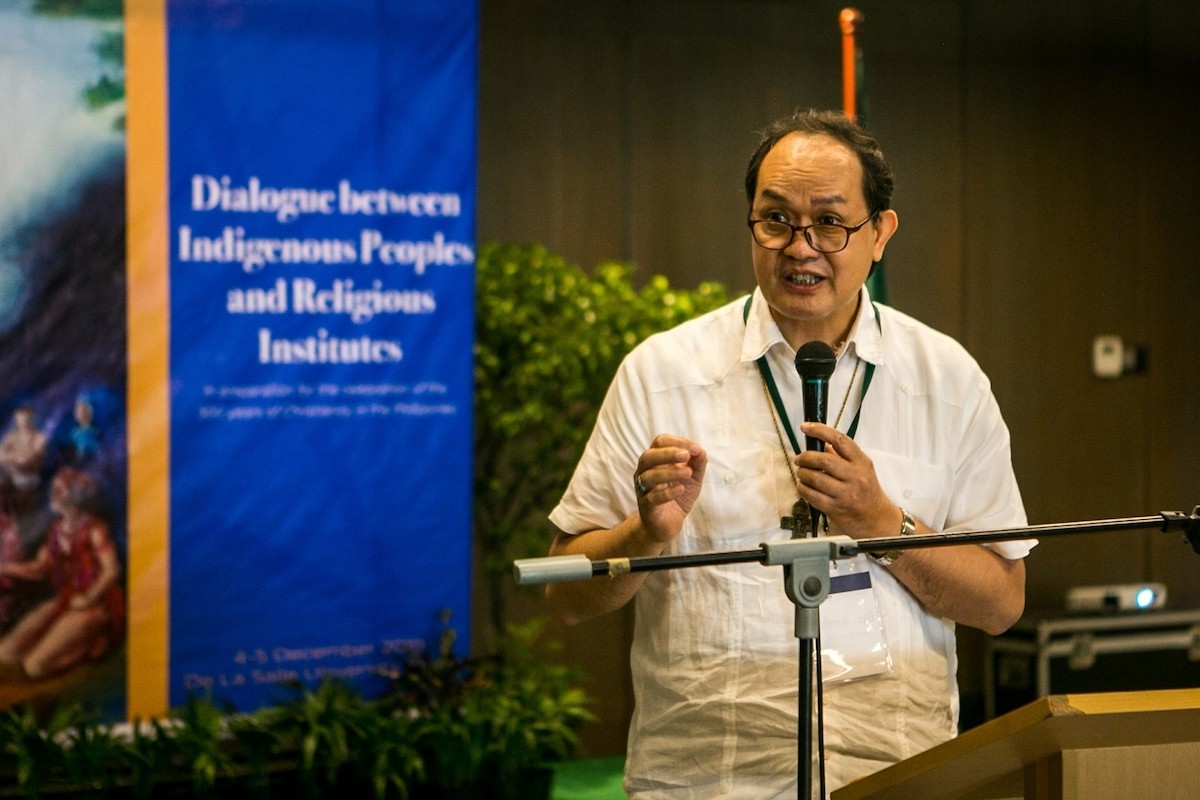
Cardinal Pablo Virgilio David of Kalookan has warned that the world’s obsession with urban progress is exacting a dangerous ecological and moral cost.
The prelate urged societies to “reimagine the city” before it collapses under the weight of its own excess.
In a reflection written for COP30 in Belém, the cardinal said that the modern metropolis—once celebrated as a triumph of human ingenuity—has become “the most visible embodiment of an unsustainable way of life.”
“While cities occupy only about 3% of the Earth’s land area, they account for over 70% of global carbon emissions and more than 75% of resource consumption,” he wrote.
“Behind every city skyline lies a vast hinterland—forests felled for timber, mountains mined for minerals, rivers dammed for power, seas overfished for protein, and rural regions depleted to feed the metropolis,” he added.
Cities built on extraction
Cardinal David said that urbanization, often justified as efficient, now reveals its ecological paradox.
“The logic of density—once justified as efficient—is now undermined by the ecological footprint of the urban lifestyle,” he said. “The city survives by drawing lifeblood from ecosystems far beyond its borders.”
He identified the “unsustainable engines of urban living,” including fossil-fuel dependence, overuse of concrete, and unchecked waste production.
“The urban rhythm—of rush hours and traffic jams—is not powered by renewable energy but by the combustion of ancient carbon,” he said.
“Cement production alone contributes 8% of global CO₂ emissions, yet concrete remains the default language of urban growth. The ecological irony is tragic: what shelters us also suffocates the soil.”
He noted that landfills across cities are overflowing with unsegregated waste that pollutes air and water, making garbage an unavoidable part of urban life—concealed only by distance and denial.
Fragile cities, unequal systems
The cardinal described today’s metropolitan lifestyle as “uniquely fragile in an era of climate disruption.”
“When typhoons, floods, or heatwaves strike, the very density that makes cities efficient becomes a liability,” he said.
“Power grids collapse, transport halts, water systems fail, and millions are left vulnerable in concrete jungles with little green refuge.”
He pointed to the looming dangers faced by coastal megacities, saying, “As sea levels rise, coastal megacities—like Manila, Jakarta, and Bangkok—face existential threats. The more we build upward and outward, the less resilient we become.”
Cardinal David also called the notion of urban prosperity “an economic illusion.” He said urban economies “accelerate both carbon emissions and social inequality,” leaving cities “as both the engines and the victims of the climate crisis.”
Toward regenerative futures
Calling for a “radical reimagining” of urban life, the prelate said cities must become “regenerative” rather than extractive.
He proposed replacing “linear ‘take–make–waste’ systems with circular economies,” transitioning “from fossil grids to decentralized renewable energy,” and redesigning “urban spaces to restore permeability, absorb water, and nurture biodiversity.”
“Urbanization is not inherently evil—but urban excess is,” he said. “The true challenge is not to abandon cities, but to humanize and naturalize them, allowing them to breathe again as part of the living Earth.”
A spiritual crisis of progress
For Cardinal David, the crisis of urbanization is not only ecological but spiritual. “At its core, the ecological crisis of urbanization is a spiritual crisis—the illusion that human progress can be built apart from creation,” he wrote.
Citing Laudato Si’, he reminded that “our common home is like a sister with whom we share our life and a beautiful mother who opens her arms to embrace us.”
“When we turn cities into fortresses of consumption, we estrange ourselves from both our mother and our sister,” he said. “A truly sustainable city must be one where communion replaces competition, where we recover a sense of balance, restraint, and reverence for the earth beneath our pavement.”
‘The choice before us is stark’
The cardinal warned that humanity is approaching a breaking point, saying urbanization—once seen as a triumph over nature—has become a stark reminder of the consequences of separating from it.
“The path forward is not merely technological but ethical: to transform cities from engines of extraction into communities of care,” he said.
“In the face of intensifying disasters and the looming threats of climate chaos, the choice before us is stark—either to reimagine the city, or to be buried by its ruins.”