
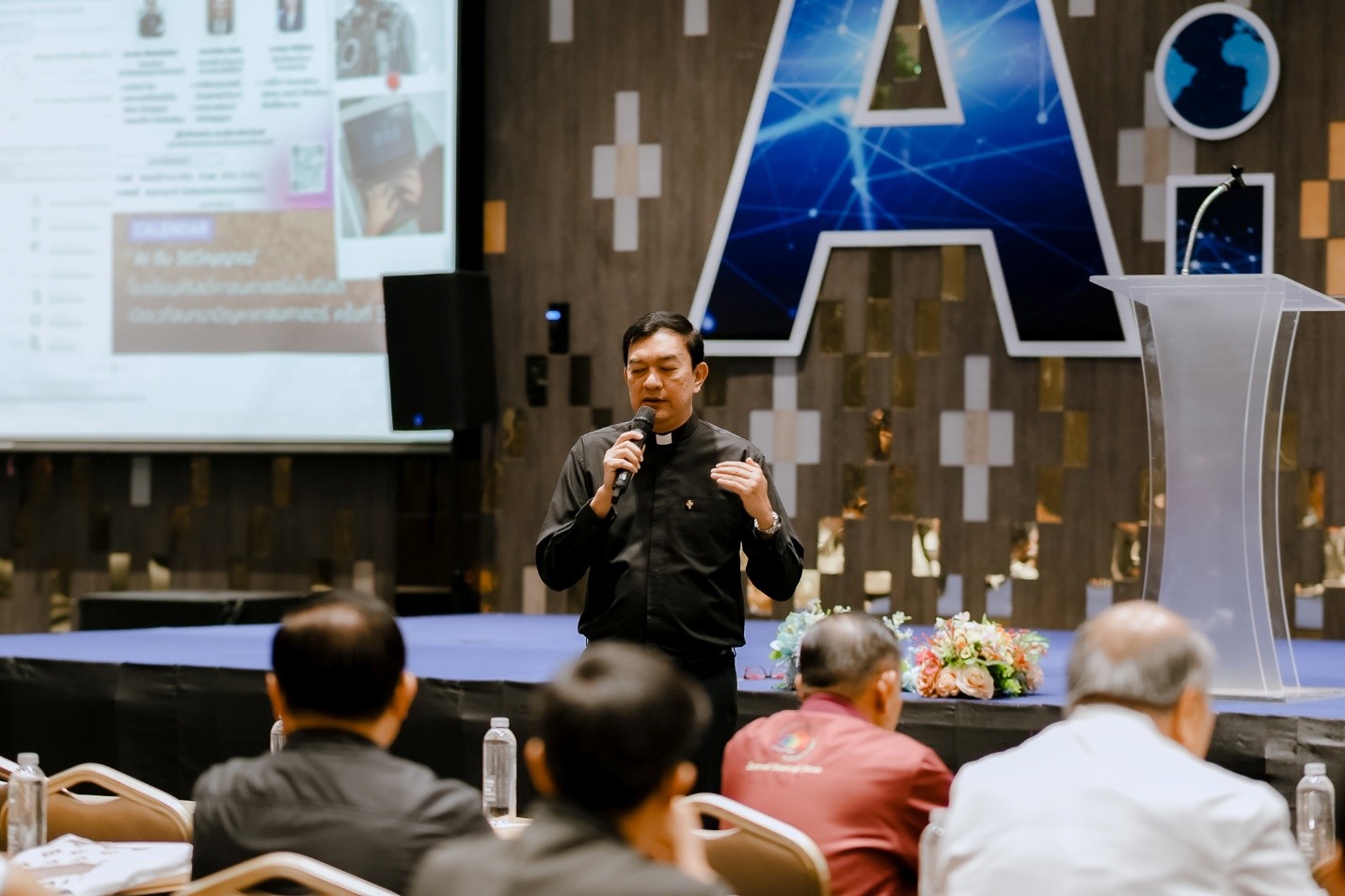
The Catholic Church in Thailand is asserting a proactive stance on artificial intelligence, grounding the digital revolution in human dignity and moral responsibility.
Nearly 200 priests, including five bishops and a delegation from neighboring Laos, gathered recently for their 2026 annual regional seminar in Nakhon Phanom province in the northeast, bordering Laos.
The central theme was not merely the technical utility of AI, but its ethical and spiritual implications, guided by the Vatican’s seminal document, Antiqua et Nova.
The seminar focused heavily on the joint guidelines from the Vatican Dicastery for the Doctrine of the Faith and the Dicastery for Culture and Education.

The document, Antiqua et Nova, serves as a compass for “those entrusted with transmitting the faith,” asserting that technological development must always serve the common good.
The main speaker, Fr. Joseph Anucha Chaiyadej, secretary general of the Office of Social Communication for the Catholic Bishops’ Conference of Thailand, delivered a poignant reminder to the clergy:
“Don’t let algorithms write your story; use technology to serve humanity.”
Drawing from the warnings of Pope Leo XIV, Fr. Anucha clarified the ontological gap between machines and the human person.
“Artificial intelligence does not possess true intelligence, consciousness, or comprehension,” he said. “AI is not the ‘subject’ but the ‘object.’ It has no conscience and no life.”
He described the tension as “statistics versus wisdom,” noting that while AI excels at averaging and predicting, the unique nature of human love and intelligence remains unpredictable and sacred.
A significant portion of the seminar was dedicated to the dangers of “truth decay” caused by deepfakes and digital “filter bubbles.”
Fr. Anucha warned that as fabrications become indistinguishable from reality, the foundational trust required for dialogue and faith begins to erode.
To address these risks, Fr. Anucha emphasized the need to shape AI as a protective “fortress” for humanity, guided by the principles of transparency, inclusion, and accountability, as reflected in emerging global AI ethics frameworks.
Transparency, he said, requires opening the “black box” of AI systems, particularly in high-impact areas, so that decisions can be understood and explained.