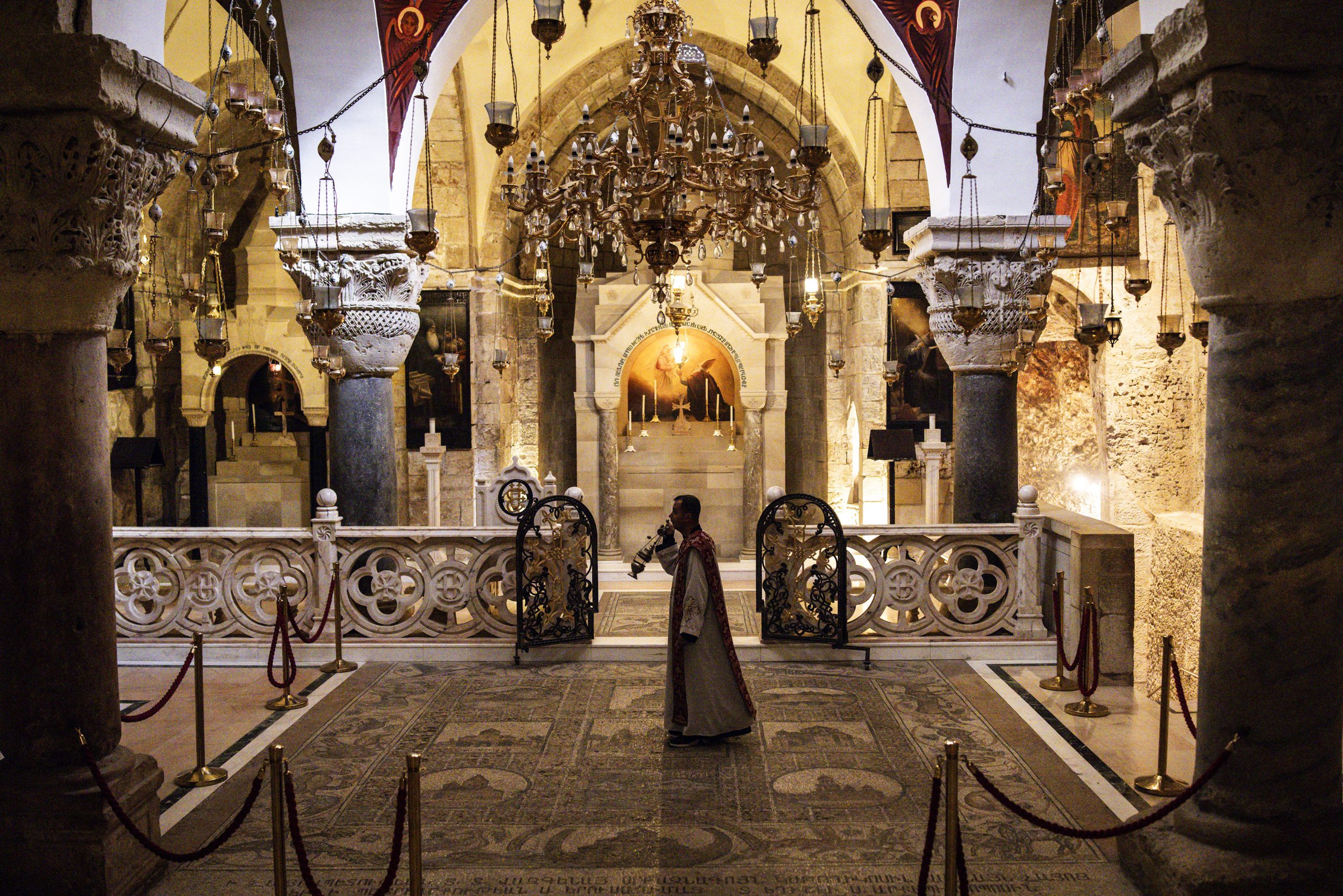
Israeli restrictions on access to the Church of the Holy Sepulchre have forced the cancellation of key Holy Week rites in Jerusalem, disrupting Easter preparations in Christianity’s holiest city.
The Church of the Holy Sepulchre is revered as the site of Jesus’ crucifixion and burial.
The measures, imposed amid escalating war conditions, have made traditional public celebrations impossible, according to a message from the Latin Patriarchate of Jerusalem.
Cardinal Pierbattista Pizzaballa, Latin Patriarch of Jerusalem, said that “due to the war,” the Church was “unable to experience the traditional Lenten journey in Jerusalem, with the solemn celebrations at the Holy Sepulcher and in the Holy Places of the Passion,” adding that while the faithful “were able to pray and prepare personally,” they “felt the loss of the community journey towards Easter.”
The prelate said conditions on the ground remain unstable, with no clear timeline for normal celebrations to resume.
The restrictions and recent developments “do not bode well for any imminent improvement,” he said, noting that Church leaders are now “evaluating how, in the ways to be agreed upon, we can celebrate the central Mystery of our salvation in the heart of our Churches.”
“The situation is constantly evolving,” he added, making it “not possible to provide definitive indications for the days to come,” while stressing that “ordinary celebrations open to all cannot take place.”
Among the affected rites, the traditional Palm Sunday procession from the Mount of Olives has been canceled and will be replaced by a prayer gathering for Jerusalem “at a location to be determined.”
The Chrism Mass on Holy Thursday has also been postponed, with approval from the Dicastery for Divine Worship.
Churches across the diocese will remain open, with priests instructed to encourage participation in the Paschal celebrations “in the forms and ways that are possible.”
The Patriarch described the disruption as a deep spiritual loss, saying the “harshness of this time of war” now carries “the added burden of not being able to celebrate Easter together and with dignity,” calling it “a wound that adds to the many others inflicted by the conflict.”
He urged the faithful to continue praying despite the restrictions, saying they “must not allow ourselves to be discouraged” and, even if unable to gather, “let us not give up prayer,” echoing the Gospel call to “Pray always and do not lose heart.”
Pizzaballa also called for a shared moment of prayer, saying he felt “the need to propose a special day” when the faithful, though separated, “feel spiritually united in prayer to find comfort.”
He invited communities to join a day of prayer on March 28, encouraging them to recite the Rosary “to implore the gift of peace and serenity, especially for those suffering because of the conflict,” expressing confidence that such prayer, even at a distance, can draw “upon the strength of God’s love, which unites us in a spirit of hope and trust.”
He said Easter remains a source of hope, reminding the faithful that “no darkness, not even that of war, can have the last word,” and that “the empty tomb is the seal of the victory of life over hatred, of mercy over sin.”
The disruption comes as international concern grows over the escalating war in the region, now in its fourth week with reported casualties exceeding 21,000.
China’s special envoy on Middle East affairs, Zhai Jun, called for an immediate halt to military operations, saying the war “should never have happened” and warning that continued fighting would deepen its impact.
“As the flames of the war continue to rage across the Middle East,” he said, “the global economy and trade are coming under severe strain,” warning that “once Pandora’s box is opened, the harm will be endless,” and that “if the fighting continues, there will be no winners,” with people in the region suffering most.
Despite restricted access, the Franciscan Custody of the Holy Land said liturgical life inside the basilica continues.
The Franciscan community “has never ceased, day or night, to carry out the scheduled celebrations, the rites, the daily processions, and the liturgical prayers,” the Custody said, adding that while access is limited for security reasons, “prayer continues unceasingly in the Holy Places.”
The friars said their presence carries the prayer of the wider Church, with their “centuries-old presence in the Holy Places of the Redemption” offered “in the name of the whole Church and for the good of all humanity,” especially in “particularly dramatic moments,” so that “a prayer for peace and reconciliation among peoples may continue to rise.”