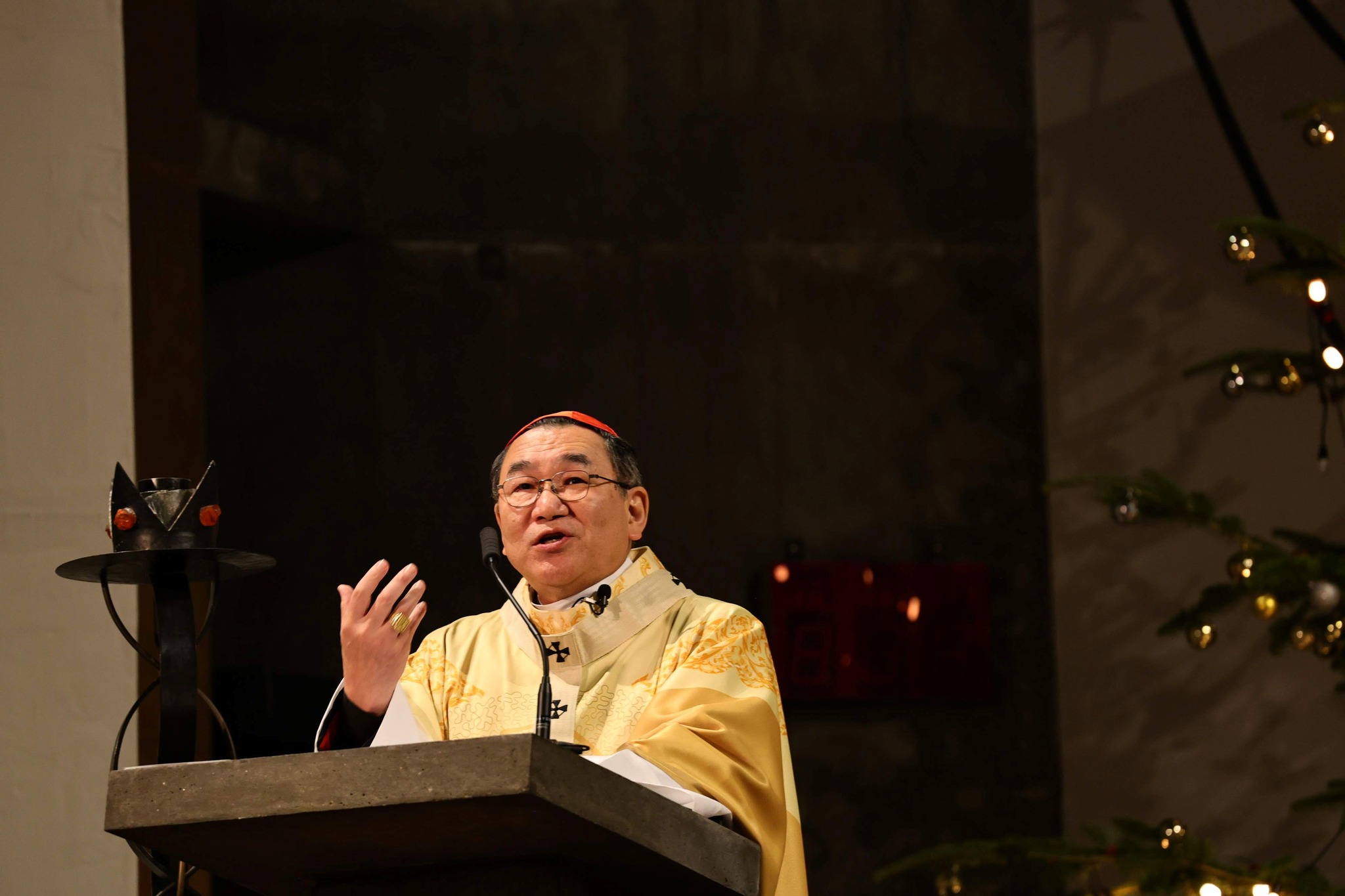
A Japanese cardinal has urged the Catholic Church not to remain passive as violence threatens human life and strips people of their dignity.
“We must not merely stand by and watch helplessly in the face of a raging storm of violence, but strive to continue sowing good wheat even more widely,” said Cardinal Isao Kikuchi in his reflection for the 16th Sunday in Ordinary Time on July 19.
The Archbishop of Tokyo used the Gospel image of wheat and weeds to describe a society where acts of compassion exist alongside violence, suffering, and disregard for life.
“The reality of modern society is exactly as the Gospel describes: good wheat, which God desires, and bad wheat, which is dominated by human desires, are growing together, mixed together,” he said.
Kikuchi said many people continue to accompany those in need and protect life despite the violence confronting society.
“Even amidst the reality of rampant violence against life, a gift from God, there are many who reach out to others in need and walk alongside them in order to protect that life,” he said.
He said the scale of violence and the threats facing human life could lead people to question whether God allows evil to prevail.
“The dominance of violence and the tragic reality of life, a precious gift, being in peril, are so glaringly obvious that one cannot help but wonder if God condones the existence of evil,” Kikuchi said.
The cardinal said the Gospel makes clear that God does not accept the domination of evil.
“The Father, the giver of life, does not tolerate evil dominating the world. He does not tolerate evil wielding its power,” he said.
Kikuchi said the Church’s mission is not simply to uproot what is evil, but to expand its witness through actions that protect life and uphold human dignity.
“Our mission is not to enter the fields and dedicate ourselves to pulling out the weeds,” he said. “Rather, it is to continue sowing good wheat even more widely so that it surpasses the weeds.”
He said Christians must recognize where violence and injustice are most widespread because those are the places where their presence is most urgently needed.
“For this reason, it is of great importance to know and point out where the weeds are,” he said. “For it is precisely where the weeds are rampant that we must sow good wheat.”
Citing the Second Vatican Council’s Pastoral Constitution on the Church in the Modern World, Kikuchi said the Church must stand with people whose lives are in danger and whose dignity has been taken away.
“The Church desires to reflect on and stand by each individual who, in the realities of modern society, faces a crisis of life, has their human dignity taken away, and struggles to survive,” he said.
Kikuchi said the Church has a duty to examine social realities in the light of the Gospel and speak for the common good.
“It is the Church’s duty to look at events in the realities of society that are hindering the realization of the world God desires, to read the signs revealed therein from an evangelical perspective rather than being swayed by what is happening, and to speak with the common good in mind,” he said. “That is our duty, necessary to overcome the weeds.”