
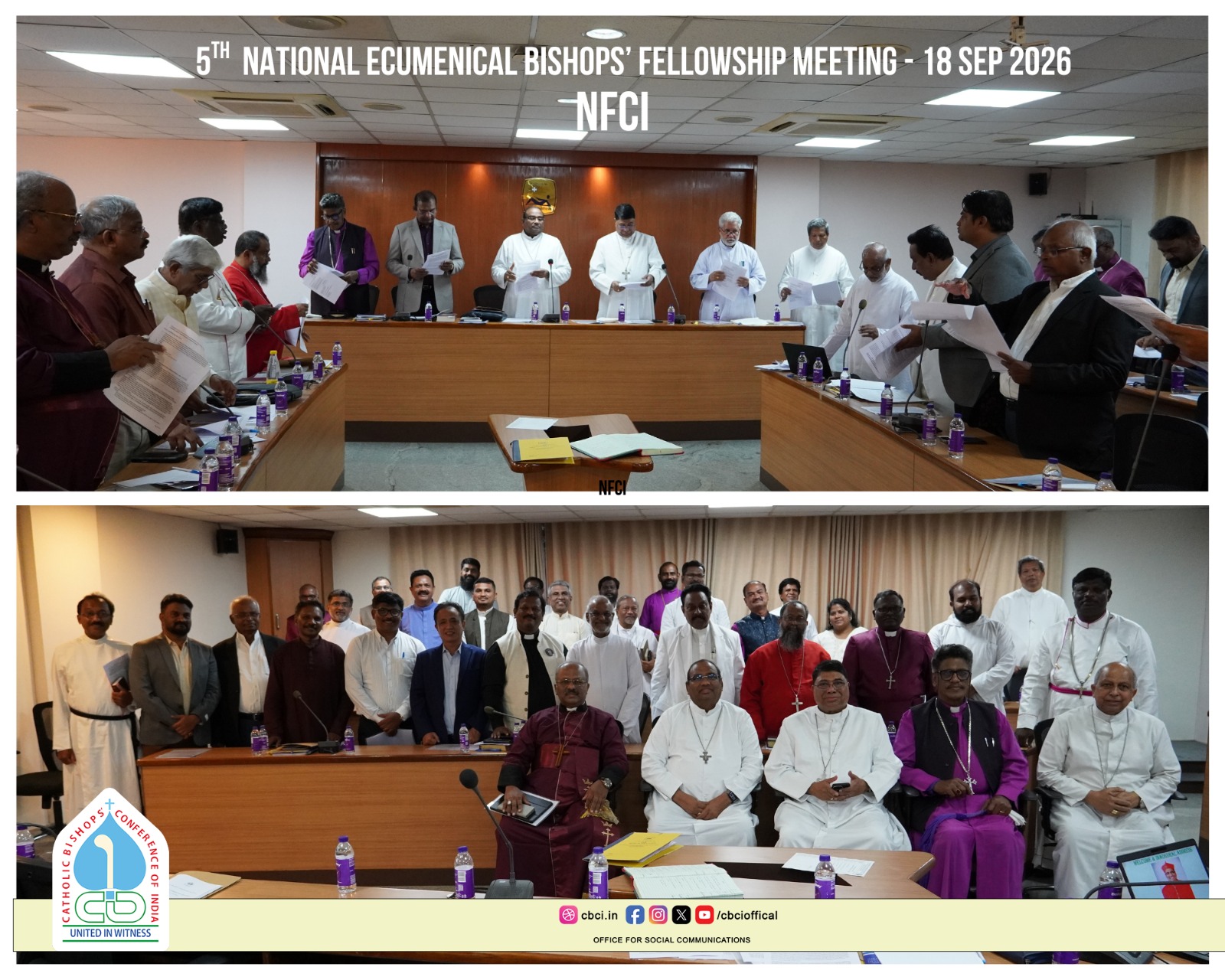
A newly formed federation of Christian churches in India has begun weighing a coordinated response to the FCRA Amendment Bill 2026, putting its call for greater Christian unity into action four months after its launch.
The National Federation of Churches in India (NFCI) discussed the proposed amendments during its first meeting Sept. 18 at St. John’s National Academy of Health Sciences in Bengaluru.
About 45 archbishops, bishops, church heads, and delegates from various Christian denominations attended the gathering, held alongside the fifth National Ecumenical Bishops’ Fellowship meeting.
Archbishop Joseph D’Souza, president of the Good Shepherd Church in India and the All India Christian Council and an NFCI convenor, proposed ways for churches to respond to the measure.
D’Souza suggested that churches submit a memorandum outlining their objections to the bill and urged the NFCI to seek a meeting with the Joint Parliamentary Committee considering it. The committee was holding its first meeting at the same time as the church gathering, according to the report.
The discussion came as church leaders sought to strengthen cooperation among Christian denominations in responding to legal and social concerns.
Cardinal Anthony Poola, archbishop of Hyderabad, president of the Catholic Bishops’ Conference of India and NFCI chairman, said churches were in “a critical situation facing many serious challenges and grave difficulties.”
The situation, he said, underscored “the urgent need of a united front to face them.”
Poola said the NFCI was launched during a fellowship meeting May 8. Membership is open to bishops and church heads of Christian denominations, including those belonging to other councils and synods.
“Indeed it is a gift of God for us for which we should be grateful to the Holy Spirit, the bond of love and communion,” Poola said.
Participants also discussed other issues affecting Christian communities in India.
Archbishop Peter Machado, chairman of the All Karnataka United Christian Forum for Human Rights, reported on efforts to meet Karnataka’s chief minister and Indian National Congress President Mallikarjun Kharge regarding the repeal of the anti-conversion bill.
Machado also briefed participants on a case pending before the Supreme Court concerning atrocities against Christians, churches and their institutions.
Father Anthoniraj Thumma of the CBCI Office for Dialogue and Desk for Ecumenism updated the gathering on a long-pending Supreme Court case concerning constitutional rights and equal status for Dalit Christians and on the Justice K.G. Balakrishnan Commission.
The meeting also formed an NFCI core group that can meet regularly and respond to current issues. It was authorized to co-opt members and appoint coordinators and executive secretaries who need not be bishops or church heads.
Bishop Mar Joseph Kallarangatt, chairman of the CBCI Office for Dialogue and Desk for Ecumenism and an NFCI convenor, said the federation’s formation was “a step towards the goal of full communion.”