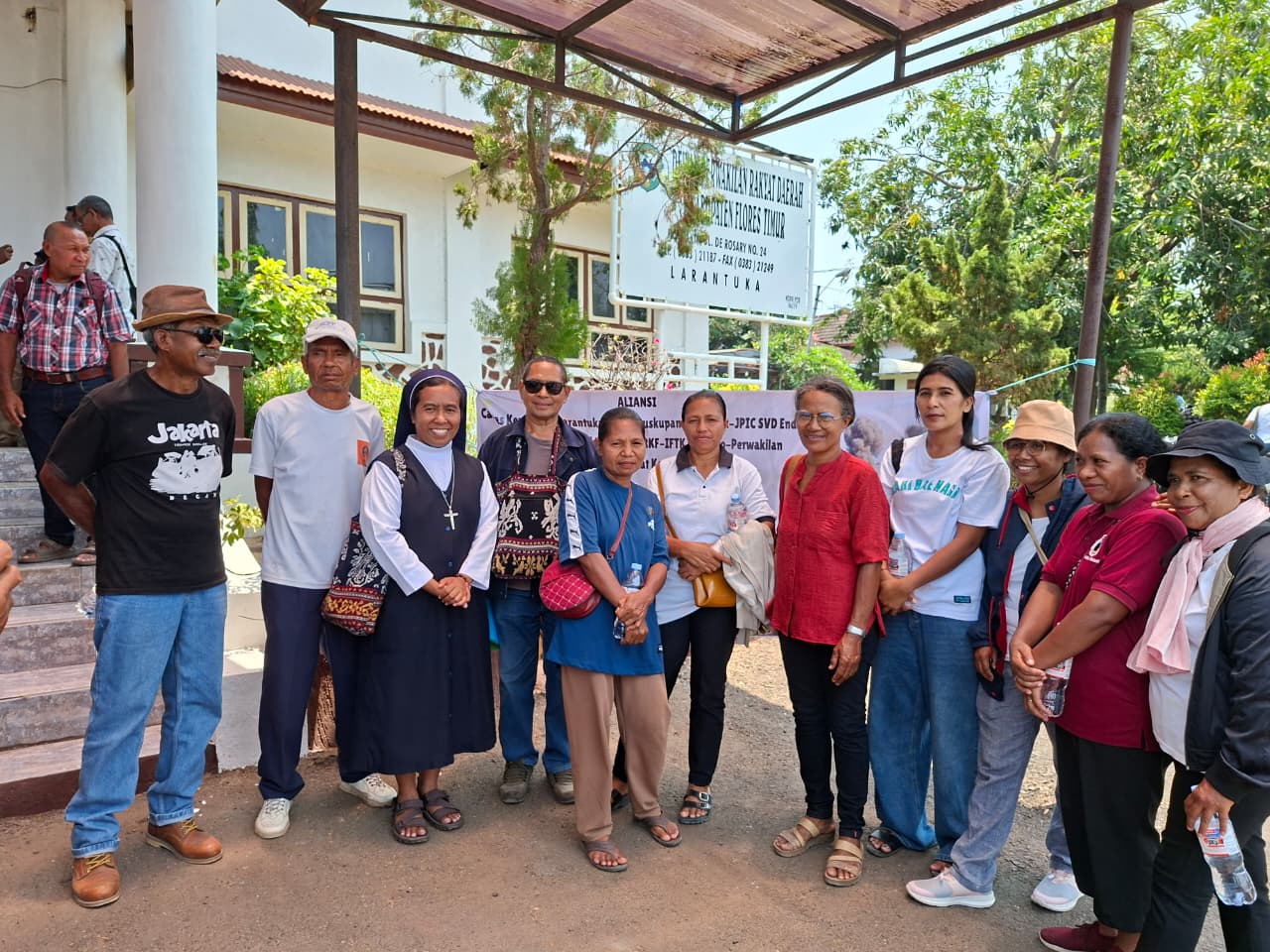
Father Ignas Ledot SVD, coordinator of JPIC SVD Ende in East Nusa Tenggara (NTT) Province, has joined calls for the government to provide permanent housing for residents affected by the eruption of Mount Lewotobi in Indonesia.
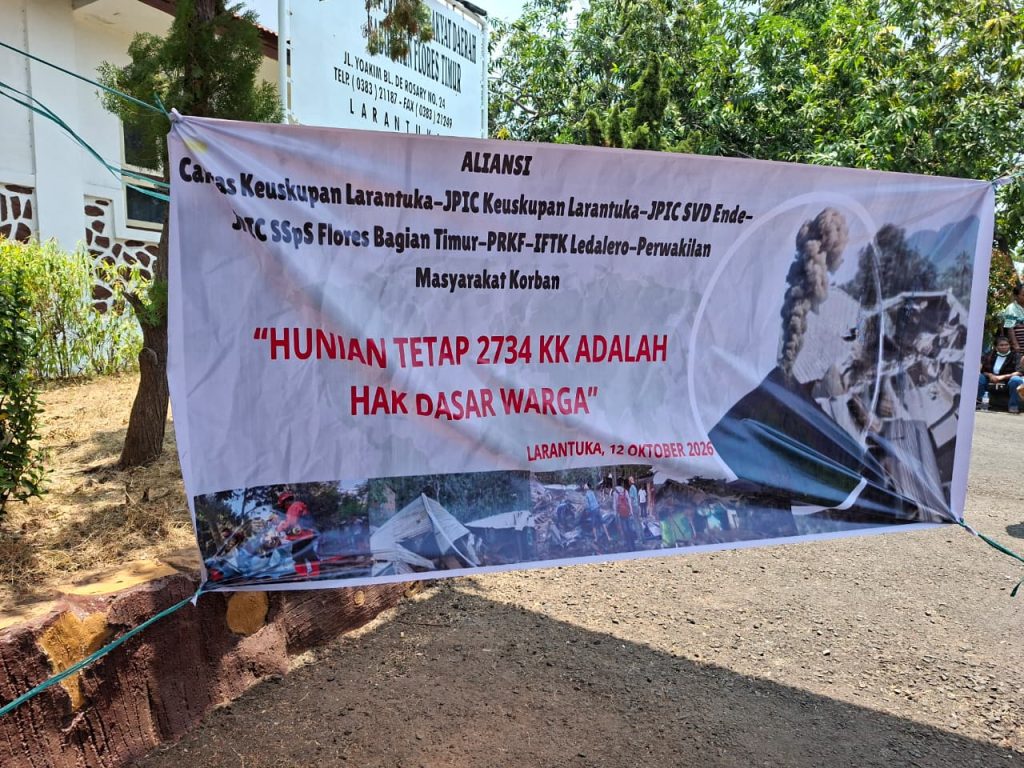
The appeal was issued by the Alliance of Stakeholders for Lewotobi Eruption Victims (Aliansi Bersama Pemangku Kepentingan untuk Korban Erupsi Lewotobi) in a press release dated Oct. 12, 2026.
The Alliance said permanent housing is a fundamental right that the government is obligated to fulfill.
“Permanent housing is a right, not an act of charity,” it said.
The group urged the East Flores Regency Government, together with provincial and central authorities, to take concrete, measurable and transparent steps to ensure that affected residents receive adequate housing.
According to data compiled by the Alliance through its advocacy work with displaced residents, 2,734 households, or about 10,295 people, continue to face difficulties securing adequate housing.
Some residents remain in temporary shelters, including in Konga, East Flores Regency, while others who have returned to their villages continue to live with damaged homes and disrupted livelihoods.
The Alliance said the situation showed that post-disaster recovery could not yet be considered complete and that protection should extend to both displaced residents and those who have returned home.
It said the situation was not only a matter of housing construction or budget constraints but also one of human rights, constitutional responsibility and social justice.
The right to adequate housing is guaranteed under Article 28H(1) of Indonesia’s 1945 Constitution and reinforced by Article 40 of Law No. 39 of 1999 on Human Rights and Article 11 of the International Covenant on Economic, Social and Cultural Rights, which Indonesia ratified through Law No. 11 of 2005.
Law No. 24 of 2007 on Disaster Management also provides a legal basis for protecting affected communities and meeting their basic needs.
The Alliance said the government’s responsibility should not end with evacuation, emergency assistance and temporary accommodation.
Recovery, it said, must continue until communities have access to safe and adequate housing and opportunities to rebuild their social and economic lives.
It acknowledged that permanent housing requires planning, safety assessments, secure land tenure and coordination among different levels of government, but said such challenges should not be used to leave residents without certainty for an extended period.
If administrative, land-related or budget problems arise, authorities should explain them publicly and provide a clear resolution plan and implementation timeline, the Alliance said.
The group also warned against overlooking residents who have returned to their villages.
Returning home, it said, does not necessarily mean recovery is complete because some families continue to face damaged homes and disrupted livelihoods.
The Alliance called for comprehensive data collection covering housing conditions, property damage, economic losses and household recovery needs.
It also urged the East Flores Regency Government to strengthen coordination with provincial and central authorities, including Indonesia’s National Disaster Management Agency (BNPB), ministries and other relevant government institutions.
The group said transparency over budgets, beneficiary eligibility, progress in permanent housing construction and implementation challenges was essential so communities could monitor how the government was carrying out its responsibilities.
It also called for representatives of displaced and affected communities to be meaningfully involved in decisions concerning their future.
The Alliance put forward six demands to accelerate post-disaster recovery in Lewotobi.
It called for a clear roadmap for permanent housing, including beneficiary data, housing locations, land status, funding sources, construction phases and completion targets.
It also sought comprehensive data collection covering both residents in temporary shelters and those who have returned home, including assessments of housing conditions, economic losses and disrupted livelihoods.
The group demanded transparency and accountability in budgets, beneficiary criteria, recovery programs and measures to address implementation problems.
It also called for protection and decent livelihoods for communities around Mount Lewotobi that have returned to their villages but continue to experience the effects of the disaster.
Affected residents, it said, should participate in decisions on housing locations, beneficiary criteria, construction and recovery programs.
Until permanent housing is available, the Alliance urged the government to ensure access to clean water, sanitation, health care, education and protection for vulnerable groups, while keeping open channels for dialogue on recovery agreements that can be jointly monitored.
The Alliance of Stakeholders for Lewotobi Eruption Victims comprises Caritas of the Diocese of Larantuka, JPIC of the Diocese of Larantuka, JPIC SVD Ende, JPIC SSpS Eastern Flores, PRKF, IFTK Ledalero and representatives of affected communities.
The Alliance said the involvement of Church organizations and humanitarian groups was not intended to replace the state’s responsibilities, but to accompany communities in defending their rights and pressing the government to fulfill its obligations.
It said the commitment was rooted in Christian faith, with human dignity, protection of vulnerable groups and the pursuit of justice at the heart of Christian witness.
The Alliance said cooperation among the government, the Regional People’s Representative Council (DPRD), Church organizations, civil society groups and community representatives could lead to humane and sustainable solutions, provided there were clear commitments, defined responsibilities, access to information and mechanisms for public accountability.
It urged the government to take immediate and tangible action so that survivors of the Lewotobi eruption are not left in prolonged uncertainty.
Fulfilling the right to permanent housing, restoring livelihoods and protecting affected residents, it said, must form part of the state’s commitment to restoring the dignity and future of these communities.