At a railway station in Mumbai, before dawn, a young migrant worker sleeps on a platform with a plastic bag beside him. He has left his village for a city that promises work but offers no certainty of shelter, wages or belonging.
For religious men and women, his sleeping figure asks a question that lies at the heart of consecrated life: who truly reigns in our communities, ministries and hearts?
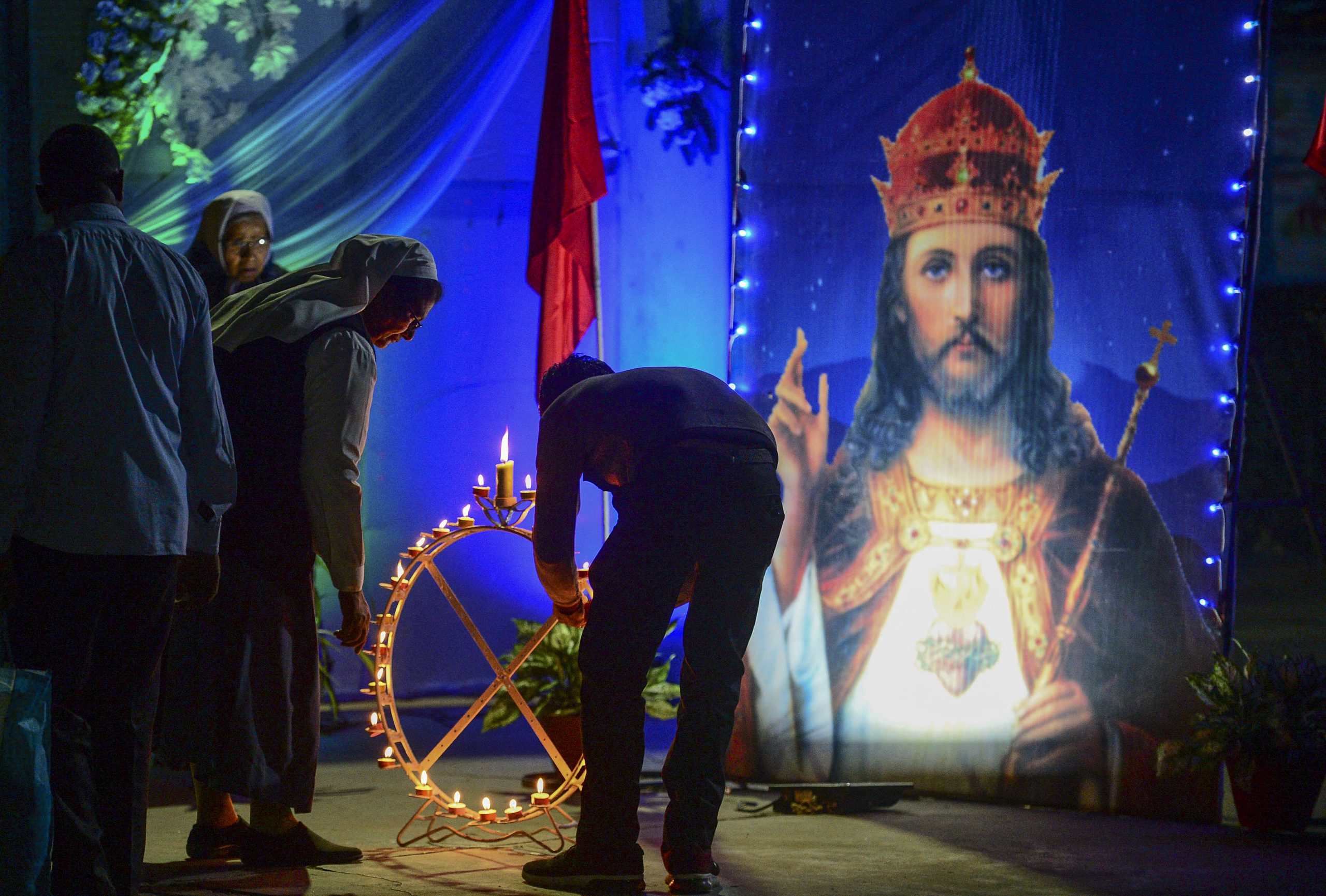
On the feast of Christ the King, religious people are invited to look again at the One they have promised to follow. Pope Pius XI instituted the feast in 1925, when nationalism, secularism and totalitarian ideologies demanded absolute allegiance. Its message remains urgent: no institution, superior, tradition, ministry, market or ideology has the final word over human dignity.
Yet the word “king” can mislead. In much of Asia, kingship evokes palaces, hierarchy and inherited power. Jesus does not fit that image. He reigns not from a throne but from a cross; not by coercion but by mercy; not through domination but through self-giving love.
A throne of wood
The Gospel for the Solemnity of Our Lord Jesus Christ, King of the Universe, places us at Calvary. Rulers sneer, soldiers mock, and one criminal taunts him: “Save yourself.” The other confesses his guilt and pleads, “Jesus, remember me when you come into your kingdom.”
Jesus replies: “Today you will be with me in Paradise” (Luke 23:42-43).
That is the whole grammar of religious life. Christ’s throne is a cross. His royal decree is forgiveness. His kingdom begins not with the defeat of enemies, but with the conversion of a heart. He does not abandon the guilty, the poor, the wounded or the forgotten; he draws them into mercy.
For religious men and women, this is not an abstraction. The migrant worker on the platform, the Dalit family denied dignity, the Rohingya refugee, the woman facing violence at home, the child out of school, the elderly person abandoned by family, and the community displaced by floods all stand where Christ stood: among the condemned, the excluded and the overlooked.
Christ’s kingship questions every structure that treats people as disposable, including structures within religious life.
Communities under Christ’s reign
Religious communities are called to be schools of the kingdom. But every community must ask: Who really governs us?
Is it Christ, whose authority is expressed in service? Or is it convenience, routine, fear of change, the desire to protect institutions, or the unspoken power of seniority?
A community may recite the Divine Office faithfully, yet remain divided by resentment. It may run impressive institutions, yet fail to listen to its youngest members. It may speak of poverty, yet live comfortably while those it serves struggle for daily bread. It may proclaim fraternity, yet exclude women, laity, migrants or those whose views disturb familiar certainties.
Christ the King does not ask religious people to deny these realities. He asks them to unmask them.
Consecrated life becomes credible when authority is exercised as service, when decisions are made with transparency, when younger members are genuinely heard, and when the poor are not merely beneficiaries of ministry but companions in mission.
Ministries that serve, not dominate
Religious men and women administer schools, hospitals, social-service centers, parishes, retreat houses, hostels and development programs. These ministries can be powerful signs of the kingdom. They can also become thrones.
There is the throne of the institution. When a school or hospital becomes primarily concerned with reputation, fees, expansion or control, it risks forgetting the poor for whom it was founded.
There is the throne of professionalism. Competence is necessary, but when efficiency replaces compassion, people become cases, numbers or clients rather than sisters and brothers.
There is the throne of religious identity. Faith can offer belonging, but it can also become a boundary that keeps others at a distance. When ministry serves only one’s own community, caste, class or tribe, it betrays the universal love of Christ.
There is also the quieter throne of the self: the need to be appreciated, the fear of losing status, the reluctance to share responsibility, or the temptation to mistake position for vocation.
Christ the King does not ask religious people to abandon institutions or professionalism. He asks them to place both at the service of love.
Power that washes feet
Jesus’ kingship is not a call to passivity. It is a summons to a different kind of authority.
At the Last Supper, Jesus washes the feet of his disciples. This is the model for every superior, formator, principal, administrator, parish priest, sister-in-charge and community leader. Authority in religious life is not a privilege to be enjoyed; it is a responsibility to be exercised on behalf of the weakest.
The feast was moved to the final Sunday of the liturgical year and renamed the Solemnity of Our Lord Jesus Christ, King of the Universe, emphasizing the cosmic scope of his lordship. Christ is not the chaplain of one congregation, ministry or institution. His kingdom transcends every religious habit, charism and boundary.
But precisely because it transcends them, it judges them.
Religious communities must ask: Do our institutions protect the weakest? Do our ministries leave room for the poor? Do we welcome strangers, people with disabilities, people with mental illnesses, those who are socially marginalized and those whom society considers unsuccessful? Do our leaders serve truth or protect reputation? Do we practice the power of Christ, the power to forgive, listen, heal and lift up?
The community’s examination
It would be dishonest to direct this question only at society. Religious life must ask whether Christ is truly on the throne within its own houses.
Do formators form disciples of the servant king or administrators of religious institutions? Do community meetings become places of honest discernment or rituals of silence? Do aging members receive dignified care, or are they quietly set aside? Do victims of abuse, exploitation and discrimination find justice and compassion, or are they asked to remain quiet for the sake of the institution?
Synodality, the Church’s commitment to walking together, listening deeply and discerning jointly, offers religious communities a practical path. It is not a political slogan. It is an attempt to make community life more transparent, participatory and faithful to the Gospel.
A religious community that proclaims Christ as King but practices clericalism, exclusion or silence contradicts its own vocation. A community that listens to the wounded and shares responsibility humbly becomes a sign of the kingdom.
Mercy as mission
Christ’s response to the good thief shows that mercy is not weakness. It is the most radical resistance to a world organized around revenge, rivalry and domination.
In communities and ministries marked by conflict, misunderstanding, hurt or historical wounds, forgiveness is often dismissed as naive. Yet forgiveness does not mean forgetting injustice or abandoning accountability. It means refusing to let hatred have the last word.
Christ’s reign forms religious men and women capable of truth without cruelty, justice without vengeance and courage without hatred. That is the spirituality religious life urgently needs.
The Cross also teaches religious where to stand. Jesus dies between two criminals, identified with the condemned. He remains present among migrants detained at borders, workers denied wages, women subjected to violence, minorities threatened by majoritarianism, and communities displaced by conflict or climate disasters.
To enthrone Christ is to recognize his face in them and to stand with them.
A kingdom still coming
This feast closes the liturgical year by pointing beyond history. Christ’s kingdom is already present in every act of mercy, truth and reconciliation; it is not yet fully visible in a world still governed by fear and violence.
That tension keeps religious men and women humble and hopeful. They do not build the kingdom by seeking influence, success or control. They witness to it by refusing the logic of domination.
So the question remains personal: Who is really on the throne in my community, my ministry and my heart?
Is it Christ, whose authority is expressed in service? Or is it my comfort, my ambition, my resentment, my fear or my desire to control others?
Christ the King does not promise religious men and women privilege. He promises them a cross, and with it, life. In Asia’s complex and wounded societies, the most credible witness of consecrated life will not come from large institutions or public influence. It will come from communities that make room for the poor, defend human dignity, practice forgiveness and serve without seeking to rule.
Only then will the world glimpse the strange kingship of Jesus: a throne made of wood, a crown of thorns, and a kingdom whose law is love.
John Singarayar, a member of the Society of the Divine Word, India–Mumbai Province, holds a doctorate in anthropology. He is the author of several books and a regular contributor to academic conferences and publications. His work focuses on sociology, anthropology, theology, philosophy, ecology, artificial intelligence, leadership, management, tribal studies, spirituality, and mission.