

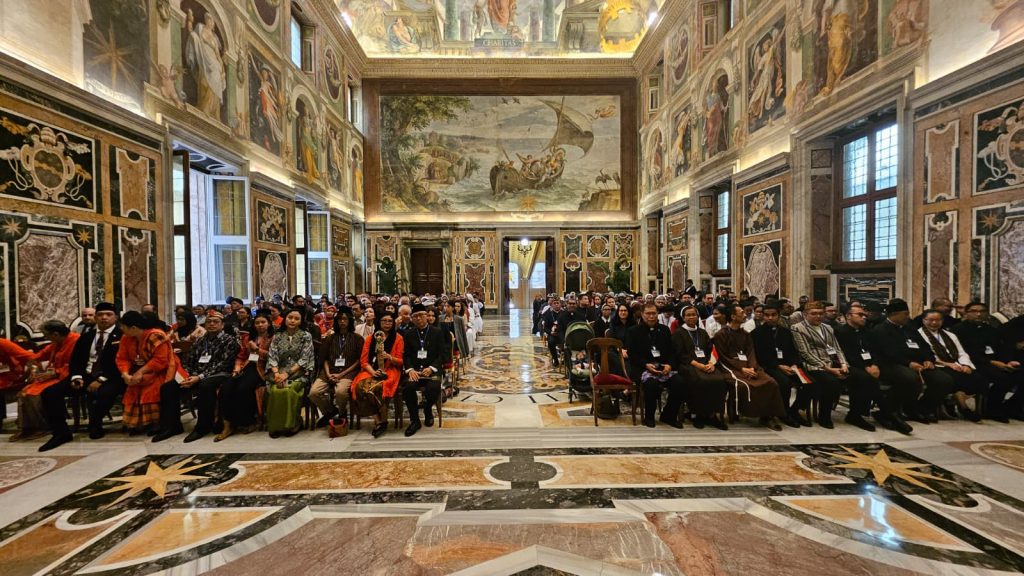
Pope Leo XIV stood before 200 Indonesians at the Apostolic Palace on September 22 and described their long-awaited meeting as a “historic” occasion for faith and unity.
The audience brought together members of IRRIKA, Rehat, and the extended community of the Indonesian Embassy to the Holy See for the first time.
It also marked the first anniversary of Pope Francis’ 2024 visit to Indonesia, the 75th anniversary of diplomatic ties between Indonesia and the Vatican, and the first occasion when all staff of the Indonesian Embassy, with their families, were formally received by a Pope.
“This audience is a sign of the good fruits of faith and unity,” Pope Leo XIV said in his address, delivered in English. He praised Indonesians abroad for their resilience, adding, “Even far from home, you maintain your vibrant traditions and care for one another.”
IRRIKA: A seven-decade presence
IRRIKA, the Association of Indonesian Religious Men and Women in Italy, has carried the witness of Indonesian Catholics in Rome for nearly 70 years.
Indonesian priests studying in the Eternal City founded IRIKA (Ikatan Romo-Romo Indonesia di Kota Abadi) on February 13, 1955.
The first leaders included Fr. Justinus Darmojuwono, later Archbishop of Semarang and the first Indonesian cardinal, along with Fr. J. Melsen O.Carm., Fr. Th. Kirdi Dipojudo O.Carm., Fr. Migeraya SVD, and Fr. Leo Soekoto SJ, who later became Archbishop of Jakarta.
As more Indonesian sisters and clergy arrived in Italy, the association expanded. In 1986, it became IRRIKA (Ikatan Rohaniwan Rohaniwati Indonesia di Kota Abadi), which reflected its broader membership of priests, brothers, and sisters across the country.
Today, IRRIKA counts 1,818 Indonesian religious men and women in Italy: 1,549 sisters and 269 priests or brothers. The majority, about 58 percent, live in Lazio, while others are based in Campania, Sicily, Sardinia, and other regions.
They serve in missionary work, leadership roles in religious orders, academic studies at Pontifical universities, service at the Holy See, teaching, and care ministries for the elderly and orphans.
Rehat: Leaders in generalates
Rehat represents Indonesian clergy and sisters serving in the generalates, or central houses, of their congregations.
The name “Rehat,” meaning “rest” in Indonesian, is not an acronym but describes their special service in leadership and administration.
Among them are Fr. Ag Purnama MSF, Superior General of the Missionaries of the Holy Family; Fr. Laurentius Tarpin OSC, Magister General of the Canons Regular of the Holy Cross; and Fr. Dwi Watun SMM, Superior General of the Montfort Missionaries.
Msgr. Paulus Budi Kleden SVD also served as Superior General of the Society of the Divine Word before being appointed Bishop of Ende in Flores.
Their leadership shows how Indonesian religious contribute to the global Church, extending beyond pastoral ministry to guiding international congregations from Rome.
Pope’s call to unity
The Pope recalled that the Holy See recognized Indonesia’s sovereignty as early as 1947, becoming the first European state to do so, before formal diplomatic ties began in 1950.
He pointed to Pope Francis’ Apostolic Journey to Indonesia in 2024, where interreligious dialogue culminated in the signing of the Istiqlal Declaration with Grand Imam Nasaruddin Umar.
Quoting Pope Francis’ words in Jakarta, he said, “Indonesian society weaves a ‘bond of unity’ when bound by a common desire for the good; indeed, preserving harmony in diversity is like a ‘work of art entrusted to each person’—a complex task.”
“I encourage you all to be prophets of communion in a world so often divided and provoked to conflict,” Pope Leo XIV said. “The path of dialogue—the path of friendship—may be challenging, but it bears the precious fruit of peace.”
He also urged Indonesians in Rome to embody Archbishop Albertus Soegijapranata’s call, saying, “One hundred percent Catholic, one hundred percent Indonesian.”
The pope entrusted them to the Blessed Virgin Mary, praying that they may always be “builders of bridges among nations, cultures, and religions.”
The Indonesian community first submitted a request for the audience during the pontificate of Pope Francis, but his illness and death delayed the gathering.
Cardinal Pietro Parolin, Secretary of State, later renewed the request, and Pope Leo XIV granted it.









