Indigenous residents of a coastal community in the western Philippines are fighting attempts to secure land titles over the lots where their homes stand, raising fears of displacement amid a dispute involving individuals allegedly linked to a private development company.
Cuyonon, Kagayanen and Palaw’an residents of Sebaring village on Bugsuk Island in Palawan province have filed protests with the Department of Environment and Natural Resources (DENR) against free patent applications covering several lots.
Bulatlat.com reported that the applications were filed by Patricia Bianca Chio, Weizenfluh Navarro and Genevieve See. Legal documents cited by residents also named Rodrigo Salo-Ay as Navarro’s co-claimant, although his name did not appear in the DENR notices.
Romilano Calo, chairperson of the Sambilog – Balik Bugsuk Movement, which has been assisting the residents, said the four are supposed affiliates of Normal Holdings and Development Corporation.
Residents said they had never seen any of the four living in Sebaring.
The dispute centers on Lots 4625, 4626 and 4628, where Indigenous families have lived for years after the shoreline expanded. Hannah, not her real name, an Indigenous Kagayanen resident, said the Gabinete family subdivided and sold the land to residents in 2002.
Normal Holdings and Development Corporation purchased the mother title of Sebaring from the Gabinete family in 2018. Bulatlat reported that the deal did not include the islanders’ homes.
Residents filed their first verified protest against the free patent applications at the DENR office in Brooke’s Point on Feb. 11, 2025, but it was rejected after officials required a Certificate of File Action from the village government.
They filed another protest on March 28, when the DENR required them to prove their occupation of the disputed lots.
An ally of the residents identified only as Alex said the refusal of the village government to issue Certificates of Residency to some community members complicated their case. He said there was no direct evidence linking the village chief to the land dispute but accused the local government of failing to perform its duties.
Residents said they have had to raise their own money for fuel, notarization, printing and other expenses related to hearings and documentary requirements.
During a DENR–Community Environment and Natural Resources Office hearing in Brooke’s Point on July 23, Hannah and about 46 other residents were offered a settlement.
Hannah said she felt officials were pressuring them to accept a compromise agreement that included a waiver of protests and a quitclaim. She refused to sign because she said the proposed relocation lacked sufficient explanation and documentation.
“They wanted to remove us from the site where our house is already standing […] The plan was for us to be relocated, and—per the agreement made with the DENR—a licensed geodetic engineer was supposed to visit to assess the property and calculate the costs. The problem is, the relocation plan never materialized, nor did the valuation of our house,” she said.
Hannah said the proposed relocation site was Lot 4625, which is also covered by the free patent applications. Fourteen other residents at the hearing declined to sign the agreement because of similar concerns.
Residents have also accused security guards of harassment amid the land dispute.
Hannah said guards from the Lab Security Agency were first deployed in 2024 and have repeatedly asserted that residents’ homes belong to Jong Balbon, identified by Bulatlat as the supposed executive vice president and general manager of Normal Holdings and Development Corporation.
On Aug. 29, guards attempted to enter the home of Indigenous Palaw’an resident JV Gabong, who had also refused to sign the agreement.
The guards reported Gabong to the DENR, accusing him of using freshly cut trees to build a new house. Bulatlat reported that DENR personnel who inspected the site found the accusation false and allowed him to continue renovating his kitchen.
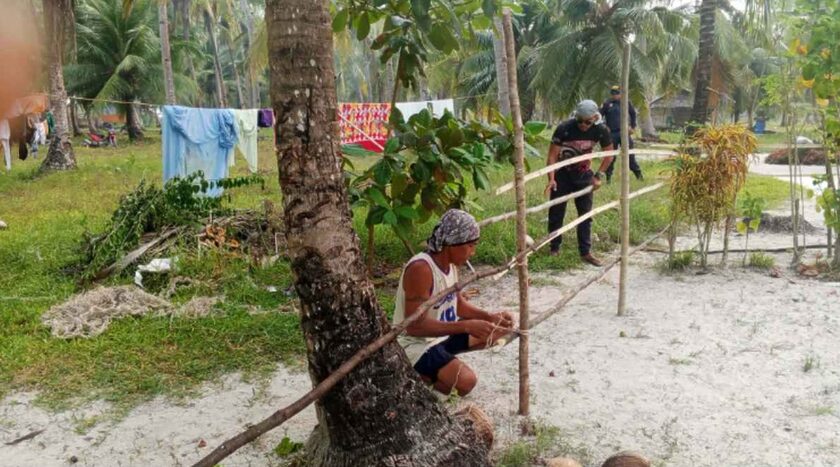
Residents also said barbed-wire fencing erected by Normal Holdings and Development Corporation and its affiliates has blocked customary pathways across the island.
In Sitio Binasag, a sub-village of Sebaring, the fencing has forced residents to walk along the beach, where seawater can rise to waist level during high tide.
Following the failure of the compromise agreement in Brooke’s Point, the community’s case was elevated to the DENR–Provincial Environment and Natural Resources Office, according to Calo.
“The reality is that we go unnoticed because we are located in such a distant area. The government remains unaware of what is happening to us Indigenous Peoples… Here in Palawan, when we seek help, it feels like we have no hope. I am appealing for someone from the national government to come down and inspect the area so they can see the actual situation of the tribes,” Hannah said.
The community is awaiting a response to its DENR protest and its appeal for national government intervention.