
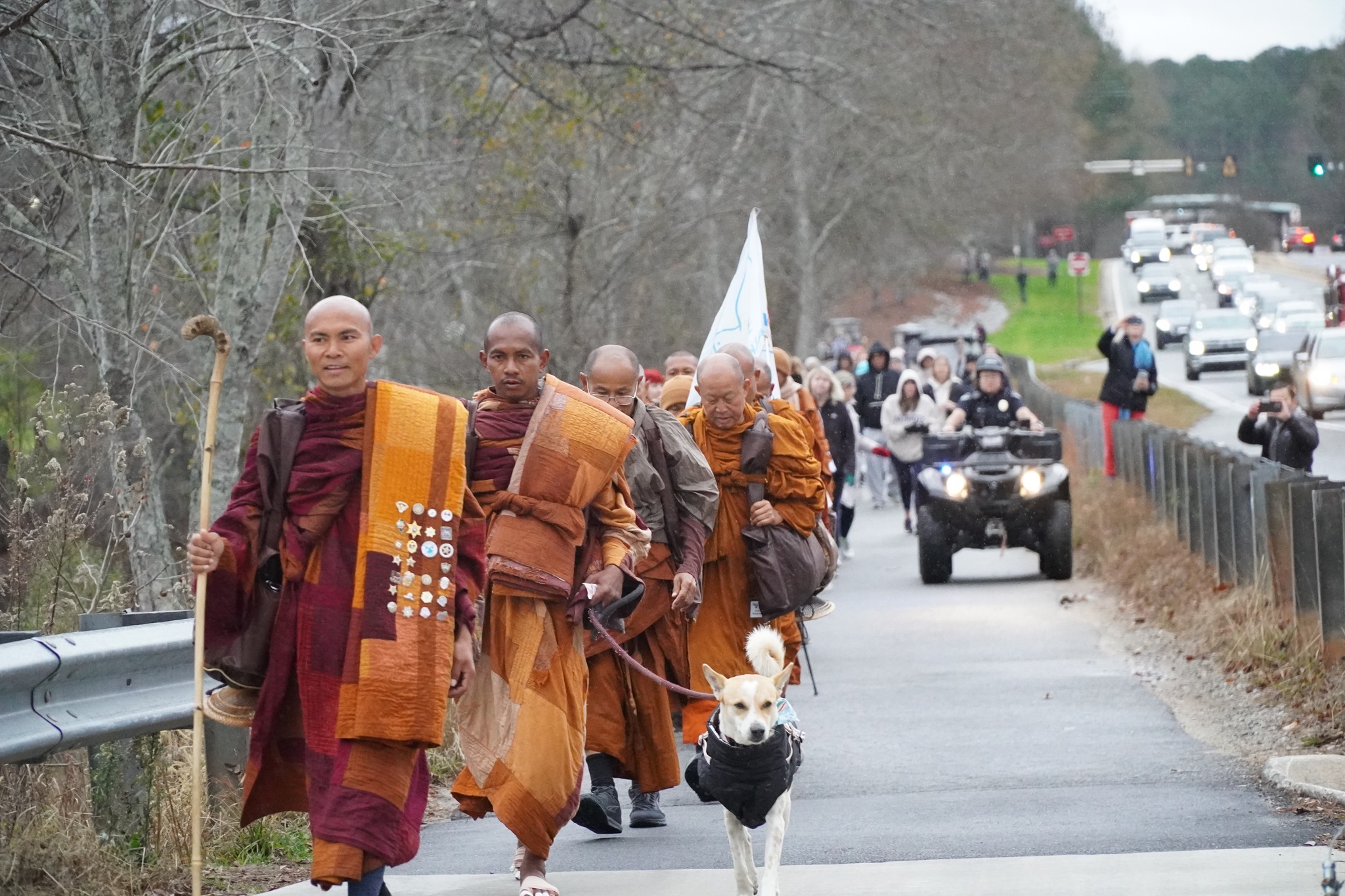
In an age often defined by digital noise and social division, a quiet procession of saffron robes is offering a powerful counter-witness across the American heartland.
A group of 24 Buddhist monks is currently nearing the final leg of a 2,300-mile “Walk for Peace,” a 120-day spiritual pilgrimage that has transformed from a simple trek into a moving tapestry of interfaith harmony and radical forgiveness.
The journey, which began in October 2025 in Fort Worth, Texas, and is slated to conclude in the nation’s capital in February 2026, has drawn the attention of Christian communities and civic leaders alike.
For the monks, representing Southeast Asian traditions from Thailand, Laos, Taiwan, and Vietnam, the mission is not a political demonstration but a “prayer in motion” aimed at healing cities burdened by histories of violence.
A sacrifice for peace
The pilgrimage took a somber but profound turn on Nov. 19 in Dayton, Texas. While the group was being escorted by local authorities, a pickup truck struck a police vehicle, which in turn hit one of the Thai monks, Phra Ajarn Maha Dam Phommasan. The accident resulted in the monk losing his leg.
In a display of grace that resonates deeply with the Christian virtue of “turning the other cheek,” Maha Dam responded not with litigation or anger but with an offering of his suffering.
“Losing a leg is a sacrifice I don’t mind making if it helps spread peace, love, hope, compassion, harmony, and kindness,” Maha Dam told WSB-TV from his hospital bed.
For Catholic observers, his words echo the theology of redemptive suffering.
“To see such a radical embrace of a personal tragedy for the sake of a greater communal good is a profound witness,” said a lay member involved in interreligious dialogue in Bangkok. “It reminds us of the Beatitudes in action.”
‘Culture of encounter’ on the road
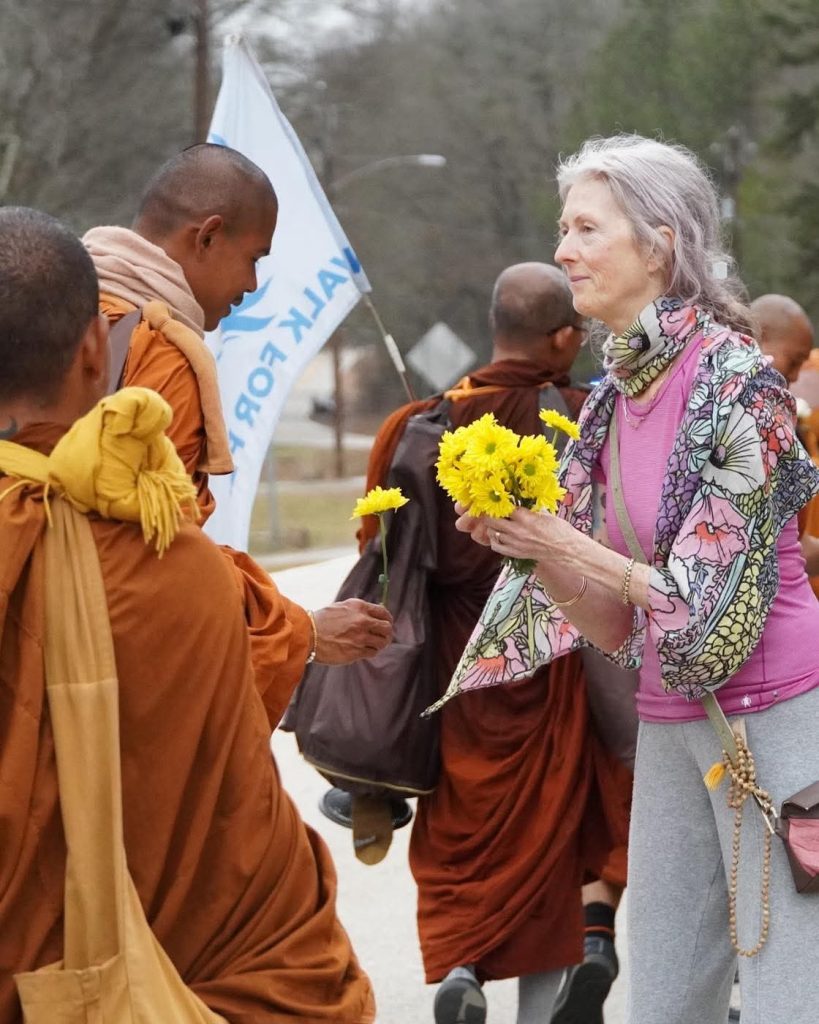
Traveling with few belongings and relying entirely on local generosity for food and water, the monks, walking in a single-file line, have been met with an outpouring of hospitality that transcends religious boundaries.
In many towns, residents have greeted the monks with flowers, symbols of goodwill that the monks carry on their robes.
“Every flower you give and place on our path tells us that the seeds of peace have bloomed in your heart,” the group shared in a public statement.
The monks have also been joined by an unexpected companion, a stray dog named Aloka, meaning “light,” about 4 years old, lighting up the faces of children and families across America. The animal’s steady, calm presence alongside the monks has become, for many, a living parable of the harmony possible within all of God’s creation.
Echoing the papal call to fraternity
This pilgrimage arrives at a significant moment for the global Church.
In September 2025, Pope Leo XIV renewed the call for “Human Fraternity,” urging religious leaders to build a “future of peace, fraternity, and solidarity.”
The pope emphasized that authentic faith must unite rather than divide, a sentiment the monks have embodied by choosing routes through cities struggling with social tension.
Venerable Bhikkhu Pannakara, the group’s spiritual leader, noted that the walk seeks to break “inherited cycles of resentment.” Even when faced with occasional hostility, the monks’ response remains a simple prayer: “May you be well, happy, and peaceful.”
The final mile
As the group traverses Georgia, North Carolina, and Virginia, their escort now includes police officers who have begun presenting the monks with official pins and badges, a rare sign of departmental respect for the monks’ commitment to nonviolence.
The “Walk for Peace” is expected to arrive in Washington, D.C., in the coming weeks. For the thousands following their journey, the message is clear. Peace is not merely a policy to be debated in the halls of power but a path to be walked, one compassionate step at a time.
Walking in peace reminds many that peace begins within. Each step becomes a quiet prayer, a promise to act with kindness, to listen deeply, and to respond with wisdom rather than anger.
The monks’ journey also invites reflection on Nostra Aetate (The Declaration on the Relation of the Church to Non-Christian Religions), which states: “The Church examines more closely her relationship to non-Christian religions … for all people form but one community.”









