
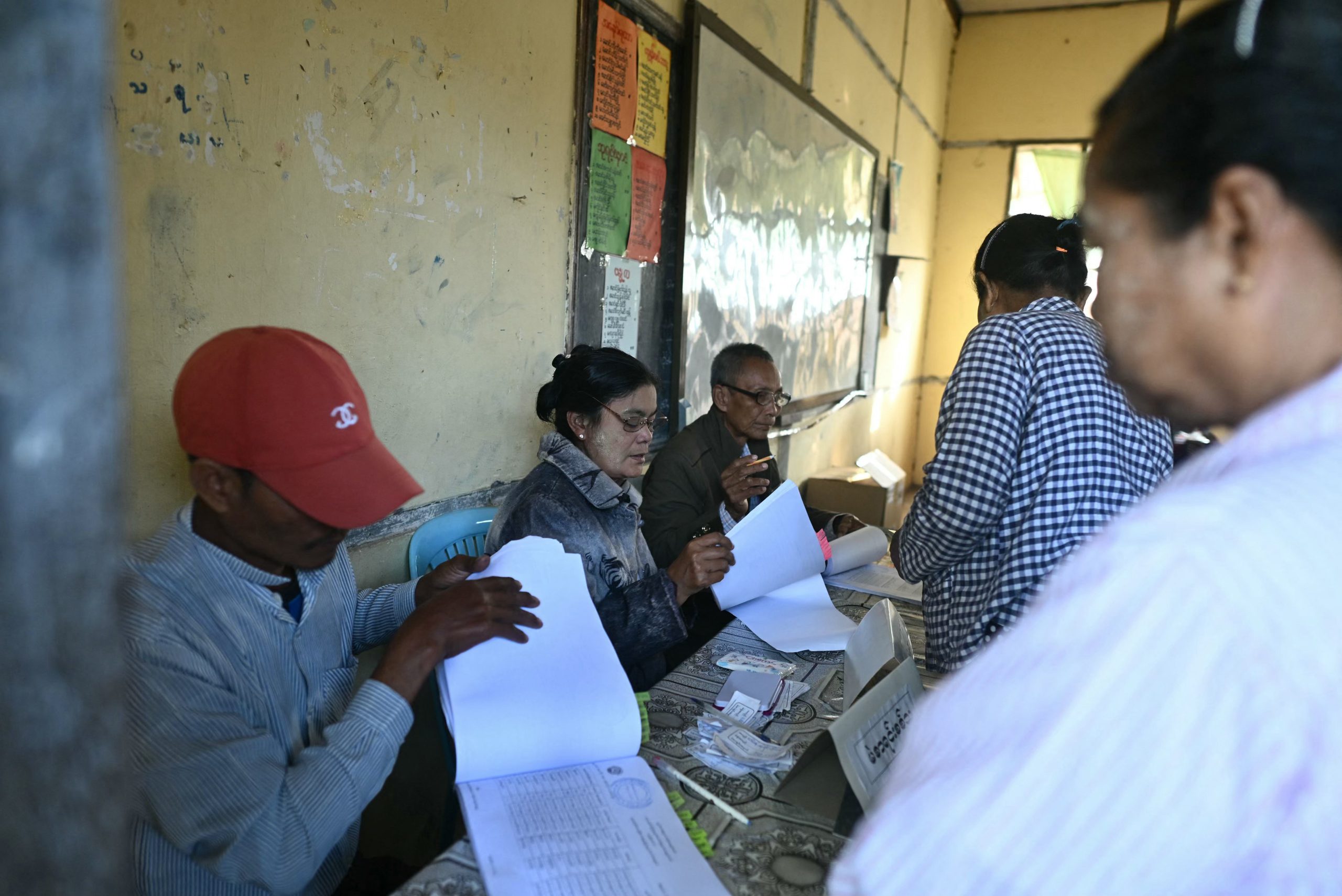
Myanmar’s ruling military has pressed ahead with tightly controlled elections to form a bicameral parliament, moving forward with voting despite an ongoing civil war, widespread boycotts, and fighting that prevents polls in large parts of the country.
According to Fides News Agency, opposition parties, including the National League for Democracy, which was in power before the Feb. 1, 2021 coup, are barred from participating in the elections.
The vote is being conducted in three phases, beginning with a first round held on Dec. 28 in 102 municipalities, followed by a second phase scheduled for Jan. 11 in about 100 municipalities across 12 states, and a final round planned for Jan. 25.
The election has been boycotted by the exiled National Unity Government, which is linked to resistance forces, as well as by ethnic armed organizations that have long operated in Myanmar.
Polling is taking place as fighting continues in more than a third of the country, restricting where voting can occur.
An analysis by the BBC, based on data from local organizations, found that the military controls about 21% of central Myanmar, while resistance forces and ethnic militias control 42% of peripheral areas.
The remaining 37% consists of contested territory where clashes persist, and voting is not possible.
In the states of Kachin, Kayah, Chin, Shan, and Rakhine, only a small number of municipalities are participating in the vote, representing a tiny fraction of the national total.
During the first round, the election commission reported voter turnout of around 70%, with the Union Solidarity and Development Party, whose candidate lists include regime officials and politicians, receiving about 90% of the vote.
Fr. John Aung Htoi of the Diocese of Myitkyina in Kachin State said the elections have generated limited expectations among the population despite being organized by a military regime.
“The elections are nevertheless a step that raises expectations and hopes for change among the population,” he told Fides.
“People are going to vote partly out of fear of reprisals if they don’t, and partly because they hope for something new that will break the stagnation the nation has fallen into,” he said.
Reflecting on Myanmar’s political history, the priest said the military has followed a familiar pattern of retaining power.
“In Myanmar’s past, the military has acted according to the same pattern, gradually transferring power to a civilian government while maintaining firm control over the country,” he said.
Father John said the Union Solidarity and Development Party’s electoral victory reflects the military’s continued grip on power, making it likely that the party will form the next government and keep junta-aligned figures in control.
He said many people still hope that the installation of a civilian-led government could expand space for dialogue, noting that resistance forces and the government-in-exile have long insisted that meaningful talks can only take place under civilian rule.
Father John said the public wants the election to result in changes to the political system that would reopen avenues for negotiations with opposition groups, while acknowledging uncertainty over whether such expectations will be realized.
He also said signs of possible openness have emerged among ethnic armed groups, citing indications from the Kachin Independence Army that it may consider dialogue with a new civilian government.
“If this happens, all the other ethnic armies will follow. Then there is the prospect and the hope for a national dialogue,” Father John said.
“The Catholics in Myanmar fervently hope for this,” he added. “We stand for dialogue and peace and hope that by 2026 this country will be able to overcome this conflict, which has brought death, destruction, and displacement.”
He said Christian communities continue to respond to the crisis through sustained prayer and concrete service, providing assistance to the wider population amid a severe humanitarian emergency caused by the war, which has displaced 3.5 million people internally.









