Asian stock markets tumbled Monday as oil prices surged on fears that the expanding conflict in the Middle East could disrupt global energy supplies and push up costs across the region.
Crude prices jumped after U.S. and Israeli strikes on Iran triggered retaliatory attacks across the Gulf, sending West Texas Intermediate as high as $118.88 per barrel and Brent crude to $118.73 per barrel.
The spike pushed oil to levels last seen during the early months of the Russia-Ukraine war in 2022.
Financial markets across Asia reacted sharply, according to Agence France-Presse.
Seoul’s Kospi index plunged more than eight percent at one point, while Tokyo’s Nikkei 225 dropped seven percent and Taipei slid more than five percent.
Markets in Hong Kong, Shanghai, Sydney, Singapore, Manila, and Wellington also posted steep losses as investors moved away from riskier assets.
The market reaction reflects growing concern that disruptions to oil production and shipping routes in the Middle East could drive up fuel, transport, and electricity costs across Asia, where many economies rely heavily on imported energy.
“The deeper shock is spreading across the production chain,” said Stephen Innes of SPI Asset Management. “Oil above $100 is not just a commodity rally. It becomes a tax on the global economy.”
Thailand warns of economic ‘Code Red’
In Thailand, a senior financial sector leader warned that the surge in oil prices signals a dangerous moment for the global economy.
Dr. Kobsak Pootrakool, senior executive vice president of Bangkok Bank and chairman of the Federation of Thai Capital Market Organisations (FETCO), said crude prices have entered what he described as a critical danger zone.
“We must admit that global oil prices have entered a ‘Code Red’ level,” Dr. Kobsak said.
He warned that the conflict could threaten key energy infrastructure across the Middle East, including ports, tankers, refineries, gas facilities, and desalination plants.
Dr. Kobsak compared the current situation to the start of the Russia-Ukraine war in 2022, when oil prices surged to $120–$130 per barrel and remained above $100 for months.
That spike triggered global inflation and forced central banks to raise interest rates.
Thailand was heavily affected during that crisis, forcing the government to spend hundreds of billions of baht on subsidies to cushion households and businesses from rising energy costs.
“If oil prices remain high, energy price support measures may not be sustainable for long,” he cautioned.
Philippines braces for steep fuel price hikes
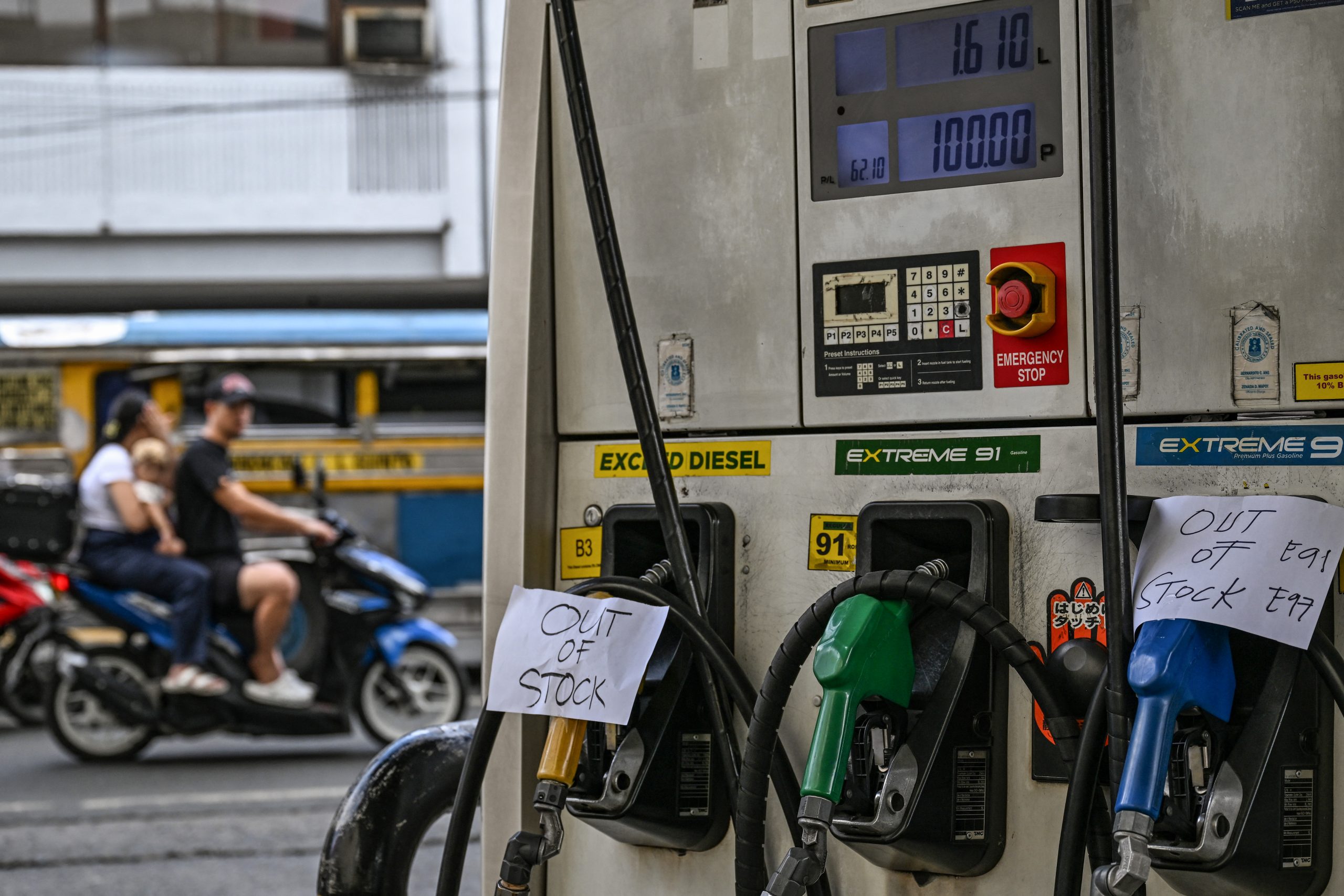
In the Philippines, the oil surge is expected to translate quickly into higher pump prices.
The Department of Energy said it is “hoping for the best” but “preparing for the worst” as oil firms are expected to increase fuel prices by around ₱17 to ₱24 per liter (about $0.29 to $0.41) in the coming week.
Energy Secretary Sharon Garin told lawmakers that the government can monitor price movements but does not have the authority to regulate them.
Singapore warns of higher energy costs
In Singapore, analysts warned that households and businesses could soon see higher petrol and electricity prices as the conflict disrupts energy supplies moving through the Strait of Hormuz.
The Strait of Hormuz, a narrow waterway linking the Persian Gulf to the Indian Ocean, carries roughly one-fifth of the world’s oil shipments and large volumes of liquefied natural gas bound largely for Asia.
Even if maritime traffic resumes quickly, analysts warned that damage to oil and gas facilities across the Gulf region could take longer to repair, potentially tightening supply for months.
Bangladesh adopts emergency conservation measures
The energy shock is already forcing governments in poorer Asian economies to take emergency steps.
Bangladesh ordered the closure of all universities starting Monday to conserve electricity and fuel as the country grapples with worsening energy shortages linked to the Middle East conflict.
Officials said university campuses consume large amounts of electricity for residential halls, classrooms, laboratories, and air conditioning. Temporarily closing them is expected to ease pressure on the national power system.
Bangladesh relies on imports for about 95 percent of its energy needs. Authorities have also imposed daily limits on fuel sales following panic buying and stockpiling.
Gas shortages have already forced the shutdown of four of the country’s five state-run fertilizer plants as supplies are redirected to power stations to prevent widespread outages.
Markets brace for prolonged volatility
The sharp rise in oil prices has renewed fears of inflation just as many economies were hoping interest rates could begin to fall.
U.S. President Donald Trump defended the military campaign despite the surge in energy prices.
“Short term oil prices, which will drop rapidly when the destruction of the Iran nuclear threat is over, is a very small price to pay for U.S.A., and World, Safety and Peace,” he wrote on social media.
Analysts say markets could remain volatile while the conflict shows no clear sign of easing.
“The worst is yet to come in the stock market reaction,” said Michael O’Rourke of JonesTrading. “I would expect more of a risk-off mood until we get some tangible positive news.”