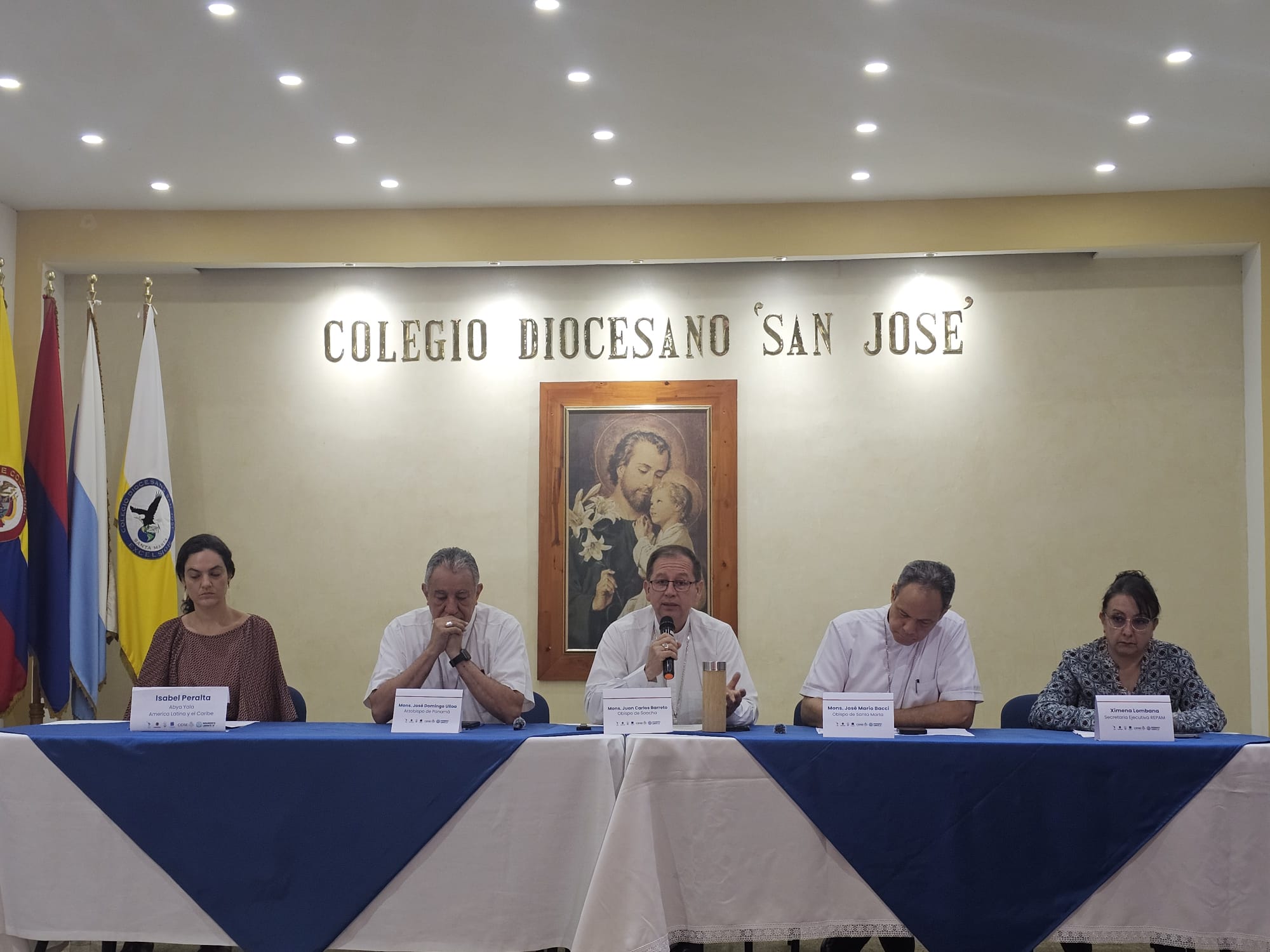
A Catholic archbishop said moving away from fossil fuels is a moral obligation rooted in faith, as church and civil society groups gathered in Santa Marta, Colombia, for international talks on climate transition.
“Working for a transition beyond fossil fuels is not, therefore, an ideological option, but a requirement of our faith,” said Archbishop José Domingo Ulloa of Panama during a homily at Santa Marta Cathedral on April 26. “It is responding with coherence to the Gospel; it is assuming our responsibility toward future generations.”
The Mass coincided with events linked to the International Conference on Transitioning Away from Fossil Fuels, where participants are contributing to the proposed Fossil Fuel Non-Proliferation Treaty and to broader global climate discussions.
Addressing participants in the Encounter of Spiritualities for a transition beyond fossil fuels, Ulloa said their presence reflects how “faith continues to seek paths to respond to the great challenges of our time.”
He described the ecological crisis as both environmental and spiritual.
“For this reason, brothers, the ecological crisis that we face today is not only environmental. It is profoundly spiritual. It is a crisis of the human heart,” he said.
Organizers said the gathering aims to unite faith communities in supporting the fossil fuel treaty and in offering ethical and technical contributions to international climate negotiations.
The meeting is expected to produce a joint statement for governments, contributions to the treaty process, and a shared work plan among faith-based groups for 2026 to 2027.
Ulloa said continued reliance on fossil fuels contradicts Christian teaching, particularly in its impact on vulnerable communities.
“To persist in a model based on fossil fuels, which worsens climate change and strikes the most vulnerable more harshly, contradicts the evangelical commandment to love one’s neighbor and to care for life,” he said.
Discussions during the conference highlighted the need for a transition that addresses social and ethical concerns and includes communities affected by extractive industries.
Participants also stressed that the shift away from fossil fuels must avoid creating new “sacrifice zones” and ensure meaningful participation of affected groups, including Indigenous communities.
Ulloa called on the faithful to see care for the environment as part of their vocation.
“God not only calls us to serve in the Church; He calls us to care for His work. He calls us to be shepherds also of Creation,” he said.
He said faith must lead to concrete action.
“Spirituality cannot remain in words. Faith has to become decisions,” he said. “Because without soul, agreements become empty. But without decisions, spirituality becomes sterile.”
As part of the events, Catholic groups also marked a Catholic Action Day for the Care of Our Common Home and Climate Justice, which included discussions on the impact of fossil fuel extraction on communities and possible alternatives.
“Brothers, what we are living here in Santa Marta is a Kairos. A time of grace,” Ulloa said. “A moment in which God speaks to us in the depths and confronts us in the concrete.”