
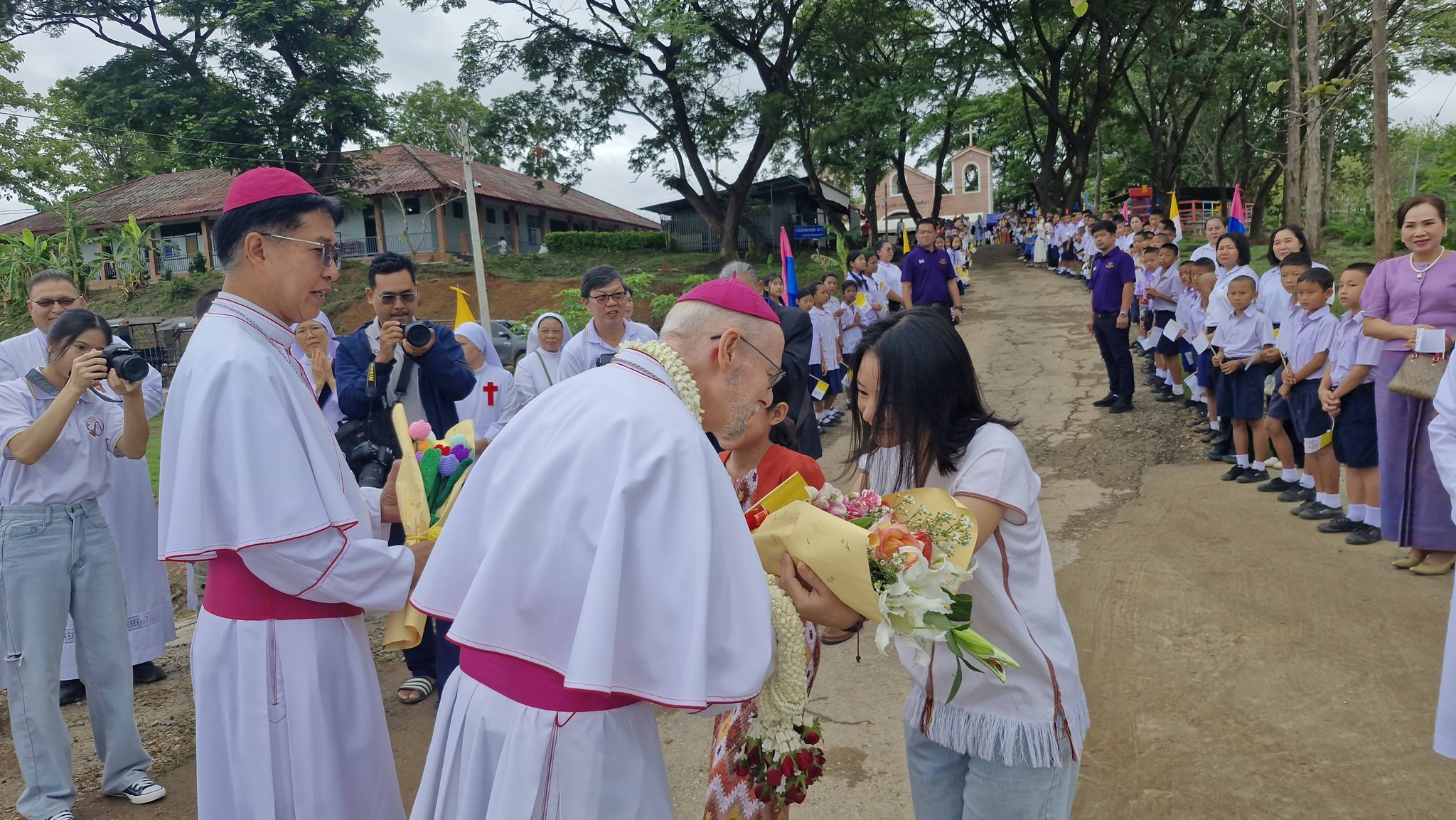
Archbishop Peter B. Wells, the Vatican’s ambassador to Thailand, visited the Thai-Myanmar border town of Mae Sot on May 16, highlighting the Catholic Church’s expanding mission among refugees, migrants, and ethnic minority communities displaced by conflict in neighboring Myanmar.
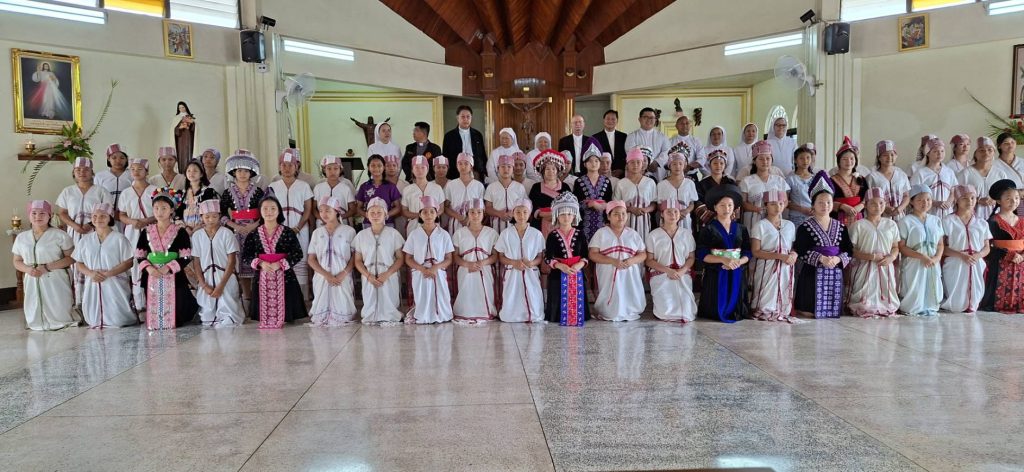
During his visit to Tak Province, the Apostolic Nuncio met clergy, religious sisters, teachers, students, and migrant communities served by the Diocese of Nakhon Sawan.
His presence was widely seen not only as a diplomatic and ecclesial gesture, but also as a sign of solidarity with people living amid the continuing humanitarian consequences of the conflict in Myanmar.
One of the main highlights of the visit was Archbishop Wells’ stop at St. Teresa’s Church and local Catholic schools, where he was warmly welcomed by students, teachers, parishioners, and ethnic minority families from the border region.
In a message written in the parish guest book, the Apostolic Nuncio offered prayers and encouragement to the local Catholic community, writing: “May God continue to accompany you in your important mission.”
The visit reflected the Church’s longstanding pastoral presence in Mae Sot, a strategic border town opposite Myawaddy in Myanmar’s Kayin State.
For decades, the Catholic Church has worked quietly among refugees, migrants, ethnic minorities, and displaced families fleeing violence and instability across the border.
Church agencies, including Caritas Thailand and the Catholic Office for Emergency Relief and Refugees (COERR), have coordinated humanitarian assistance in refugee camps and migrant communities, providing food, medicine, education, pastoral care, and psychosocial support.
Catholic schools and parishes in Mae Sot have also become important centers of stability for children affected by conflict and cross-border displacement.
Archbishop Wells began the day by visiting the Second Thai-Myanmar Friendship Bridge before attending activities hosted by the Salesian Sisters and local Church workers engaged in refugee and educational ministries.
According to Fr. Rangsiphol Plianphan of the Diocese of Nakhon Sawan, the Apostolic Nuncio celebrated a Thanksgiving Mass in English, with hymns sung in both English and Burmese, reflecting the multicultural reality of the border community.
He later blessed a newly completed school building and a residence for the Salesian Sisters.
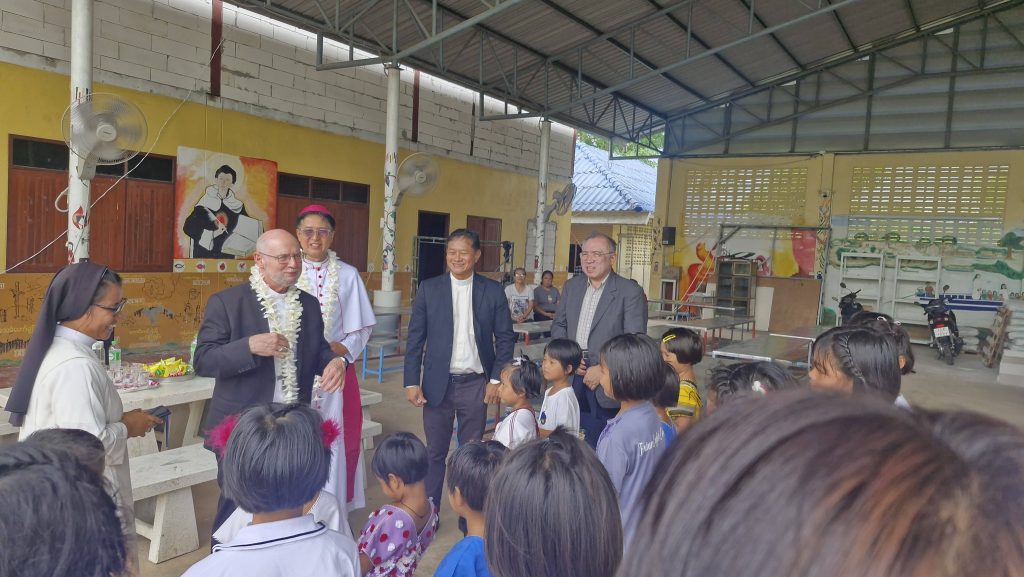
The Nuncio also visited a home for underprivileged children run by the Dominican Sisters, where children welcomed him with songs and cultural performances.
At Pataravittaya School, Archbishop Wells met many students from migrant and ethnic minority families.
Located in Tha Sai Luat subdistrict near the Myanmar border, the Catholic school serves not only Thai students but also children from Karen, Karenni, Mon, and Burmese migrant communities, many of whom face barriers to education because of poverty, displacement, or lack of legal documentation.
In Mae Sot, the border is more than a geographical line. Daily life along the Moei River is deeply intertwined with migration and cross-border trade.
Thousands of people move between Thailand and Myanmar each day, while periodic fighting in Myanmar’s border regions continues to disrupt livelihoods, education, and family life.
For many Catholic institutions in the area, education has become inseparable from humanitarian outreach and pastoral accompaniment.
Schools such as Pataravittaya function not only as academic institutions, but also as places of refuge, counseling, and community support during periods of uncertainty.
Local Church leaders said the visit of the Apostolic Nuncio brought encouragement to clergy, religious sisters, catechists, and lay workers who continue serving vulnerable communities despite ongoing regional challenges.
The Diocese of Nakhon Sawan has maintained pastoral outreach to migrant and refugee communities in Mae Sot for more than four decades, often working in close cooperation with Church leaders and catechists across the border in Myanmar.
For many Catholics in Mae Sot, the visit of the Pope’s representative was therefore more than a ceremonial occasion. It was a reminder that the universal Church remains close to those living on the margins, especially communities searching for peace, dignity, and hope along one of Southeast Asia’s most fragile frontiers.









