
In the semicircular Chapel of the Holy Spirit at St. Louis Hospital in central Bangkok, the Solemnity of the Most Holy Trinity unfolded not through the thunder of an organ or the resonance of spoken text, but through the profound, expressive syntax of motion.
Dozens of Deaf faithful gathered on Sunday, May 31, choosing to celebrate this major feast day together despite a five-day nationwide holiday weekend.
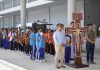
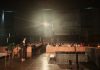
The chapel’s distinctive semicircular seating arrangement appears ideally suited to the needs of Deaf worshippers. With pews arranged in a gentle curve, every participant enjoys a clear, unobstructed view of the altar, the celebrant, interpreters, and fellow worshippers, an essential element of visual communication.
The Mass was celebrated by Fr. Peter Bhuravaj Searaariyah, a diocesan priest from the Diocese of Chanthaburi who commutes four hours to Bangkok to serve the community.
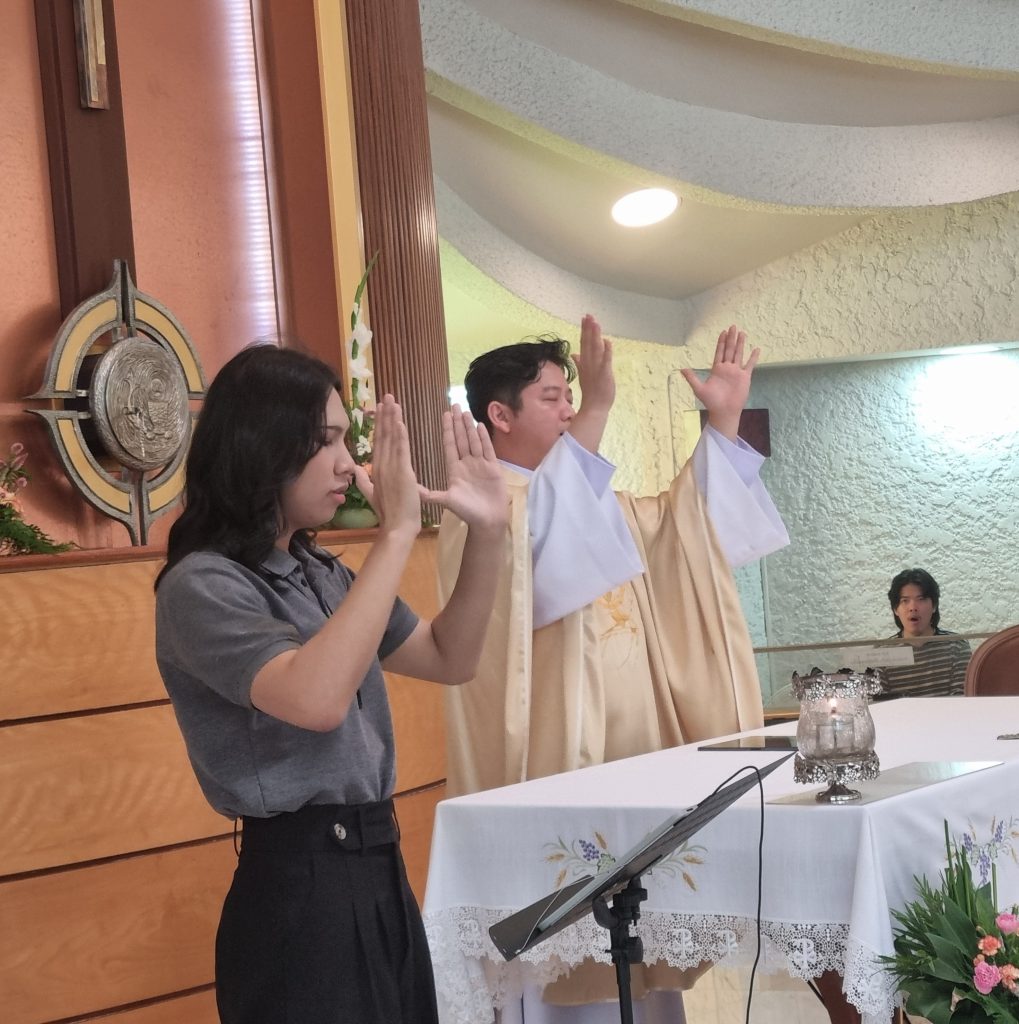
Photo by LiCAS News
Appointed by the Catholic Bishops’ Conference of Thailand as national coordinator for Deaf Ministry a decade ago, Father Bhuravaj remains the only priest in the kingdom fluent in Thai Sign Language (TSL), a skill that enables him to celebrate the liturgy directly in the language of the Deaf community without relying solely on interpreters.
For the underserved Deaf and hard-of-hearing Catholics from across Bangkok and neighboring provinces who journey here each week, the Sunday Mass represents a vital sanctuary of accessibility, inclusion, and specialized pastoral care.
In this sacred space, silence does not mean the absence of communication. Rather, it is transformed into a rich visual language.
Every aspect of the liturgy, from the prayers and Scripture readings to hymns of praise, is expressed through Thai Sign Language, supported by trained interpreters and led by Fr. Bhuravaj himself.
For first-time visitors, a Mass celebrated in sign language can be a profoundly different experience. The eyes, rather than the ears, become the primary means of participation. Worship is highly visual, expressive, and deeply communal.
Although spoken words are largely absent, the chapel is far from silent. The congregation signs prayers and hymns together through synchronized movements and expressive facial gestures. Music is experienced visually, as members of the signing choir move rhythmically in unison.
To accommodate hearing attendees, a trained interpreter spoke into a microphone during the pre-Mass announcements and the liturgy, translating the signed words aloud.
“Sign language for church and religious terminology is incredibly challenging,” Father Bhuravaj explained.
“It often relies on deep theological metaphors and abstract concepts that do not always have direct equivalents in everyday sign language. To bridge this gap, we are likely the only country that has developed a specialized, visual ‘picture language’ version of the Bible.”
The mystery of the Trinity, traditionally one of the most abstract doctrines in Christian theology, found a vivid, material expression during the service.
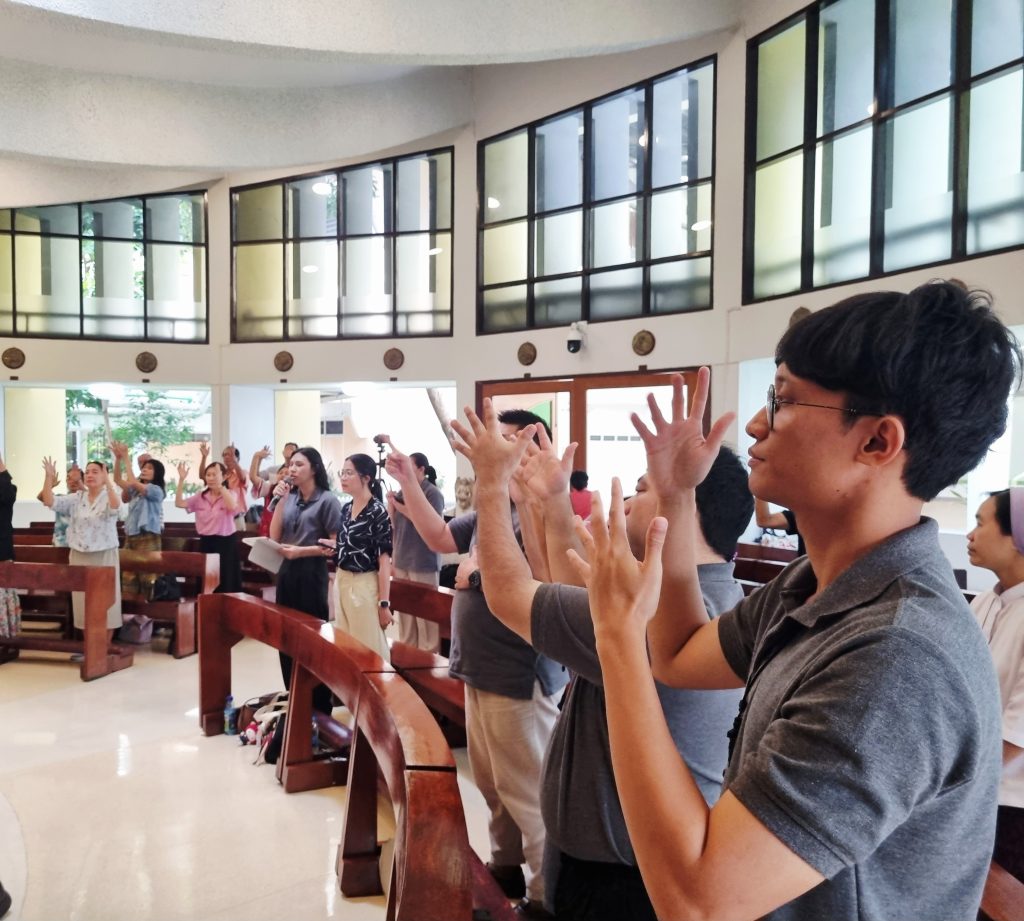
Photo by LiCAS News
To signify the Triune God, the priest and the congregation signed the Holy Trinity by showing three distinct fingers shifting seamlessly into a single, unified handshape. Through this fluid motion, the theological concept of “Three Persons, One God” became immediately visible.
This deep theological precision was mirrored during the Gloria and the Creed. The congregation moved in striking unison, their hands deliberately shaping their shared belief in creation (the Father), salvation (the Son), and the ongoing life of the Church (the Holy Spirit).
For many Deaf Catholics, participation in such a Mass brings a profound sense of belonging.
For many Deaf Catholics, standard parish services can induce feelings of isolation, requiring exhausting lip-reading or detached observation. Here, they form the majority and encounter the Word of God in their own linguistic context.
“It is entirely normal to feel a bit out of your element at first,” said Narong Thanamlek, a longtime member of the Deaf Catholic community. “But the Deaf community at St. Louis is known for being incredibly warm and welcoming to visitors.”
Narong was the first Catholic to graduate with a bachelor’s degree in Deaf education, a specialized program established under the royal patronage of Her Royal Highness Princess Maha Chakri Sirindhorn to train educators in TSL communication.
Every Sunday, Narong assists Father Bhuravaj with the liturgy, post-Mass Bible sharing groups, pastoral retreats, and the ongoing refinement of liturgical sign language.
“There are more individuals currently enrolled in this degree program,” Father Bhuravaj added, noting the vital future of the ministry. “It is designed specifically for teaching, learning and utilizing Thai Sign Language to communicate effectively with those with hearing impairments.”
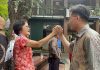
As the Mass concluded and worshippers exchanged greetings through smiling faces and animated signs, the gathering offered a powerful reminder that faith transcends spoken language.
In the language of signs, the Gospel continues to be proclaimed, understood and lived, ensuring that every member of the Church can encounter Christ in a way that speaks directly to the heart.