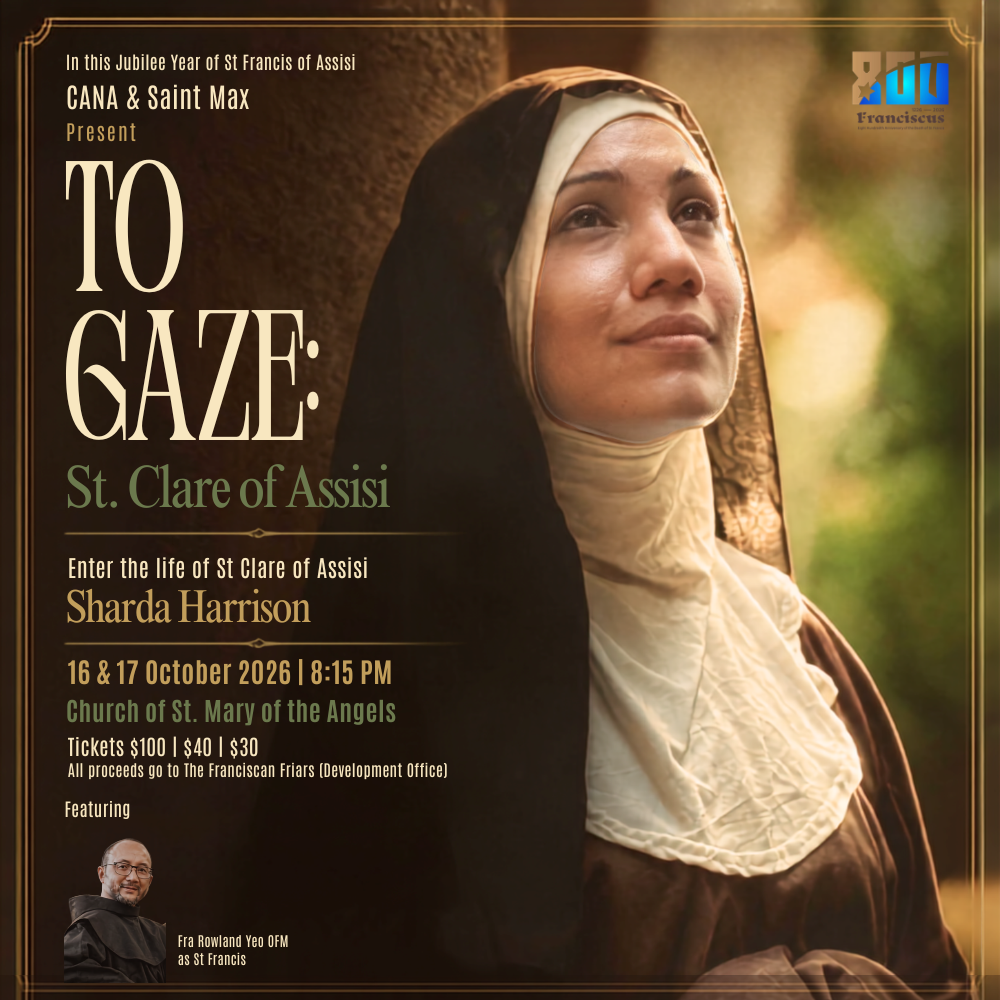
A play about St. Clare of Assisi that asks why anyone would call poverty a privilege gave its last performance in Singapore on Oct. 17, the day the United Nations observes as the International Day for the Eradication of Poverty.
The organizers themselves pointed to the date. Asked what they hoped audiences would take away from “TO GAZE: St Clare of Assisi,” an organizer from CANA, one of the two presenting groups, put it as a question: “Why is poverty a privilege?” Noting the Oct. 17 observance, the organizer went on: “So why is this crazy lady Clare so resolved to live it?” The organizer asked not to be named.
The production opened on Oct. 16 at the Church of St Mary of the Angels in Bukit Batok, a parish run by Franciscan friars. Presented by CANA and Saint Max, it was one of the events marking the Jubilee Year of St Francis, 800 years after his death in 1226. According to its poster, all proceeds went to the development office of the Franciscan friars.
The script is by Sharda Harrison, who played Clare and, the organizers said, directed the production; in 2024, she wrote, directed and starred in “St Thérèse: The Little Way” for the same organizers. Fra Rowland Yeo, OFM, a Franciscan friar, played St Francis.
From ‘everything’ to nothing
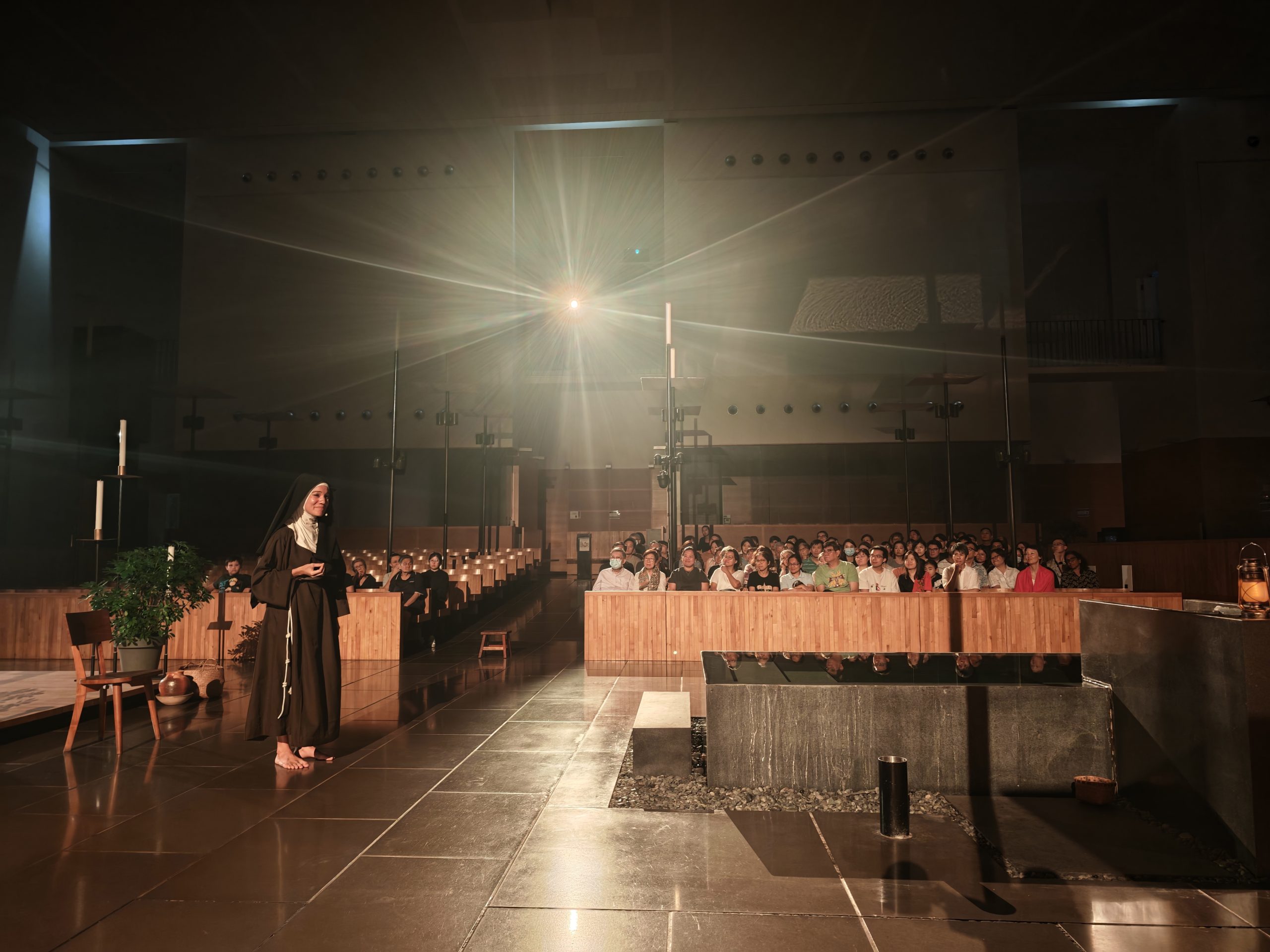
The question of poverty is set up from Clare’s first scenes, which stress how much she had. “We had money, we had servants … we had horses,” she tells the audience, describing her childhood in Assisi, where, by her account, she was born in 1194. “Sometimes you can have everything and still feel trapped.”
After hearing Francis, the merchant’s son who exchanged fine clothes for rags, she decides: “I realised that I had everything, but I wanted none of it.” She leaves home on a Palm Sunday night, has her hair cut, and later tells her father, “I belong to Christ now, Father.”
Late in the evening, Clare asks the audience to “imagine you have nothing — no money, no husband, no wife, no property, no shoes on your feet.”
“This is what it means to live in the privilege of poverty,” she says, “to be given the right to possess nothing.” She recalls that the idea met resistance: “The world did not understand. Not even the church.”
‘Not feasible’ in Singapore?
Some in the audience said the idea was hard to live out in one of Asia’s wealthiest cities.
“To possess nothing may not be feasible in Singapore’s materialistic society today,” said Angela, 73, a parishioner of St Mary of the Angels who attended both performances. “These days people just want to possess things, for example having the newest phone model and paying a high price for it, even when the old phone is still perfectly good!”
She said that in Singapore, she would take Clare’s “privilege” of poverty “to mean being more frugal and living simply, not chasing after and accumulating possessions. Learning to be contented with what you have.”
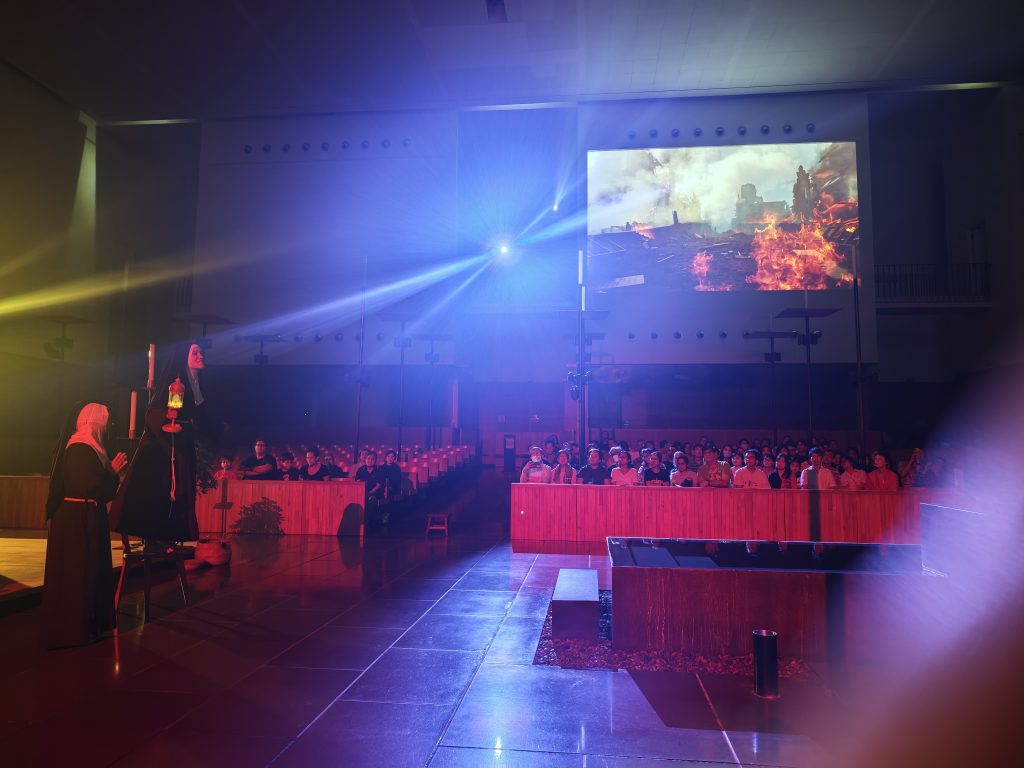
Caroline David, 62, also a parishioner of St Mary of the Angels, saw the closing performance. “We are very blessed to have so much that nowadays the sense of entitlement seems to creep into our lives. We forget that the blessings we have are a privilege indeed,” she said.
“Frankly, it is a tough call to practise ‘the right to possess nothing,'” she said, because it is easier to give from one’s excess than from what one has.
Humor and audience participation
The two-night run also used humor. Clare’s arranged-marriage prospects were shown as a parody of a dating app, with suitors on a screen and the audience asked to “swipe right” or “swipe left.” Later she picked out women in the audience and received them into her community of “Poor Ladies.” Lay actors played Clare’s companions and the early friars.
“The dating app scene helps to link and relate past and present practices of a similar issue, and adds a touch of humour too,” Angela said.
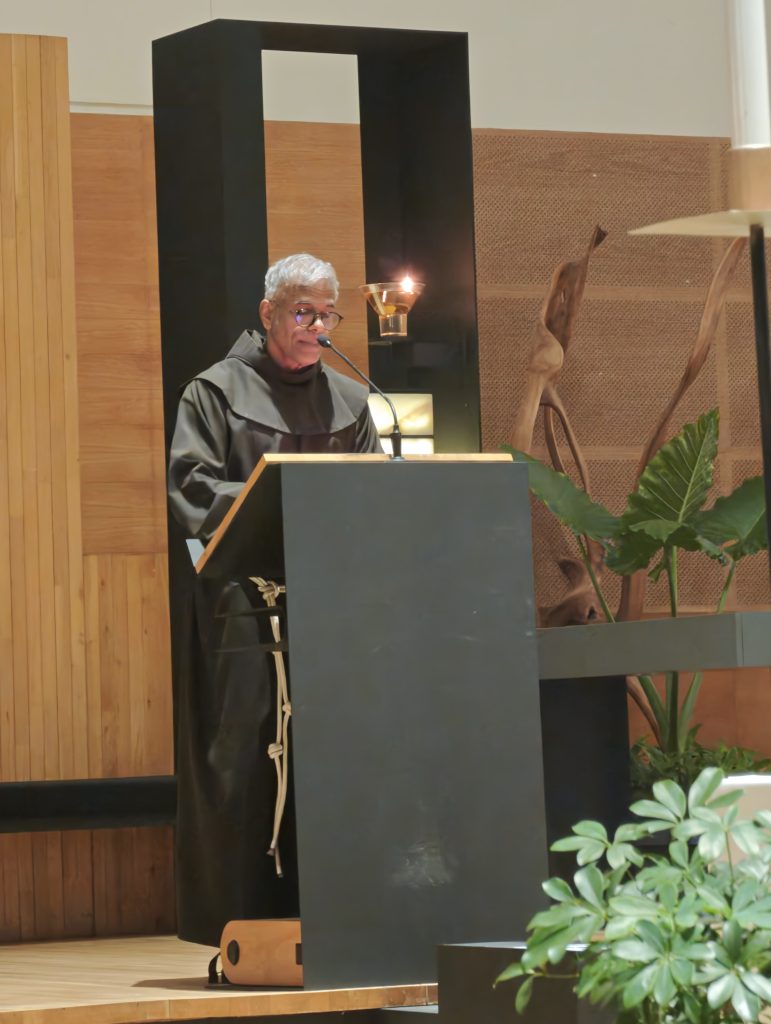
In welcoming remarks, Fra Michael D’Cruz, OFM, the Franciscan friar overseeing the event for the parish, said of Clare and Francis: “You cannot really tell the story of one without the other.”
The organizer said the play was a way to close the Jubilee year with “the precious legacy of St Clare.”
Clare, who died in 1253, sums up her life near the play’s end: “I had to learn how to say yes, yes to Christ, yes to poverty.”
Benedict Tang is a Singapore-based Catholic writer and a convert to the faith. He holds a Diploma in Theology from the Catholic Theological Institute of Singapore, writes as a freelance contributor for various international and regional Catholic media, and works in digital marketing.