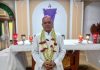
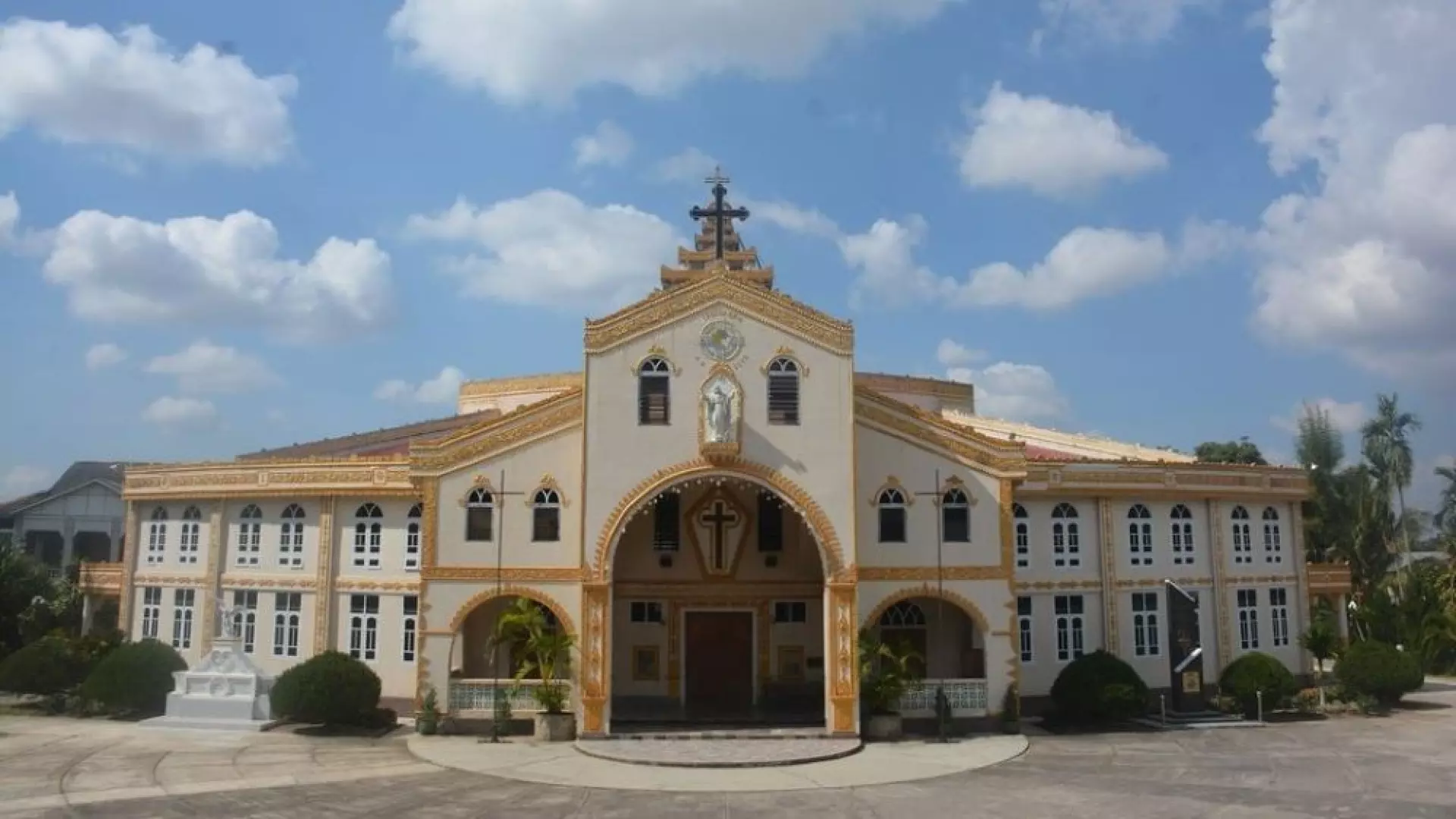
A Catholic bishop in Myanmar has chosen to remain among more than 300,000 displaced people despite the military’s return of his cathedral in conflict-ravaged Kayah State, saying his place is with communities uprooted by years of war.
The decision comes after Myanmar’s military returned the Christ the King Cathedral and the pastoral center of the Diocese of Loikaw, which had been occupied since November 2023 and used as a military base amid fighting that followed the country’s 2021 coup.
“It is a great joy that the army has returned the Cathedral of Christ the King and the pastoral centre of the Diocese of Loikaw to us,” Bishop Celso Ba Shwe told the Vatican’s Fides News Agency.
The return of the cathedral marks a rare sign of hope for Catholics in one of Myanmar’s hardest-hit conflict zones. Yet the bishop’s decision to remain with displaced families reflects the continuing humanitarian crisis across the diocese, where armed clashes have forced hundreds of thousands from their homes and left many parishes deserted.
“The majority of the faithful in the diocese still live scattered across remote areas, in camps for displaced persons or in the forests. Many parishes are empty and closed,” Ba Shwe said.
Rather than return to Loikaw, the bishop continues to live in Shansu at the Church of the Mother of God, where he can regularly visit displaced communities across the diocese.
“As a Pastor, I feel a duty to remain close to my people and I reside in an area where thousands of internally displaced persons live,” he said.
Kayah State, also known as Karenni State, has experienced some of the heaviest fighting since the military seized power in February 2021. Villages, schools, places of worship and civilian infrastructure have been damaged or destroyed, while ongoing clashes have driven large-scale displacement across the region.
Ba Shwe said the diocese now has hundreds of camps for internally displaced people and that the number of displaced residents “far exceeds 300,000.”
“In some areas the fighting continues, in others the situation is relatively calmer,” he said.
The cathedral itself suffered damage during the military occupation. While repairs to the roof have allowed the resumption of liturgical celebrations and pastoral activities, the adjoining pastoral center remains largely unusable.
“The pastoral centre requires extensive renovation and restoration work. We still have no electricity or water, so it is not fully accessible. We are working to make it usable again. We are proceeding in small steps,” the bishop said.
Some parishioners have begun returning to the cathedral parish, prompting church leaders to reorganize pastoral services in Loikaw. But much of the Church’s ministry now takes place in displacement camps and remote communities.
Ba Shwe described this as a new reality for the clergy.
“I visit the refugee camps regularly, and all the priests in the diocese do the same. Most of them live permanently in those camps alongside the displaced people,” he said.
“It is a different kind of mission, a different way of being a priest. Pastoral ministry is changing too: it is no longer carried out solely within a church or a specific area, but within the community, amongst people, wherever they may be,” he added.
The Church continues to celebrate Baptism, First Communion and Confirmation in displacement camps, where many families remain cut off from their homes and parishes.
“People need the Bishop, the priests and the consecrated persons. They want to meet them, see them, and bring their children to the sacraments,” Ba Shwe said.
Despite the hardships of camp life, he said faith and solidarity continue to sustain displaced communities.
“We face the difficulties of the refugee camps together, helping one another. We move forward thanks to the support of donors, who for us represent Providence,” he said.
“We do not know when God will allow us to return to our homes and our churches. But wherever we are and wherever our people may be, we maintain a deep faith in God. We hold onto the hope that one day we will be able to return,” he added.
The prelate also expressed concern about the future of young people whose education has been disrupted by conflict. He said the Church, often with the support of religious sisters, has organized informal schools and educational activities using limited resources and teaching materials.
Looking beyond the immediate humanitarian crisis, Ba Shwe renewed his call for national reconciliation as the only path toward lasting peace.
“We desire peace and reconciliation. We want people to come together and unite. Without reconciliation, there will be no peace,” he said.
“For this reason, we propose and accompany with prayer a process of national reconciliation involving political leaders, armed groups and the country’s authorities. It depends on them, but today we must think first and foremost of the people, the nation and, above all, the poorest,” he added.