

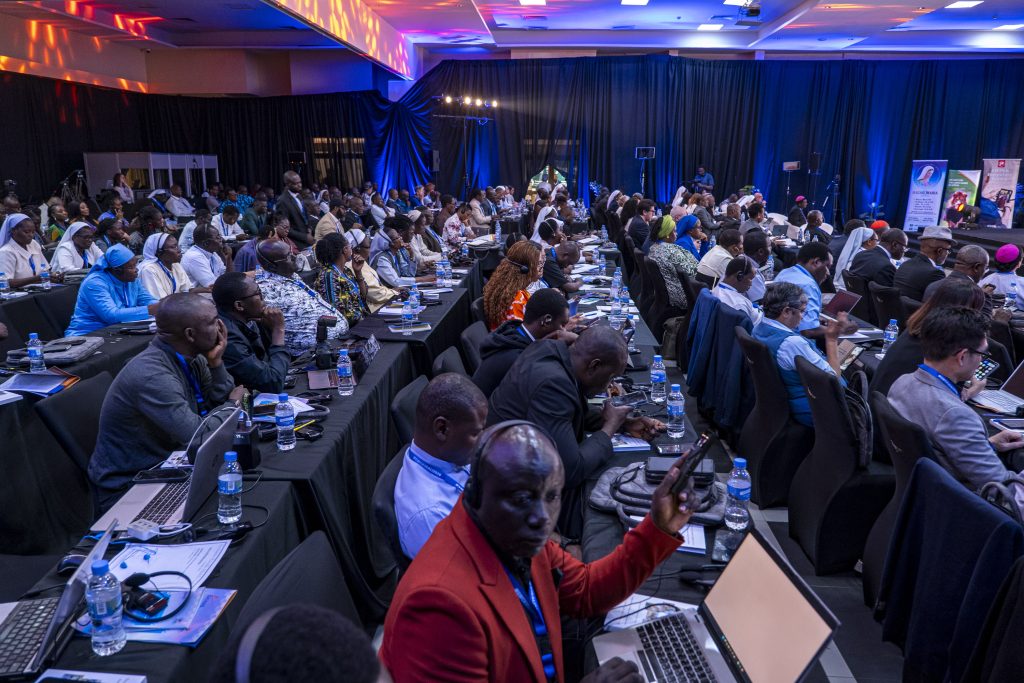
A senior Catholic Church official in Rwanda warned Aug. 4 that media can become an agent of violence when used to spread division and terror.
Cardinal Antoine Kambanda, speaking at the opening of the SIGNIS World Congress, recalled how the media contributed to the 1994 genocide against the Tutsi in Rwanda.
“It is tragic that the media was misused to intensify division and terror, facilitating the genocide, to the point that the media itself acted as a powerful participant,” Kambanda said.
The Archbishop of Kigali said Rwanda had since sought to transform media into an instrument for rebuilding trust and healing communities scarred by violence.
“Since then, the media have increasingly become instruments of unity, reconciliation and peace,” he said.
The prelate, who heads the Episcopal Conference of Rwanda, urged Catholic communicators to use technology to promote peace, reconciliation, and human dignity.
Kambanda said Rwanda now uses social communication to promote national unity and support personal and communal healing in a society still recovering from the genocide.
Catholic media organizations have developed programs on trauma healing and reconciliation to help address the wounds of the past and rebuild trust among Rwandans, he said.
The cardinal said Rwanda continued its journey through the “purification of memory” and reconciliation with its history.
SIGNIS held its world congress in Africa for the first time, allowing Rwanda to share its experience in developing professional Catholic media while confronting traditional and social media that spread “division, hatred, and falsehood,” Kambanda said.
He urged Catholic communicators to draw lessons from Rwanda’s history as they respond to the growing influence of artificial intelligence and other digital technologies.
“Authentic communication is ultimately inspired by the human mind and heart,” he said.
Kambanda called on the Church and people of goodwill to “make responsible use of artificial intelligence and other digital technologies without compromising human dignity or Christian values.”
He said technology must remain a tool in the service of humanity. The cardinal also recalled the Second Vatican Council’s call for Catholics to make effective use of social communication in the Church’s mission.
He also called for greater Church investment in Catholic media, citing shortages in funding, equipment, and trained personnel. “Among these challenges is the lack of adequate financial and technical resources,” he said.
Such limitations often prevent Catholic media organizations from acquiring modern equipment and employing well-trained professional journalists, the prelate lamented.
He urged Catholic media organizations and Church communication offices to work together more closely.
Greater solidarity, he said, could help build credible Catholic media capable of serving both the Church and contemporary society.
SIGNIS, or the World Catholic Association for Communication, is recognized by the Vatican as an International Association of the Faithful with the mission to “help transform cultures in the light of the Gospel by promoting human dignity, justice, and reconciliation.”
It has consultative status with UNESCO, the Economic and Social Council of the United Nations, in Geneva and New York, and the Council of Europe.