
A senior Thai Catholic educator urged Church schools to help young people navigate artificial intelligence, digital isolation and social fragmentation through stronger human formation.
Dr. Chainarong Monthienvichienchai, vice president of the Catholic Education Council of Thailand (CECT) and chancellor of St. John’s University in Bangkok, made the appeal before more than 500 Catholic educators, bishops, clergy, religious superiors and lay school administrators attending the council’s 55th annual seminar in Khao Yai from Aug. 16-19.
The gathering focused on the apostolic letter Drawing New Maps of Hope, issued by Pope Leo XIV to commemorate the 60th anniversary of the Second Vatican Council’s declaration on Christian education, Gravissimum Educationis.
Dr. Chainarong structured his keynote address as a three-movement “pilgrim symphony,” moving from the foundations of Catholic education to present challenges and the responsibilities facing educators.
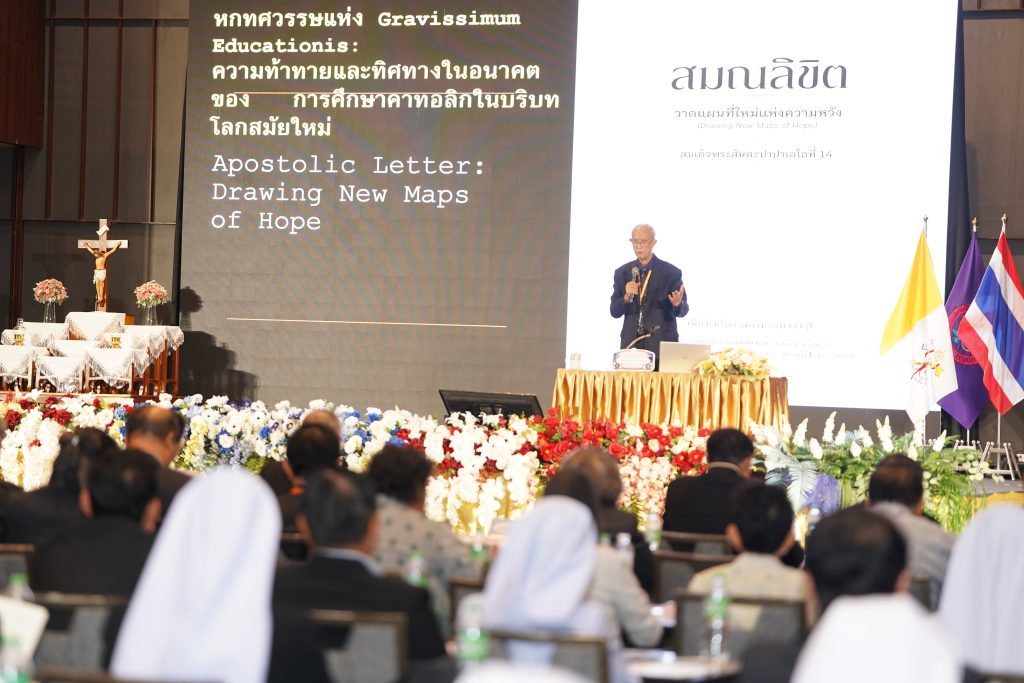
Movement I: The Inherited Map and the Sacred Dream
Reflecting on the legacy of Gravissimum Educationis, promulgated six decades ago, Dr. Chainarong said the document was intended not as a rigid administrative manual but as a vision of education rooted in human dignity.
“Sixty years ago, the Council Fathers handed us a map born out of a profound dream, a sacred one,” he noted. “That dream reminded the world that education is not merely about examination results or economic utility, but about forming the whole human person.
“In Thailand, where our schools welcome students and teachers of diverse religious backgrounds, this vision has flourished through daily, quiet acts of service.”
Movement II: Navigating a Complex Landscape
Dr. Chainarong described today’s educational landscape as one marked by technological saturation, hyperconnectivity and deep psychological fatigue among young people.
While acknowledging that artificial intelligence and digital networks offer unprecedented access to information, he urged educators to look beyond technology and programs and focus on the human person, underlying wounds and their vocation as educators.
“Artificial intelligence can process data in fractions of a second, but it cannot weep with those who weep, nor can it discern the subtle movements of the human spirit,” Dr. Chainarong said, echoing the apostolic letter.
“Technology connects continents, but it cannot substitute for authentic communion. Pope Leo XIV does not hand us a pre-drawn map for this digital frontier; instead, he places a compass gently into our hands, pointing us back to our true north: wisdom, truth, and human dignity.”
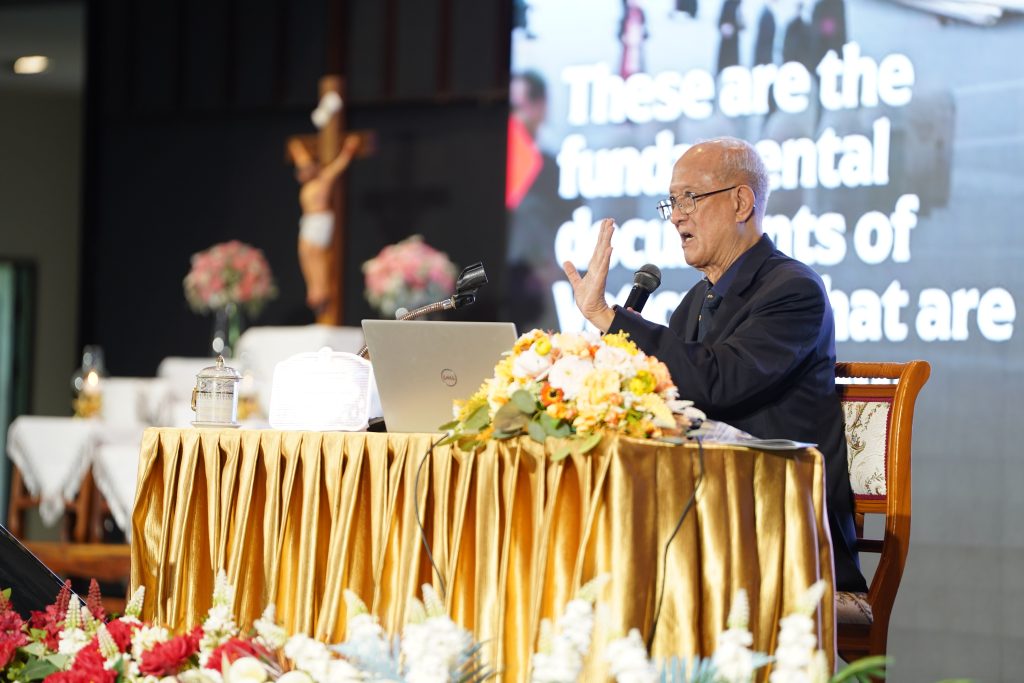
Movement III: Choreographers of Life
In the final part of his address, Dr. Chainarong called on administrators and teachers to see themselves not merely as instructors but as “choreographers of Life.”
“A choreographer does not step onto the stage to perform every movement,” Dr. Chainarong explained. “Instead, a choreographer creates space, listens to the rhythm, and guides others to move together with grace and purpose. We do not live our students’ lives for them; we accompany them, teaching them how to use the compass of discernment so they may draw their own maps grounded in faith and reason.”
Dr. Chainarong also addressed the recent fatal shooting on the outskirts of Bangkok, where a 14-year-old student left several people dead and dozens injured, citing the incident as an example of why drawing “new maps of hope” has become an urgent pastoral concern.
He said Catholic schools must respond to violence, brokenness and despair among young people by becoming places of accompaniment, healing and moral formation.
Dr. Chainarong urged participants to return to their communities asking not only what new methods they should introduce, but what kind of educators God is calling them to become — choosing dialogue over polarization, spiritual depth over superficiality, and courageous hope over quiet resignation.
He said educators were being called to bring that commitment back to their own schools and begin Drawing New Maps of Hope.