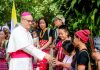
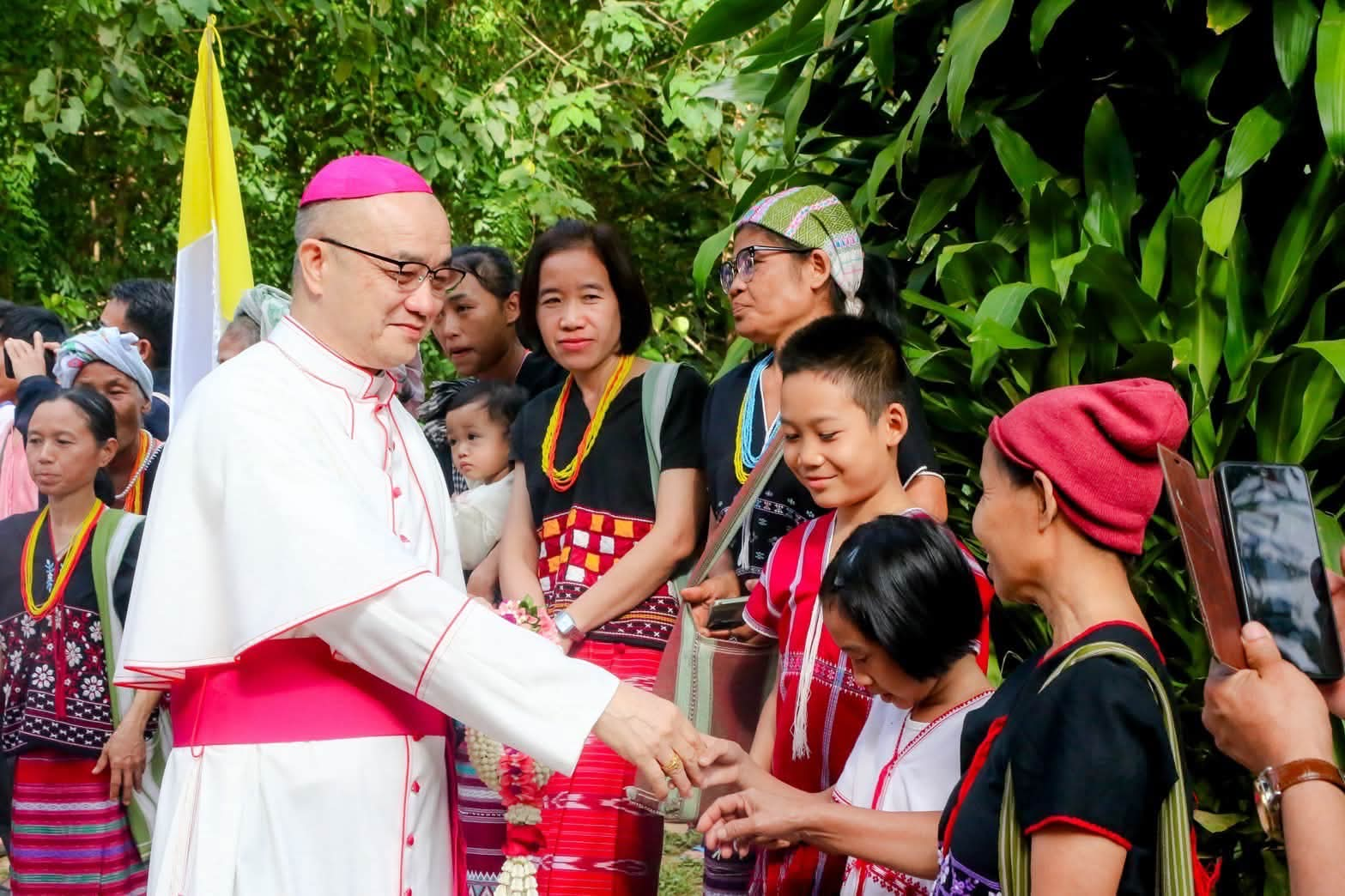
After a grueling eight-hour journey across 315 kilometers of winding mountain roads, Bishop Peter Suphot Roerksujarit of Chiang Mai joined the Catholic community of Huai Ton Nun on Saturday, Nov. 21, 2026, to celebrate the annual feast of its patron, St. Cecilia.
The Eucharistic celebration brought together residents of this isolated ethnic Karen village situated along the Thailand-Myanmar border.
Facing Myanmar’s Kayah State, Huai Ton Nun is a quiet frontier outpost closed to foreign tourists, where life is shaped by subsistence farming and local cross-border trade with Karenni neighbors.
Home to just over 500 residents across roughly 100 households, Huai Ton Nun maintains a self-reliant rhythm of life despite its geographical isolation in Khun Yuam district.
Villagers cultivate brown rice, corn and soybeans in the upland valleys and harvest seasonal wild honey, the settlement’s most prized local product.
While the community preserves ancestral Karen customs such as traditional wrist-tying ceremonies, Roman Catholicism has formed the spiritual bedrock of the village since the arrival of missionaries decades ago.
Alongside its primary school and community health clinic, St. Cecilia Catholic Church stands at the heart of village life.
Witnessing to faith through everyday vows
During his homily, Bishop Suphot connected the third-century martyrdom of St. Cecilia, the patron saint of the parish and church music, to the quiet, lifelong fidelity required of families living in remote communities.
Reflecting on the hymns sung at the start of Mass, the bishop noted that while the congregation sang with one voice, each person carried distinct prayers: parents giving thanks for the children beside them and others entrusting absent loved ones to God.
He recalled how St. Cecilia sang praises to God in her heart even on her wedding day, remaining steadfast in her devotion until she gave her life rather than deny Christ.
“For Cecilia, faithfulness began the day she gave her heart to God… When the moment arrived when preserving her own life would have meant denying Christ, she chose to sacrifice her life instead—remaining faithful to the One to whom she had sung praises in times of joy, and in whom she placed her trust when facing death.”
The quiet martyrdom of marriage and family life
Drawing on the witness of the saints and the daily realities of village households, the bishop offered a pastoral reflection on the sacrament of matrimony.
He observed that the wedding promise to love “for the rest of your life” is lived out in the unseen sacrifices of shared daily life rather than in grand gestures.
He described a young father rising in the middle of the night to comfort a crying infant so his exhausted wife might sleep, contrasting that moment with the later years of marriage, when aging spouses steady one another just to rise from bed.
“The hands that steady one another in those later years are the very same hands that were joined in marriage long ago. This is the vocation of a husband and wife: to gradually learn how to love and care for one another through every stage of life, until the day comes when one must bid the other farewell as they return to God.”
To young couples in the village preparing for marriage, Bishop Suphot urged them to honor the traditions of their Karen ancestors while seeking guidance from their parish priest.
He encouraged them to look beyond wedding preparations and consider fundamental questions together: how they will resolve disagreements, care for aging parents and raise their children to know God.
Addressing widows, widowers and elderly parishioners who had already fulfilled their vows until death parted them, the bishop turned to the day’s Gospel and Jesus’ teaching that in the resurrection, “to Him, all are alive.”
In concluding his homily, Bishop Suphot invited the congregation to look at the spaces beside them in the pews.
If an empty seat brought to mind a departed spouse or loved one who once worshiped there, he urged them to speak that person’s name silently in their hearts, give thanks for the years spent caring for one another and entrust them to the promise of eternal life.
As the liturgy concluded and villagers returned to their fields and livelihoods along the border, the celebration offered a reminder that even in the most remote corners of the diocese, the quiet fidelity of ordinary families remains a living witness to the Gospel.