Indonesian President Prabowo Subianto’s nomination of Andi Amran Sulaiman and Sugiono to replace Gibran Rakabuming Raka as vice president has drawn mixed public reactions, with critics questioning the dominance of the Gerindra Party in the selection process and the political legitimacy of a successor not directly elected by the people.
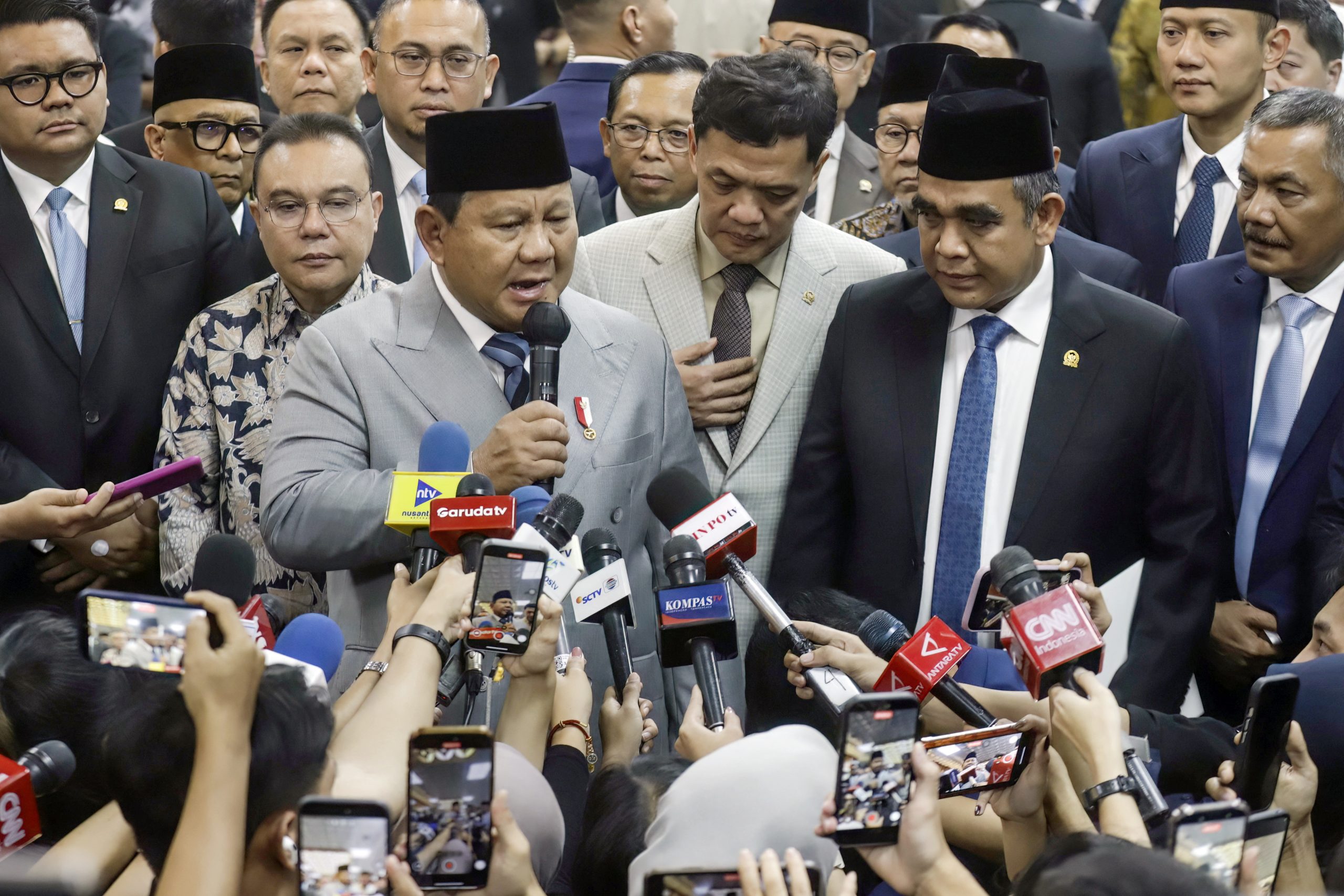
Prabowo submitted the names of the two candidates to People’s Consultative Assembly (MPR) Speaker Ahmad Muzani on Nov. 23 at the parliamentary complex in Jakarta. The nominees are seeking to fill the vacant vice presidential position for the remainder of the 2024-2029 presidential term.
Prabowo said his decision was based on the candidates’ achievements, dedication, loyalty to the nation and his confidence in their ability to contribute to the government.
“In accordance with our constitutional provisions and system of government, I am here today to submit two names for the MPR to elect as vice president for the remainder of the 2026–2029 term,” Prabowo said.
The president maintained that the replacement mechanism demonstrated that Indonesia’s constitutional system was functioning as intended.
The MPR verification team, chaired by Habiburokhman, has a maximum of seven working days to examine the candidates’ administrative documents, educational backgrounds and medical qualifications.
The election and inauguration of the new vice president are scheduled for Dec. 11 during an MPR plenary session.
Two figures close to Prabowo
Andi Amran Sulaiman serves as agriculture minister in the Red and White Cabinet. A prominent figure from South Sulawesi province, he is known for his work in agriculture and food security.
Sugiono serves as coordinating minister for human development and cultural affairs, having previously held the position of foreign minister.
A former member of Indonesia’s Army Special Forces (Kopassus), Sugiono has long been a close associate of Prabowo.
The nominations have generated mixed reactions on social media. Some users have praised Sugiono’s experience in diplomacy and defense, while others have acknowledged Amran’s performance in agriculture and food security.
Some have expressed a preference for Amran to remain agriculture minister to ensure the continuity of agricultural programs.
Criticism has also focused on the political affiliations of the two candidates, Muzani and Habiburokhman, raising concerns about political representation and the independence of the selection process.
Constitutional legitimacy and public trust
The sarcastic term “Giveaway VP” has emerged on social media to describe whoever is selected to replace Gibran. The expression reflects frustration among some Indonesians over a succession process that does not involve a direct popular vote.
In the 2024 presidential election, the Prabowo-Gibran ticket secured 96,214,691 votes, representing 58.59% of the total valid votes nationwide.
Some social media users argue that voters granted the electoral mandate to Prabowo and Gibran as a joint presidential ticket. Others have called for a fresh election.
However, Article 8, paragraph 2, of Indonesia’s 1945 Constitution provides for the MPR to fill a vice presidential vacancy.
The controversy underscores the distinction between constitutional legitimacy and public acceptance. Critics argue that assuming office without a direct electoral mandate could become a political liability ahead of the 2029 general election.
Meanwhile, the political influence of former President Joko Widodo and Gibran remains a subject of public discussion. Some of Gibran’s supporters on social media have encouraged him to run for president in 2029.
Such expressions of support, however, do not necessarily reflect broader electoral preferences.
The influence of young voters
Millennials and Generation Z accounted for more than half of Indonesia’s approximately 204.8 million registered voters in the 2024 election, making younger Indonesians an important electoral constituency ahead of 2029.
Digital platforms such as Instagram, TikTok, YouTube and X have expanded opportunities for young Indonesians to participate in political discussions, scrutinize government policies and shape public opinion.
While Gibran continues to attract attention on social media, representative survey data would be needed to determine whether that attention translates into electoral support.
Whoever succeeds Gibran will face the challenge of building public confidence while fulfilling constitutional responsibilities. With younger generations accounting for a substantial share of the electorate, their political preferences could help shape Indonesia’s democratic direction ahead of the 2029 elections.