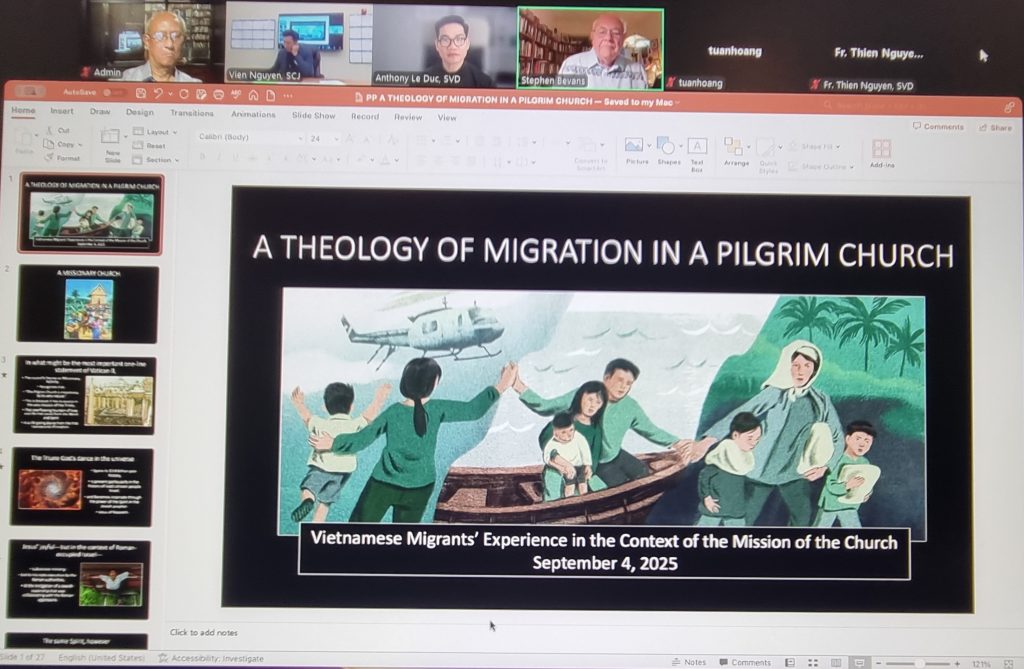
The experiences of Vietnamese migrants and their role in the Catholic Church’s mission in a global age of migration took center stage in an international webinar on Friday in Bangkok.
The event was organized by the Asian Research Center for Religion and Social Communication (ARC) at St. John’s University, in partnership with the Dehonians USA, Priests of the Sacred Heart.
The event was led by ARC Executive Director, Fr. Anthony Le Duc, SVD, who placed the discussion within the long and complex history of Vietnamese Catholic migration.
“Migration is not a new reality for the Vietnamese people, nor for the Church,” he said in his opening remarks.
“From the 18th century, when Catholics fled persecution to Siam, now Thailand, to the post-1975 movements across Asia, North America, Europe, and Australia, migration has always been intertwined with faith, mission, and witness,” he said.
Fr. Le Duc traced key moments in this history, including the 1954 migration of nearly one million Catholics from North to South Vietnam, and the exodus following the fall of Saigon in 1975 that scattered hundreds of thousands of Vietnamese across the globe.
Today, Vietnamese migrants number more than six million in 130 countries and territories, with over one million Catholics among them.
In the United States alone, approximately 700,000 Catholics trace their roots to Vietnam, while vibrant communities also thrive in Japan, Taiwan, Korea, and Australia.
“Every Christian migrant is a potential missionary,” Fr. Le Duc emphasized, quoting theologian Jehu Hanciles. He noted that migrants, often living at the crossroads of cultures, carry their hopes.
The webinar featured contributions from leading theologians and researchers who explored the theological, pastoral, and social implications of migration.
Among them was Fr. Stephen Bevans, SVD, professor emeritus at Catholic Theological Union in Chicago, who highlighted the idea that the Church is by nature a pilgrim and migrant community, constantly reshaped by the presence of migrants.
“As a local church welcomes, protects, promotes, and integrates migrants into itself, it is changed, enriched by the gifts and challenges that migrants bring,” Fr. Bevans noted.
Fr. Văn Thanh Nguyễn, SVD, also from Catholic Theological Union, described global migration as the defining issue of the 21st century, reshaping societies, religious communities, and even theological institutions.
He pointed to the growing presence of Vietnamese religious within his own congregation as an example of how migration transforms the Church from within.
“One notable contribution is the presence of Vietnamese SVDs and how their presence actually altered the makeup and mission of its congregation,” said Fr. Nguyễn.
Sr. Thu T. Do, LHC, PhD, a researcher at Georgetown University, spoke about the role of parishes in the faith life of Vietnamese American Catholics.
She noted that, despite their relatively small numbers, they have had an outsized impact on the U.S. Church, visible in the growing number of Vietnamese-language Masses, dedicated parishes, and large gatherings such as Marian Days in Missouri, which annually attracts more than 100,000 participants.
Her presentation also explored how the Vietnamese Eucharistic Youth Movement contributes to the pastoral needs of this young population, documenting its role in nurturing the faith and encouraging vocations to the priesthood and religious life in the U.S. Catholic Church.
Fr. Anh Quoc Tran, SJ, associate professor at the Jesuit School of Theology in California, turned attention to the challenges and opportunities presented by intercultural and interfaith marriages among Vietnamese migrants.
Such unions, he argued, can become “domestic mission fields” where the Gospel is embodied through love, dialogue, and mutual respect.
“Vietnamese Catholics increasingly encounter love across boundaries of race and religion. Intercultural and interfaith marriages are becoming more common in the diaspora, presenting both profound challenges and unique opportunities for the mission of the Church,” Fr. Tran remarked.
The webinar concluded with a call for the Church to recognize and empower migrants as missionary disciples. “The experience of migration is not only a pastoral concern but also a source of renewal for the Church’s mission in Asia and beyond,” Fr. Le Duc said.